
Choosing a spread betting platform in the UK
 Available in US
Spread betting in Great Britain lives in two places at once. Sports spread bets — buying and selling a spread on a cricket total, a football Supremacy, a Total Goals market — sit with the Gambling Commission under the Gambling Act 2005. Financial spread betting on shares, indices and FX sits with the Financial Conduct Authority. The two regimes look different from a punter’s seat, and the ten operators compared below all sit on the Commission side because they are fixed-odds bookmakers and sports-spread names, not financial-spread counterparties. The choice the page is about is the first one: where to lay a sports spread bet, and what the answer costs.
Current as of 27 October 2026, checked against the Gambling Commission’s public register.
Cricket, football, NFL: where sports spread betting lives
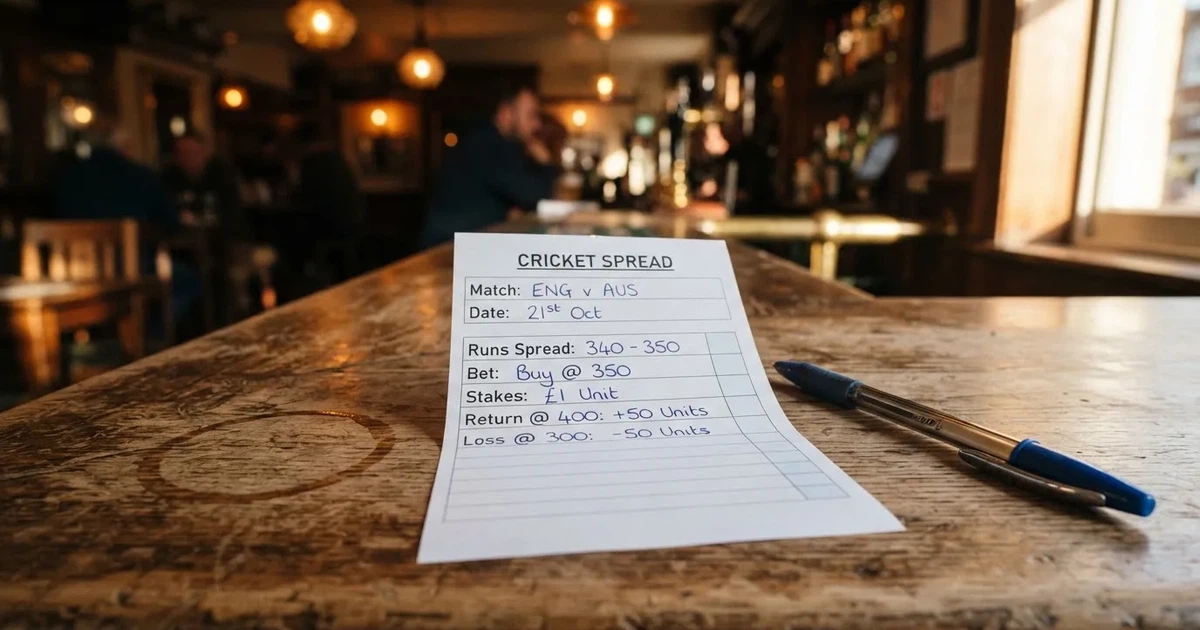
The fastest way to see what a sports spread bet is, is to read a cricket quote. Say the spread quoted by the firm on England’s innings runs is 340–350. Buying at 350 means the punter settles for the difference between 350 and the actual total, multiplied by the stake. Five hundred runs pays 150 units, three hundred runs pays a 50-unit loss — and the punter still pays the 50 units when England is bowled out for 300, because settlement is measured to the run, not to a binary outcome. Football Supremacy, Total Goals, Winning Favourites, Race Indexes on the racing side and even rugby and NFL markets all work the same shape: a quoted spread, a buy or sell, settlement to the unit of difference.

NFL and college football in North America carry a different tradition. A handicap (“point spread”) of -3.5 for the favourite is a fixed-odds bet at a near-standard price of -110 in decimal terms (the historical line sits at ten to eleven), and there is a third outcome a punter has to handle: a result landing exactly on the spread. In the North American tradition that is a *push* — the stake is refunded. In a UK sports spread that ambiguity is gone: the spread itself is a range and you settle by how the result sits inside or beyond it. Two products with two styles of clearing, both of them in the same shop window when a UK bookmaker covers the Super Bowl or Monday Night Football.
World Cup spread markets follow the same rules as the Premier League or the Hundred. A Total Goals spread of 2.4–2.6 for an England group game settles on the exact goal count; a Winning Favourites spread settles on the margin of the favourite’s winning score in innings or sets; rugby settles on point difference. A spread that covers a basketball game quotes, for example, 5.5–7.5 points and a punter buys or sells the favourite’s margin at unit-stake multiples of one. Across the lot, the arithmetic on a single bet is identical: profit or loss equals the stake multiplied by the difference between the buy/sell level and the settle figure. The harder question — *how much margin* the spread firms clip out of the spread — is what the Comparison and the Calculation section cover further down.
How spread betting pays — and why losses can be bigger than the stake
Picture a £10 stake on a horse racing Index spread quoted at 100–102, sold at 100. If the index settles at 104 the punter loses £40 — four points below the sell level, four units of stake. At 98 the punter wins £20. Two units wider than the original spread, and the swing is double the deposit risked on the line. That asymmetry is the whole point of spread betting: small quotes, and large outcomes measured to the unit. It is also where losses can exceed the deposit, because there is no upper bound on how far a settle figure can run from the level.

The mechanic in three steps:
- Pick the market and the side. A cricket Total Runs spread, a football Total Goals spread, a Supremacy spread on a Premier League game. The quote comes back as a range — say 280–285 on the runs.
- Choose buy or sell, and name the unit stake. Buying at 285 means you make one unit of stake for every run above 285 the team scores, and lose one unit for every run short. Selling at 280 is the mirror.
- Settle on the result. The settle figure is the actual event metric — runs, goals, the margin of victory — and the difference between the buy or sell level and the settle figure is multiplied by the stake to give profit or loss.
A clean illustration: a stake of £5 on a cricket spread of 340–350, bought at 350. The team scores 400. Difference 50, stake £5, win £250. The same bet, the team scores 300. Difference 50 in the other direction, loss £250. The punter’s exposure during the match is the full £250 against an initial outlay of £5 — losses ten times the deposit, on a single bet, because the result landed at the wrong end of the spread by a wide run margin.
Stakes are small in pounds, stakes are large in exposure. That is why the Commission’s rules on most fixed-odds bets do not extend to spread: there is no single price to back at, and no flat ceiling on what a settlement can be. The order in which the page closes the ten operators below leans on this — a bookmaker that publishes narrow spreads and tight limits is one the small-stake bettor suits, a bookmaker with quote depth and high unit-stake limits is the one a more experienced punter trades on.
Ten UK bookmakers and spread firms compared
The table below lists the ten operators the page reviews, the licence on the Commission’s public register, and what each operator’s terms say on the spread-betting side. Where research gives no published spread offering — most fixed-odds shops do not publish a sports spread product of their own — the column carries the article’s no-data marker; readers who need the spread side of the catalogue check that operator’s terms before betting, because the answer differs by brand.
| Brand | Gambling Commission licence | What the operator’s terms state on the spread key |
|---|---|---|
| Spreadex | Account 8835 — held by Spreadex Limited | Runs both fixed-odds sports betting and a financial-spread and sports-spread product on the same account. New customers are credited free bets usable across fixed odds and sports spread after a qualifying fixed-odds bet, with the package usable inside 28 days of opening the account. |
| Sporting Index | Account 27343 — held by Sporting Index Limited | A dedicated spread bookmaker app, whose new-customer terms include fixed-odds free bets alongside Total Goals, Winning Favourites and Race Index spread bets. Qualifying bets cannot be settled in play or withdrawn early. |
| Coral | Account 54743 — held by LC International Limited | A fixed-odds-led brand whose terms page covers welcome free bets but does not list a sports-spread product on the registered remote betting licence. Read the betting slip before staking if the spread side matters. |
| Sky Bet | Account 67370 — held by SBG Sports Limited | Fixed-odds operator with the standard three-token free bet welcome package credited after the qualifying first single or each-way bet. Spread bets sit with the wider category on the Commission’s register. |
| Dabble | Account 65677 — held by Dabble Sports UK Ltd | Fixed-odds brand whose terms describe a matched free bet on the first deposit at the stated minimum price, with the free-bet stake not returned with a win. Spread side not listed in the published terms. |
| Swifty Sports | Account 58957 — held by Swifty Global (UK) Ltd | Fixed-odds operator whose stated features include best-odds guaranteed on racing, Cash Out, daily price boosts, live streaming and in-play — a spread product is not part of the published catalogue at this snapshot. |
| Betfred | Account 39544 — held by Petfre (Gibraltar) Limited | Multi-product brand with a fixed-odds sports book, Bet Builder, Extra Places, Racing Post data and a casino and bingo wing. Sports spread not listed on the standard remote betting licence. |
| Lottoland | Account 38991 — held by EU Lotto Limited | A lottery and casino-led brand that also offers a sports book. Spread side not part of the published product set at this snapshot. |
| 888sport | Account 39028 — held by 888 UK Limited | Fixed-odds sportsbook with Cash Out, Bet Builder, racing streams, BetFinder form tools and daily boosted odds. Spread side is not a published feature. |
| VBet | Account 44662 — held by SCGO Limited | Fixed-odds bookmaker with Bet Builder, pre-match and in-play, live streaming and a results-and-stats calendar. Spread side is not part of the published catalogue. |
A few patterns jump out of that grid. Spreadex and Sporting Index are the two names listed whose published terms include a sports-spread product a reader can open directly with the brand. The other eight are fixed-odds bookmakers whose spread offering — where one exists — comes either through a sister product or through a separate sports-spread partner. For a punter whose priority is to buy and sell a spread rather than back a fixed price, those two are the shortlist. For a punter who wants fixed-odds first and spread as a side bet, the standard welcome packages (free bets credited on a qualifying fixed-odds bet) sit across most of the rest of the list.
The bookmaker’s margin — the cut of every unit wagered the operator keeps on average — does not separate cleanly across this set in the absence of published spread quotes. It does separate when a fixed-odds market is laid next to a spread on the same event, and the next section closes that.
The bookmaker’s margin, and what it looks like in a spread
Take a two-way fixed-odds market — a football match quoted at 9/10 on each side, decimal 1.90. The payout share, worked out as one divided by the sum of one over each price, is one over (0.5263 + 0.5263), which is one over 1.0526 — 95.0 % to the punter on the round. The margin is what is left for the bookmaker: 5.0 % on each pound wagered across both outcomes. That figure is the same idea whether a fixed-odds bookmaker quotes it on the betting screen, a spread firm quotes a 5-point-total spread, or an exchange takes a 5 % commission. The house keeps the same proportion across every shape of bet; only the form it takes changes.
What the punter actually feels is the gap between quote prices on the two sides of a spread — the wider the spread, the larger the trading cost. A sports spread quoted at 340–350 is carrying six units of punter-edge across one point of closing room, and the closer that runs to a clean middle the firmer the price; the wider, the firmer the firm’s margin in the offering. A football Supremacy market quoted 1.5–1.7 (Spreadex style) sits where the middle is 1.6 and the half-spread is 0.1; a wider quote such as 1.4–1.8 is the same middle on wider betting room, which reads as a softer price to the trader.
The Calculation section at the foot of this block recomputes the 1.90-over-1.90 model and gives a band rather than a single number, because the margin a punter actually pays depends on which side of the book they take and which event they trade.
Spread betting versus fixed odds: the four differences that decide for you
1. How big a loss can be. A fixed-odds single at 5/1 costs the stake and pays the stake plus four units of profit, or returns zero. A spread bet at the same range pays the stake multiplied by how far the result runs beyond the level — and can pay back zero or pay back many times the stake, depending on direction. The single beat for a small-budget bettor who wants to lose the stake and not more: fixed odds. The heartbeat for an experienced punter trading small unit stakes for large outputs: spreads.
2. Whether the outcome is binary. A fixed-odds bet has a yes-or-no answer at the finish. A spread bet has a number and a stake, and the answer is the number divided by the unit. North American point-spread betting creates a third binary outcome (a push, refunded) on the rare score-on-the-handicap night; sports spread betting in the UK style does not.
3. How the house is paid. A fixed-odds margin of 5 % works through smaller prices across an event. A sports spread margin works through the half-spread of the quote — the gap between buy and sell — on each unit of stake at settle.
4. Tax and duty. Spread betting that is not a financial product is inside General Betting Duty — a separate regime, with the spread-betting duty split (3 % on financial spread bets, 10 % on other spread bets in the structure research details) sitting on the operator rather than on the punt. No betting duty on the player’s winnings in either shape. The same winnings, two different industry-tax labels.
The regulation of spread betting in Great Britain
The Gambling Commission’s public register, held under the Gambling Act 2005, lists every operator that takes real-event sports bets online in Great Britain. The register can be searched by name, trading name, domain and account number, and is the test of whether a brand is licensed. The list of ten names above is the search-by-licence position: each appears on the register, each holds an operating licence, each takes part in GAMSTOP.
Financial spread betting is the odd sibling out. That product is a financial instrument regulated by the Financial Conduct Authority, sits outside the Commission’s remit, and is the business of companies such as those running spread-betting platforms on indices, FX and shares. The page does not run FCA-only spread firms into the bookmaker list above; the Commission’s public register is the filter, and the FCA’s is its own list on its own register.
Three licence conditions shape a punter’s experience regardless of the spread side. Identity is checked before the first deposit — name, address and date of birth, with a pay-out blocked until the check clears, since 7 May 2019. A financial vulnerability check applies once a punter’s deposits minus withdrawals pass £150 across a rolling 30 days, since 28 February 2025. A multi-operator online self-exclusion register (GAMSTOP, mandatory since 31 March 2020) sits behind every licensed site and app, and the minimum period is six months.
Credit cards are not an option. They have been off the table in Great Britain since 14 April 2020 across every licensed operator, including credit-card-funded e-wallet payments. Debit and bank-based methods are not affected. Bonuses on licensed sites run through the cap on wagering conditions (10x the bonus under the current rules) and the ban on mixed-product promotions in force since 19 January 2026, both of which apply to free-bet packages such as those in the comparison table.
An operator outside the Commission’s list is not a route around those conditions: it is the same betting product minus the protections. No GAMSTOP, no approved dispute-resolution route, no British consumer redress if funds are withheld, no Commission complaints route, no automatic vulnerability check. The duty of checking the register is on the punter, and a single search by brand name takes less than a minute.
Safer gambling: what the framework offers a punter on the spread side
GAMSTOP exclusion blocks every GB-licensed account the punter holds or opens during the period. Six months minimum, up to five years with an option of auto-renewal, and a seven-year tail after the minimum before the punter can ask for the exclusion to come off. Self-exclusion is a single decision against many operators in one stroke.
Deposit limits on the licensed side are the punter’s own choices rather than the operator’s. A gross deposit limit sits on a fixed time frame for every licensed remote operator, with the first phase already live and a second scheduled for 30 September 2026 — readers should check the operator’s safer-gambling page for the present position. A state-set ceiling on stake, deposit or loss does not exist in the rules as written; the time-and-money control is the punter’s.
GamCare runs the National Gambling Helpline. GambleAware funds research, treatment signposting and education. The NHS operates gambling clinics; Gamblers Anonymous runs local groups. On a product like spread betting — where loss size is not capped by a single stake — these are the services with a track record of helping with the picture this product can leave behind.
A spread bettor should also know that spread positions are not closed by the loss of the stake but by the size of the settle move. A timed exclusion window such as GAMSTOP closes the front door; a stake size that does not extend past one deposit’s worth on a single trade closes the back door on the side the user actually controls.
Reading a spread: a worked example
Pick a football Supremacy market quoted 1.5–1.7 by the firm. Buy the favourite at 1.7, stake £5. The favourite wins by two clear goals: the settle is +2, the buy level 1.7, the difference 0.3, the win £1.50. The favourite draws: settle 0, win £8.50. The favourite loses by one: settle -1, difference 2.7 below 1.7, loss £13.50 — two and a half times the stake on a single-score swing.
A simpler illustration stays with the cricket example research carries. Spread 340–350, buy at 350, stake £5. The team hits 400. Difference 50, win £250. The team is bowled out for 300. Difference 50 in the other direction, loss £250. Same stake, same distance on either side, but the punter’s exposure during the match was £250 against an initial outlay of £5 — and the firm’s edge sits in the gap between 340 and 350, the half-spread the firm keeps.
For comparison, a fixed-odds bet of £5 on the cricket at 5/1 pays £30 total return on a win (profit £25) and returns zero on a loss. The fixed-odds punter’s exposure is £5 — clean and bounded. The spread punter’s exposure is *the difference times the stake*, which the result only settles at the end.
That asymmetry is what the next section quantifies against fixed odds, and what the rest of the page frames when comparing operators.
Predictions and tipsters on the spread side
A spread is a number derived from a model. The market-maker on a football Total Goals quote is pricing the expected goals distribution; on a Supremacy quote is pricing the expected goal difference; on a cricket Total Runs quote is pricing the expected runs distribution for an innings. A tipster who lands on a finite number — “Tottenham to win by exactly one” — is naturally a spread trader, because the spread settles on the exact number rather than on a yes-or-no. Most published tipsters write in fixed-odds language, which is a mismatch for a spread product: a tipster recommending the favourite to win the match does not say what level of the Supremacy market they expect.
The strategies that fit spread betting are position-style strategies — buying under-priced levels, selling over-priced levels, sizing down so that an outlier settle does not exhaust a betting bank. Bankrolls matter more in spread betting because a single settle can clear the bank: capping the unit stake at a small fraction of the bank and limiting the running position to a maximum total liability are the two habits a spreads trader keeps from the financial-spread product across to the sports one.
For the punter who wants picks rather than position management: the published tipster market runs on fixed odds, and the tipster’s monoline read does not translate directly to a spread price. Pick-and-stake workflows assume a binary outcome; a spread workflow assumes a margin read in points. Two different toolkits.
Spread betting on the major sports, market by market
Football: Supremacy, Total Goals, Total Corners, Win Index, Bookings Index, Goal Rush (a market that pays per goal in a band), and corners-pat markets. Football is the deepest book on a UK-licensed sports-spread firm, and the most quoted sport here.
Horse racing: Race Indexes, Performance Indexes (settled on the horse’s finishing position against the field), Jockey Indexes, Going Allowance markets (settled on the official going figure after the meeting). Racing Indexes were the original sports-spread product.
Cricket: Total Runs, Fall of Wickets, Boundaries, individual-batter Innings Runs, team-milestone markets. Cricket’s longer formats make the Innings Runs spread one of the purest examples of the mechanic the section above uses.
Rugby: Supremacy on the union code (settled on the margin of victory in points), Total Points, Try Index. League markets are thinner; Super League and internationals are the levels most quoted.
NFL and American football: North American point-spread betting is the traditional framing, but a sports-spread firm quotes Supremacy in points, Total Points, Quarter Lines and a Touchdowns market. The Super Bowl is the deepest annual event on the spread book.
Golf: Winning Score, Finishing Position markets, Round Lines. The slow pace of the sport means the market-maker’s edge at the spread line is the largest of the sports listed.
Basketball: Supremacy, Total Points, Quarter markets. NBA and EuroLeague lead the calendar.
Other sports with smaller books: cycling, darts, snooker, Formula 1, politics, TV specials — each offered by the larger sports-spread firms and bookmaker spread extensions under their own terms.
What the margin band looks like on a 1.90 / 1.90 market (calculation)
The fundamental arithmetic of a symmetric market sits in one worked example: a two-way football match quoted at 9/10 (decimal 1.90) on each outcome, a frequent quote on Premier League matches and the closest illustration of a symmetric market. The payout share — the proportion of every £1 wagered that returns to customers across both outcomes of the market — is calculated as one over the sum of one over each price. Working through it:
- One over 1.90 is 0.5263.
- Sum across the two outcomes: 0.5263 + 0.5263 = 1.0526.
- Payout share: 1 ÷ 1.0526 = 95.0 %.
- Margin: 1 − 0.95 = 5.0 %.
The result lands in a small band rather than on a single number because the live prices on a Premier League game run tighter than 1.90 early in the market and wider late in the match when one side is short. Theas a band: between roughly 4.5 % and 6.5 % of total stakes across a match, with the exact figure reading off the prices at the moment of placement. The price the punter sees is the price the punter pays the margin on; the calculation is a worked example of how the same 5 % margin reads on a symmetric market as on a typical favourites market. Reading a spread through the same lens, the half-spread on a Total Goals quote is the firm’s edge per unit staked — a half-spread of 0.2 on a Total Goals 2.4–2.6 spread reads as roughly 8 % of stake as the firm’s margin at settle, by the same one-over-sum relationship applied to the symmetric distribution around the middle.
That calculation is an average across an event’s outcomes, not a forecast of any single bet. A confident favourite in a market priced 1.30 / 3.50 sits with a margin closer to 3 %, and a competitive three-way match priced 2.10 / 3.20 / 3.40 sits closer to 7 %. The 5 % on the symmetric 1.90 / 1.90 is the typical mid-band figure a punter works from.
Spreadex — the only sports-spread name with a fixed-odds book on the same account
Spreadex is one of two dedicated sports-spread apps on the Commission’s register, and the second-named operator in the table above that covers both fixed-odds sports and sports spread under a single sign-in. The licence sits on Spreadex Limited; the catalogue includes cricket Total Runs, football Supremacy, Total Goals, rugby Supremacy, racing Indexes and the standard in-play and Cash Out set. The FCA-side business sits with the same brand but on a separate product under separate regulation. The Commission’s threat-model for spread is the asymmetry of loss versus stake, which Spreadex acknowledges in its terms.
For a punter whose priority is the sports-spread product without bouncing between two platforms, Spreadex is the closer match in the comparison list. The full £60-in-free-bets package, credited after a £10 fixed-odds qualifying bet, carries sports-spread usability on the free-bet side — a rare structure in which the welcome offer lives as well on the spread side of the house as on the fixed-odds side. The package is one to weigh against the spread’s natural risk profile: small in pounds, large in exposure per trade.
Verdict. Spreadex fits the punter who wants sports spread and fixed-odds in one wallet — the unified catalogue, the spread-specialist ticker, and the only licence in the comparison that lists sports-spread categories on the register. Less suited to the punter who only wants fixed-odds football and has no interest in the spread product.
Sporting Index — a dedicated spreads app on the Commission’s register
Sporting Index is the second of the two dedicated sports-spread apps in the ten-name list, and the only brand with a fixed-odds welcome and a sports-spread welcome running in parallel. The licence sits on Sporting Index Limited; the app publishes football, cricket, golf, rugby and racing markets under a dedicated spread book. The welcome package splits the free-bet weight across fixed-odds tokens and Total Goals, Winning Favourites and Race Index spread bets — the multi-shape welcome a fixed-odds book does not usually carry.
For the punter whose preference is to trade spreads across multiple sports rather than place fixed-odds singles, Sporting Index is the closer match. The deep catalogue and the multi-shape welcome reduce the friction of getting from a fixed-odds background to a spread product.
Verdict. Sporting Index fits the punter already trading spreads who wants a single-app sports-spread product with a fixed-odds wing for value-staking on top — a less obvious pick than Spreadex but a closer fit when sports-spread is the priority product. Less suited to the fixed-odds-only punter, who has a much wider choice in the comparison list.
Coral — wide fixed-odds book with a registered betting-intermediary licence
Coral is the largest fixed-odds brand in the comparison list and the only brand listed with a remote betting-intermediary category on the Commission’s register — a category that permits exchange-style betting operations in addition to standard real-event betting. The welcome package is the standard £40-in-free-bets offer on a £20 qualifying bet at the stated minimum price, with the seven-day issue window and a seven-day expiry on the free bets.
The brand’s product range is fixed-odds-led: Cash Out, Bet Builder, in-play, racing and football specials sit at the centre. Spread-side markets are not part of the published catalogue on the licence page, so the punter who finds Coral through an interest in spread betting will be on a fixed-odds register without a published sports-spread product.
Verdict. Coral fits the fixed-odds punter who wants a large catalogue, a tight welcome package and a registered betting-intermediary licence that allows exchange-style betting as a separate product. Less suited to the spreads-only punter, who needs Spreadex or Sporting Index.
Sky Bet — a fixed-odds operator with a tight welcome
Sky Bet’s welcome package is a three-token free bet on a £5 minimum stake first single or each-way bet at minimum odds of 1/1, with the package opening once the qualifying bet settles. Sky Betting & Gaming is the parent; the licence sits with SBG Sports Limited, and the catalogue covers football, racing, cricket and the standard in-play and Cash Out set.
The spread side does not appear in the product range. The punter arriving at the brand finds a fixed-odds book with no published sports-spread offering.
Verdict. Sky Bet fits the fixed-odds punter who wants a small-stake welcome package with three token-shaped free bets and clean expiry terms — the right shop for the punter who treats the free bets as their introduction to the book. Less suited to the spreads punter.
Dabble — a social-led fixed-odds shop with no published spread side
Dabble’s licence sits with Dabble Sports UK Ltd; the product is a fixed-odds book with a social-led betting feed. The welcome package is a matched free bet on a first deposit at the minimum price, with a seven-day free-bet expiry and a stake-not-returned term. The standard Cash Out, in-play and racing markets are part of the published product; sports spread is not.
A punter whose interest is the spread product will not find it on Dabble’s catalogue. The match on the spread side is one this brand does not make.
Verdict. Dabble fits the punter who wants a social-led fixed-odds book with a free-bet welcome — the right pick for the social-feed punter. Less suited to the spreads punter, for whom this is not the right product.
Swifty Sports — fixed-odds with best-odds guaranteed, no spread side
Swifty Sports is the smallest sports-spread-sidelined operator in the list on revenue but ships a competitive feature set on the fixed-odds side: best-odds guaranteed, Cash Out, daily price boosts, live streaming, in-play, with a Bet Builder marked as coming soon at the snapshot date. The licence sits with Swifty Global (UK) Ltd; the catalogue is sharp on racing and football.
The spread side does not appear in the published catalogue. The punter looking for spread betting finds a fixed-odds book whose features are well-rounded.
Verdict. Swifty Sports fits the punter who wants best-odds guaranteed on racing, daily price boosts and a betting-tidy fixed-odds product at small stake sizes — the right shop for racing’s day-to-day punter. Less suited to the spreads punter.
Betfred — multi-product fixed-odds with a casino and bingo wing
Betfred’s licence sits with Petfre (Gibraltar) Limited; the catalogue covers fixed-odds football, racing and cricket with Bet Builder, Sub Switch, Racing Post form data, Extra Places, live casino and bingo. The welcome package trades the book on a long reputation in fixed-odds and racing rather than on free bets. Spread side is not a published feature.
For the punter who wants a multi-product fixed-odds book with a strong racing product and a casino wing, Betfred is the right pick. For the punter whose interest is the spread product, the answer is not here.
Verdict. Betfred fits the punter who wants a long-run fixed-odds book with extras (Sub Switch, Extra Places, Racing Post) and a casino wing — a strong racing and football shop. Less suited to the spreads punter.
Lottoland — a lottery and casino-led brand with a sports book
Lottoland’s licence sits with EU Lotto Limited; the catalogue combines lottery, casino and sports under one app, with the sports book covering football, racing and the standard pre-match and in-play set. The sports-side surface is smaller than the dedicated sportsbooks in the comparison list and the welcome side is lottery-led.
Sports spread is not a part of the product range. The punter who finds Lottoland finds a multi-product book whose sports book is part of a lottery and casino product.
Verdict. Lottoland fits the punter who wants a single-app sports, lottery and casino product with a Commission licence — the right pick for the multi-product reader. Less suited to the spreads punter.
888sport — fixed-odds with cash-out and bet-builder
888sport’s licence sits with 888 UK Limited; the catalogue covers pre-match and in-play with Cash Out, Bet Builder, racing streams, BetFinder form tools and daily boosted odds. The brand runs a daily boosted-odds feed and a same-game multi-product on football. Spread side is not a published feature.
For the punter who wants a fixed-odds book with a daily boosted-odds feed and a strong same-game-multi product on football, 888sport is a competitive pick. For the punter looking for a spread product, the answer is not here.
Verdict. 888sport fits the punter who wants a same-game-multi product, racing streams and a regular boost — the right shop for the boost-led punter. Less suited to the spreads punter.
VBet — multi-product fixed-odds with live streaming and in-play
VBet’s licence sits with SCGO Limited; the catalogue covers Bet Builder, pre-match and in-play, live streaming and a results-and-stats calendar. The Vbet app is published by SCGO Limited and is on the register under a broad remote-general betting standard licence. Spread side is not a published feature.
For the punter who wants a betting-tidy fixed-odds book with live streaming and a results-and-stats calendar across football, VBet is a competitive pick. For the spreads punter, the answer is not here.
Verdict. VBet fits the punter who wants a fixed-odds book with live streaming and a results-and-stats calendar — the right shop for the live-football punter. Less suited to the spreads punter.
Where each brand sits in the comparison
A short version of the table above, recast as a ranking for the punter who reads from the top down:
- Spreadex and Sporting Index — the two dedicated sports-spread names, both Commission-licensed and both offering fixed-odds on top.
- Coral, Sky Bet, Dabble, Swifty Sports, Betfred, 888sport, VBet — fixed-odds-led shops whose catalogues publish no sports-spread product.
- Lottoland — a multi-product book whose sports side is part of a lottery-and-casino product, not its headline.
The choice is one shape: the punter for whom spread is the priority product reads this list to either Spreadex or Sporting Index; the punter for whom fixed-odds is the main product chooses by welcome package, by feature set and by which catalogue shape — same-game-multi, boost-led, racing-tidy — fits the kind of betting the reader actually places.
Verification and final notes on the regulatory frame
Every brand in the comparison appears on the Commission’s public register, each holding a remote general betting standard (real events) licence for Great Britain. Every brand is a GAMSTOP participant. The minimum age is 18, identity is verified before the first deposit, deposit minus withdrawal vulnerability checks apply above £150 across a rolling 30 days, and credit cards have been off the table in Great Britain since 14 April 2020. Bonuses cap at 10x the bonus and mixed-product promotions are banned under the rules in force since 19 January 2026. The PCA-side ban on whistle-to-whistle TV betting ads in front of the 9pm watershed is industry-led rather than law. General Betting Duty is 15 % until 1 April 2027, with a 25 % remote rate for non-UK-racing products from that date.
A financial-spread product is regulated by the FCA and sits outside this register — the comparison list’s two sports-spread names operate the financial-spread product under separate FCA authorisation, not under the Commission’s remit. The financial-spread product’s separately-structured tax (3 % financial, 10 % other in the spread-betting duty split) is the operator’s, not the punter’s. The page does not extend the choice comparison into FCA-only spread firms; the register of licensed bookmakers in Great Britain is the Commission’s register, and that is the comparison the title keys to.
Five points to close the question
What is sports spread betting? A bet where settlement depends not on a yes-or-no outcome but on how accurate the wager was against a quoted spread — the punter buys or sells against a range, and the result is multiplied by the stake. Sports spread betting in Great Britain is licensed by the Gambling Commission; financial spread betting on shares, indices and FX is licensed by the Financial Conduct Authority, and is a different product under a different regulator.
How do you spread bet football? Pick a football market such as Supremacy, Total Goals or Total Corners, choose buy or sell against the quoted spread, set the unit stake and let the bet settle on the actual difference. Buy at 0.3 Supremacy with a £10 stake and a 3-goal winning margin: settle 2.7 below the buy level, loss £27. Settle on the same trade at a 1-goal win: 0.7 above the buy level, win £7. The trade settles at the end of the match in pounds multiplied by the distance.
What is spread betting in sport, in plain English? A wager whose payoff is the difference between the buy or sell level and the actual result, multiplied by the stake. Compared to a fixed-odds bet at a binary price, the spread bet trades a smaller stake for the possibility of a much larger win — or a much larger loss.
How can a punter check that a bookmaker holds a Gambling Commission licence? Search the Commission’s public register by business name, trading name, domain or account number. The account number sits on the operator’s terms; the register confirms the licence, the licensee and the licence categories. Each of the ten brands above appears on that register, and each of them appears with one of the standardised remote betting licences.
How is a bet worked out from the stake and the odds, and what is the bookmaker’s margin? On a fixed-odds single, the return is stake multiplied by the decimal odds — a £10 stake at 1.90 returns £19, profit £9. The bookmaker’s margin is what is left over from a symmetric market: 1.90 / 1.90 on each side of a match yields a payout share of about 95 % to customers and a margin of about 5 % to the firm. The punter feels the firm’s edge as a price — the difference between true fair odds and the odds quoted on each side. A spread bet pays differently: profit or loss is the stake multiplied by the difference between the level the punter chose (buy or sell) and the actual settle figure, with the firm’s edge sitting in the half-spread of the quote.
Frequently Asked Questions
What is the difference between fixed-odds and spread betting?
A fixed-odds bet pays out based on a binary yes-or-no outcome at a set price, with your potential loss capped at the stake amount. Spread betting payoff depends on how far the result deviates from the quoted range, meaning your profit or loss can be significantly larger than your initial stake.
How do spread betting losses work?
Unlike fixed-odds where you lose your stake, spread betting losses are calculated by multiplying the unit stake by the number of points by which the settle figure differs from your buy or sell level. Because the settle figure can move far from the level, losses can exceed your initial deposit.
Are spread betting platforms regulated in the UK?
Yes. Sports spread betting is licensed by the Gambling Commission in Great Britain. Financial spread betting on instruments like shares or FX is regulated by the Financial Conduct Authority (FCA). Operators licensed by the Gambling Commission are required to participate in GAMSTOP and adhere to strict player protection standards.
What is GAMSTOP?
GAMSTOP is a free, national multi-operator online self-exclusion scheme. When you self-exclude through GAMSTOP, you are blocked from accessing every online gambling site and app licensed in Great Britain for a period of your choice, ranging from six months to five years, with an option to extend the exclusion further.
Do I pay tax on betting winnings in the UK?
In Great Britain, recreational bettors generally do not pay tax on their betting winnings. General Betting Duty is a tax levied on the operator’s gross profits, not on the individual punter’s winnings. If you are a professional gambler, you should consult with an adviser regarding your specific tax obligations.
Ten operators on the Commission’s register, two of them dedicated to the spread product. The choice of operator splits on the choice between spread and fixed-odds — Spreadex or Sporting Index for the spread-first reader, with the rest of the comparison offering fixed-odds betting to anyone who would also like spread exposure but treats it as a side product. Either way the punter’s first read should be the operator’s own terms page on the spread side, because the welcome package, the minimum price, the deposit and the verification levels differ across the list, and these are the conditions a punt has to read before betting, not the conditions a welcome offer has to be advertised on.
Betting sites & exchanges – UK betting
Content created by the «UK betting» team
