
Snooker betting odds 2026: the licensed bookmakers, the markets and the margin
 Available in US
The Crucible Theatre in Sheffield still frames the snooker year, and the betting market around the sport has not stood still while the green baize gets relaid each morning. This page walks through who holds a Gambling Commission licence to take bets on snooker in Great Britain, what they actually offer once you sign in, how snooker odds are priced, and what the bookmaker’s margin takes out of every price before a ball is potted. The £ sign, the fractional odds the high street still uses and the “acca” shorthand are British; so is the rule that no licence, no business with a British customer, no matter where the operator sits.
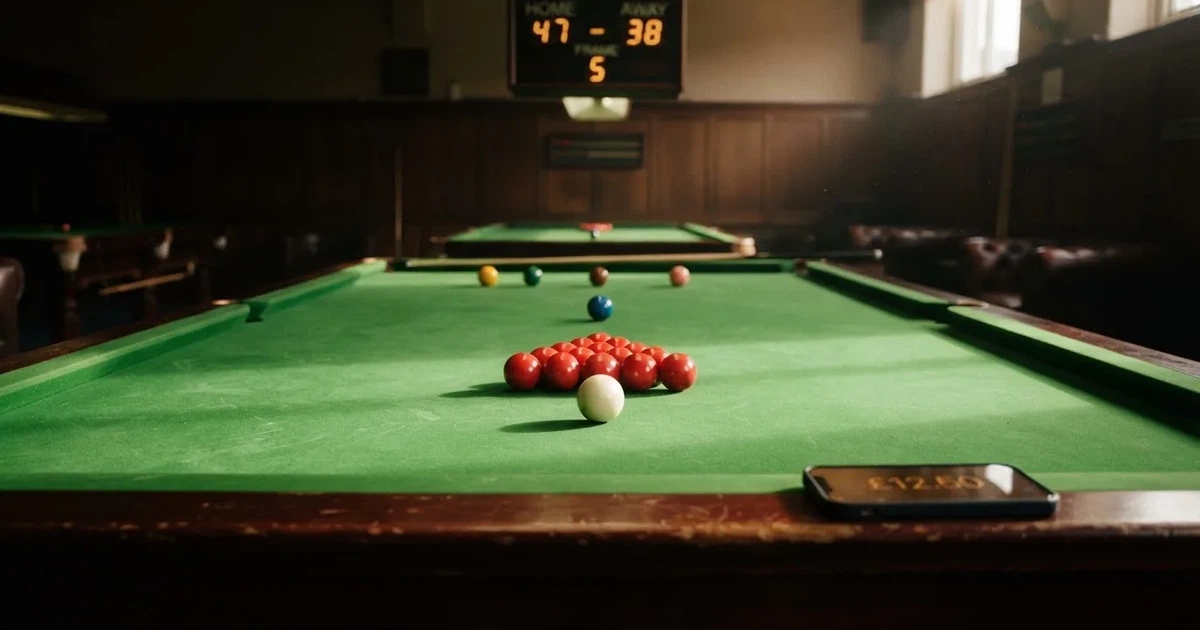
*Data current as of 27 October 2026; checked against the Gambling Commission’s public register of remote betting licence holders.*
Crypto, bitcoin and anonymity around snooker betting
Betting with bitcoin, ethereum or any other cryptocurrency on snooker in Great Britain runs into the same wall as crypto betting anywhere else in the regulated market: licensed operators do not take crypto deposits. The reason is not a stated ban on digital assets in the Gambling Act 2005; it is the verification work that precedes any first bet. A bookmaker serving British customers has to confirm the customer’s name, address and date of birth before they can deposit or place a bet, including with a free bet or bonus. A proof of address document and a payment method held in the same legal name are the working baseline. Cryptocurrency sits outside that frame, so a licensed operator does not build it into its cashier.
The brands that do take bitcoin, ethereum or stablecoin deposits are brands without a Great Britain licence. The Commission’s published marketing describes the result plainly: a customer using one of those sites has no GAMSTOP self-exclusion to lean on, no Commission complaints route, no approved dispute-resolution service if funds are withheld, no protection under the 10x bonus cap and no automatic £150 financial vulnerability check. Stopping with the practical detail rather than the marketing: offshore crypto books settle in their own coin and pay back in their own coin, sometimes with no conversion at the cash desk, and a punter’s balance can fall by half on a quiet Tuesday while a frame is in progress. Bet on snooker through a licensed brand with a sterling account and the bet, the win and the loss stay in pounds.
For most readers, the path that fits is the one that never names the word “anonymous”: the licensed bookmaker, the debit card or bank transfer in your own name, and the GAMSTOP register running in the background. For the reader whose reasons push the other way, the trade is sharp: zero verification against zero protection, and a regulator’s enforcement reach that runs through payment providers and domain registrars rather than through a blocked page.
A last point before the next section. Crypto prices on snooker moves only when somebody on a licensed exchange has laid the same number, and liquidity on a world championship semi-final at a licensed sportsbook is many multiples of liquidity on the same event at a crypto book. The price you actually get is shaped by who else is on the other side.
Free bets, bonuses and the real cost of the welcome offer
The marketing word on snooker welcome offers is the lede and the snare both. “Free bet”, “£40 in free bets”, “bet £20 get £40”, “four £10 free bets”: each describes what the bookmaker is willing to hand over. None of them describes what it costs the punter to clear it.
Two rules govern the whole market since 19 January 2026. First, wagering requirements on bonuses are capped at 10x, so a £10 bonus at 50x becomes impossible to offer legally and a £10 bonus at the cap asks for no more than £100 of qualifying bets. Second, mixed-product promotions — an offer that pushes the customer from sports to bingo, or from betting to casino, or bundles a free bet with free spins — are banned. Both rules are conditions on the licence, not a promise in the marketing.
Free bets, by their own terms, do not pay back the stake when they win. A £10 free bet at odds of 5.00 returns £40 in winnings, not £50. Boosted odds work the same way: the winnings are paid at the boosted price, but the stake that produced them is the bookmaker’s money. An each-way free bet is two bets of equal free-bet value: a £10 free-bet stake each way costs the bookmaker £20 and settles two outcomes.
Welcome offers for snooker at the licensed books run to a small set of patterns. The Coral and Unibet headline reads “Get £40 in free bets when you bet £20”: deposit £20, place a sports bet of £20 or more at minimum odds of 2.0 (1/1), and £40 in free bets arrive within seven days and expire seven days after issue. BetMGM’s version, for a deposit of £10 or more and a sports bet within seven days, is four £10 free bets — two on football accumulators of four or more selections, two on sports multiples of two or more selections — each valid for seven days with minimum odds and an opt-in. Vbet hands over a £10 free bet if a new, verified customer stakes £10 or more on a first bet that loses. Bar One Racing, QuinnBet, 888sport, Tote and Kwiff each run their own version, and the terms of each are pinned to the operator’s own promotional page rather than to the headline.
A worked example shows the shape. Bet £20 at minimum odds 2.0 (1/1) on a snooker match: a win returns £40, of which £20 is profit and £20 is the stake. The £40 in free bets arrives, sits at the seven-day clock, and on each free bet a snooker frame winner at 3.00 (2/1) gives £30 in profit if it lands. The free-bet winnings, not the stake, are what lands in the cash balance, and only after the seven days are the funds withdrawable.
The number to read before any welcome offer is the wagering factor next to the bonus amount, not the bonus amount on its own. A £40 free bet with no wagering factor and seven days to use sits at one end of the market; a £10 bonus with a 10x turnover and a 14-day window sits at the other. The arithmetic in the next section is the version of “what does it cost” the marketing copy never quite prints.
Live betting and cash out on the snooker table
In-play betting on snooker is not a feature some of the licensed books have and others do not; every Commission-licensed brand in the comparison runs an in-play product, and the snooker section lights up through the World Championship and the Masters. The market mechanics on snooker are simpler than on a football match: frames are discrete, a winner is determined in the same session, and a mid-frame break is a quiet moment for a trader.
A live snooker price tracks the same three-outcome shape as the pre-match price: player A to win the frame, player B to win the frame, the frame to go to a deciding ball. A few licensed books add frame handicaps and a total points market over the session, but the spine of the in-play product is the frame winner at decimal odds that move with each visit to the table.
Cash out is the licensed version of being allowed to climb down. A back bet at 2.50 (6/4) on player A to win the match settles partway through the final if the punter reads the shape right: player A 5-3 up, opponent A’s pre-tournament jitters gone, take the cash-out value, leave the bookmaker to manage the rest. The cash-out value is the bookmaker’s own number — its current price of the position reversed, with its own margin baked in. A punter who waits and loses gets nothing; a punter who cashes out early and the selection wins forfeits the rest; a punter who cashes out at the right moment takes the bookmaker’s price and avoids the variance. The decision is the punter’s; the price is the book’s.
Live streaming sits next to cash out and ahead of it in the price the bookmaker charges in margin. A licensed book that streams a ranking event through its app gives the punter the table without a separate subscription, and the price it offers on the in-play market absorbs the cost of the feed. Some books stream freely once a small stake is logged; others gate the stream behind an active bet on the same event; 888sport’s racing streams are the licensed version of a paid-for service stitched into a betting app.
The timing of an in-play snooker bet is its own risk. A trader can move the frame-winner price on a single visit to the table: a 40 break in four shots drops player A from 2.20 to 2.60 (6/5 to 13/8) before the pot on the next ball has settled. The cash-out price moves with the same hand on the same clock. A punter who uses the in-play product on snooker for the full session and on the difference between the bookmaker’s price at frame end and the next frame’s opener is using a sharper tool than the marketing lets on.
Snooker betting predictions, tips and the analyst’s frame
Snooker betting tips are a market like any other. The BBC and the sporting press run previews for the World Championship and the UK Championship with picks and an analyst’s reasoning; the licensed books’ own blogs carry the same shape with their own traders’ names. What the tipster does not do is name a winner. The break builder can name a 147, the match trader can flag a value price, but the bookmaker’s liability is set the morning of the match, the snooker betting tips today list is a working opinion, and the price the punter takes at the counter has the bookmaker’s margin already taken out.
A punter who treats “snooker betting tips” as a list of selections to copy has bought the bookmaker’s product twice. The bookmaker’s product is a price; the tipster’s product is an opinion. The two do not always meet, and when they do, the price has usually moved by the time the punter is at the till.
Analyst-grade work on snooker splits into a few shapes. Form tables over the last twelve months, head-to-head in the same event, ranking position and seed, frame-by-frame scoring on the same season’s run, and the running average of points per visit at the table. Each is a piece of the picture; none of them is the picture. A punter who looks at two pieces at once has a fair claim to value; a punter who looks at one and goes no further is reading the table the bookmaker has already read.
A more useful frame for the punter who bets small and bets often is the bankroll. A flat stake of one or two per cent of the bank per match is the rule a serious snooker punter keeps even when a tip reads as hot as the analyst’s prose. The flat stake does not protect against a loss; it protects against the streak of losses that follows a hot tip’s first win, when the punter raises the stake on the second.
The honest version of “snooker betting predictions today” is that the licensed books’ traders have already priced the picks the tipster is about to make, and the punter’s edge is the price the trader has mispriced. The size of that edge on a single ranking event is small enough that the punter who does not keep a record cannot tell whether they have any edge at all. A record of every snooker bet, the price, the stake and the result is the working tool of a punter who intends to keep at it past the next tournament.
Snooker bet types, odds and what the price pays back
Snooker match betting sits on a thin shelf of markets and a deep one beneath it. The spine is the match winner: player A or player B, in the pre-match and the in-play product. The next layer is the frame winner — the same shape on a single frame within a match — and a total points market over the session. A few licensed books add frame handicaps and a highest-break market for the session; one or two add an outright winner market for the next tournament and a quarter-by-quarter match-up for the World Championship draw.
A bet is a contract between the punter and the bookmaker: the punter hands over a stake, the bookmaker offers a price. The decimal odds are the multiplier the bookmaker pays back on the stake when the bet wins. A £10 bet at decimal odds of 3.00 pays £30 — £20 of winnings and £10 of stake returned. The fractional odds the high street prints at half-odds are the same number in a different shape: 3.00 decimal is 2/1 fractional (two pounds of winnings for every pound staked); 6.00 decimal is 5/1; evens, 2.00 decimal, is 1/1.
The formula the punter carries is two lines. Return on a winning bet = stake multiplied by decimal odds. Profit on a winning bet = stake multiplied by (decimal odds minus 1). For a combination or “acca” bet the odds of each leg multiply into one price, and the stake is multiplied by that single product. A £5 four-fold acca at legs of 1.80, 2.10, 2.50 and 1.95 prices the acca at 14.43 and pays £72.15 if all four legs land, of which £67.15 is profit and £5 is the stake returned.
A working example for a £20 stake on a snooker match winner at decimal odds of 1.90 (9/10). A win returns £38 (£20 stake and £18 winnings). A second example for a £50 stake at odds of 2.50 (3/2): a win returns £125 (£50 stake and £75 winnings). The arithmetic is the same on every price; the wager is the punter’s read on the form, the price is the bookmaker’s.
Bookmaker’s margin, sometimes called overround, is the difference between what the prices add up to at a perfect market and what they add up to at the bookmaker’s window. A two-way market at perfect prices of 2.00 and 2.00 returns 100% of every pound bet across the two outcomes. The bookmaker’s prices are never 2.00 and 2.00: each side is short, so the implied probabilities add to more than 100%, and the surplus is the bookmaker’s margin. The margin is paid by the punter on every bet, whether the bet wins or loses, and is the single largest cost of the bookmaker’s product.
A worked margin for an illustrative two-way market at decimal odds of 1.90 and 1.90. The implied probability of each side is 1 ÷ 1.90, which is 0.5263 or 52.63%. Two sides imply 105.26% in total. The payout share is the inverse: 1 ÷ 1.0526 = 0.9500 or 95.00%. The margin is 100% minus the payout share, which is 5.00%. The same shape in fractions: 9/10 on both sides, the implied probabilities are 10 ÷ 19 = 52.63% on each side, the same 5.00% margin. The margin scales with how short the bookmaker’s prices run: 1.85 and 1.85 implies 108.1% on both sides, the payout share falls to 92.5%, the margin rises to 7.5%. The 1.90 / 1.90 example sits in the band a serious punter reads as tight; 1.80 / 1.80 is heavy, and a punter who reads both sides of a market at 2.10 / 2.10 has caught a soft line.
The same arithmetic extends to a three-way market — a frame winner with the deciding ball priced as a third runner — and to a bookmaker outright market with twenty runners. The margin never reads as a number on the screen; it reads as the short price on every runner, the small gap between 100% and what the prices imply. The punter who reads the gap as a habit rather than a calculation is the punter who picks which bookmaker to use on the day.
The snooker calendar and the tournaments the bookmakers price
The professional snooker calendar runs through ten ranking events and three majors in a typical year, plus the invitational events the broadcasters pick up. The World Snooker Championship, held at the Crucible Theatre in Sheffield since 1977, is the four-week centrepiece in April and May. The UK Championship runs at the Barbican in York in late November and early December, the Masters at Alexandra Palace in January, and the Champion of Champions in its own slot in November.
Match formats inside the ranking events scale with the round. Most early-round matches are best of seven frames; a quarter-final is best of nine or best of eleven; the World Championship semi-final is best of 25; the final is best of 35. The frame count matters because it scales the value of the long-shot each-way wager: a best-of-35 final is a different shape from a best-of-7 first round, and the bookmaker’s price for player A at 8.00 (7/1) on the final hides a different set of possible endings than the same price on a first-round match.
The records the bookmakers price against are themselves the spine of the analyst’s form book. Stephen Hendry and Ronnie O’Sullivan hold seven world championships each in the modern era; Joe Davis won fifteen in a row from 1927 to 1946 in an era the modern ranking structure did not yet frame. The 147 is the working benchmark for the highest-break market: potting all fifteen reds with a black and then the six colours in order. The 2026 World Snooker Championship, played at the Crucible from 18 April to 4 May, was won by Wu Yize 18-17 over Shaun Murphy in the final, with a £500,000 winner’s share from a £2,395,000 prize fund.
What may be bet on in snooker is not bounded by a statute. The Gambling Commission issues licences by category — remote general betting standard (real events), remote general betting standard (virtual events), pool betting and the betting intermediary licence for exchanges — and within its category the bookmaker writes its own market list. The licensed books’ snooker sections are broadly the same shape: match winner, frame winner, total points, frame handicap, highest break, and the tournament outright winner. The depth — how far down into the draw the bookmaker prices — differs brand by brand.
Two practical points for the reader. First, the World Championship is the four weeks when the snooker market on a licensed book is at its widest: every match in the draw priced, the outright market running from the qualifying rounds, and the in-play product running through every session. Second, the events the licensed bookmaker does not price — invitational events with no broadcaster, qualifying rounds the trading room has not picked up — are the events the unlicensed books sometimes price for the patient. The licensed price is the safer shape; the unlicensed price is the deeper shape.
The top ten licensed bookmakers for snooker in Great Britain
Ten bookmakers hold a Gambling Commission remote betting licence covering snooker, and each is reviewed below. The order is editorial: the brands closest to a snooker punter’s working day sit at the top; the brands with a thinner snooker product sit lower. Each review ends on the page’s own judgement of the brand for snooker betting, not on a recap of the figures that came before.
The headline column carries the brand and what sets it apart for snooker. The licence column carries the Commission’s account number and the licence holder; the figures are pinned to the public register as a reader can check it. The third column carries the brand’s own terms on the key snooker product or limit. Cells with no data carry the no-data marker; a brand the table cannot price on a column does not appear on that column.
| Brand | Gambling Commission remote licence | Snooker product on the operator’s own terms |
|---|---|---|
| BetMGM — sports welcome offer built around free bets | 039198-R-319450-029 · LeoVegas Gaming PLC · remote general betting standard (real events) | Welcome offer: four £10 free bets (two football accumulators of 4+ selections, two sports multiples of 2+), valid 7 days, minimum odds apply, opt-in required |
| Bar One Racing — Irish independent bookmaker with race-day specials | 056516-R-332750-007 · Bar-One Racing Limited · remote general betting standard (real events) | Irish and UK racing-focused bookmaker with horse racing sponsorships across Dundalk, Fairyhouse, Navan, The Curragh, Curraheen Park and Cork |
| QuinnBet — Best Odds Guaranteed on Irish and UK racing | 061011-R-335683-004 · QuinnBet (Gibraltar) Limited · remote general betting standard (real events) | Best Odds Guaranteed on Irish and UK horse racing from 10:00am daily, singles / multiples / system bets, maximum benefit £150 per customer per race |
| Coral — £40 in free bets on a £20 sports bet | 054743-R-330863-014 · LC International Limited · remote general betting standard (real events), remote betting intermediary | Welcome offer: £40 in free bets when a £20+ sports bet is placed at minimum odds 2.0 (1/1); free bets expire 7 days after issue |
| Smarkets — exchange pricing on snooker outrights | 039173-R-319366-011 · Smarkets (Malta) Limited · remote betting intermediary | Open-bank-transfer deposits instant from £10 up to £10,000; withdrawals within 6 hours from £10 up to £100,000; UK debit-card deposits instant from £10 up to £15,000 |
| VBet — a £10 free bet if the first bet loses | 044662-R-324273-022 · SCGO Limited · remote general betting standard (real events) | Welcome offer: £10 free bet if a new, verified customer stakes £10+ on a first-ever bet that loses |
| Unibet — long-established bookmaker, deep snooker coverage | 045322-R-324275-019 · Platinum Gaming Limited · remote general betting standard (real events) | Welcome offer: £40 in free bets when a £20+ sports bet is placed at minimum odds 2.0 (1/1); free bets expire within 7 days of issue |
| 888sport — Cash Out, Bet Builder and racing streams | 039028-R-319297-014 · 888 UK Limited · remote general betting standard (real events) | Pre-match and in-play betting, Cash Out, Bet Builder, racing streams, BetFinder form tools, live bet feed, daily boosted odds |
| Tote — pool betting heritage alongside fixed-odds snooker | 054779-R-331321-008 · TDCO Limited · remote general betting standard (real events) | Pool-betting operator with fixed-odds sports alongside the tote product |
| Kwiff — trademark surprise pricing on selections | 044448-R-323408-017 · Eaton Gate Gaming Limited · remote general betting standard (real events) | UK Gambling Commission licensed trademark operated by Spryme Ltd |
BetMGM — a snooker welcome offer built around football and sports multiples
BetMGM’s UK sportsbook sits on the LeoVegas Gaming PLC licence (Commission account 39198) and runs the same shape of welcome offer the wider market uses, with the free-bet split across football accumulators and sports multiples. A punter who deposits £10 and places a sports bet within seven days picks up four £10 free bets, two of them on football accumulators of four or more selections and two on sports multiples of two or more, each valid for seven days with the minimum odds and the opt-in the promotional terms set out. Snooker is on the sportsbook’s menu through the major events, and the BetMGM pricing tracks the wider market without setting a clear value margin on a tight outright. The free-bet stake is not returned on a win, so the punter’s edge sits in the price the football or sports multiple is taken at, not in the headline £40. A reasonable choice for a snooker punter who uses the sportsbook alongside a football acca habit; the snooker product is the secondary leg of the welcome, not the primary one.
Bar One Racing — an Irish racing bookmaker with a snooker section
Bar One Racing rebranded to BAR 1 Betting and runs an Irish independent bookmaker with shops and sponsorships across Dundalk, Fairyhouse, Navan, The Curragh, Curraheen Park and Cork. The Commission licence sits with Bar-One Racing Limited (account 56516), and the brand’s strongest product is horse racing — Irish and UK racing specials, the sponsor-driven markets the high street runs on race day. Snooker sits on the menu in the four weeks of the World Championship and the larger ranking events, but the depth of the snooker outright market is thinner than at a bookmaker whose central product is the sport. The right reader is an Irish or UK racing punter whose snooker interest is a single tournament each year rather than a season-long habit.
QuinnBet — Best Odds Guaranteed and a snooker fixture list
QuinnBet runs the Best Odds Guaranteed promotion on Irish and UK horse racing from 10:00am each day, on singles, multiples and system bets, with a maximum benefit of £150 per customer per race. The Commission licence is held by QuinnBet (Gibraltar) Limited (account 61011), and the brand’s snooker product carries the same shape other licensed books carry on the major events. The Best Odds Guaranteed rule is a horse-racing product; it does not extend to snooker, and the snooker punter who backs the brand for racing does not pick up a snooker-specific value hook. A reasonable choice for the racing-first punter whose snooker book is a secondary account for the World Championship and the Masters.
Coral — £40 in free bets on a £20 sports bet and a deep snooker section
Coral’s UK sports welcome offer reads “Get £40 in free bets when you bet £20”, with the £20 sports bet at minimum odds of 2.0 (1/1), the free bets issued within seven days and expiring seven days after issue. The licence sits with LC International Limited (account 54743), and the brand runs both remote general betting standard (real events) and remote betting intermediary categories — the latter being the technical frame for a betting exchange. The snooker section runs deep into the draw during the World Championship, and Coral’s racing streams and BetFinder form tools sit alongside the snooker outrights and the in-play product. Coral remains the go-to for the snooker punter who balances racing markets with a snooker habit.
Smarkets — exchange pricing with the lowest margin on snooker outrights
Smarkets runs as a betting exchange, not a traditional bookmaker, and the licence is a remote betting intermediary under Smarkets (Malta) Limited (account 39173). The exchange model is the shape a snooker outright punter reads for value: lay prices on the favourites sit tight, and the commission on net winnings is the only margin the exchange takes, rather than the overround on every price. The cashier runs UK open-bank-transfer deposits from £10 up to £10,000 instant, withdrawals processed within six hours from £10 up to £100,000, and UK debit-card deposits from £10 up to £15,000 instant. The right reader is the snooker punter who lays as well as backs, who reads the depth of the liquidity at the price the back is taken, and who prefers the exchange’s net-win commission to the traditional bookmaker’s overround on every runner.
VBet — a £10 free bet on a first losing bet and a snooker season price
VBet’s UK sports welcome offer is a £10 free bet if a new, verified customer stakes £10 or more on a first-ever bet that loses. The licence sits with SCGO Limited (account 44662), and the brand runs a snooker product across the ranking events and the majors. The shape of the welcome offer is a refund-in-free-bet rather than a refund-in-cash, and the punter’s edge sits in the price the first bet is taken at rather than the headline £10. VBet offers a solid refund mechanism for the punter focusing on a single high-value first bet.
Unibet — a £40 in free bets welcome offer and a long snooker section
Unibet’s UK sports welcome offer mirrors Coral’s headline “Get £40 in free bets when you bet £20”, with the £20 sports bet at minimum odds of 2.0 (1/1) and the free bets expiring within seven days of issue. The licence sits with Platinum Gaming Limited, Gibraltar (account 45322), and the brand has operated since 1999. The snooker section runs deeper than most — outrights into the qualifying rounds, frame-winner markets into best-of-35 finals, and an in-play product through the World Championship. The free-bet stake is not returned on a win, and the £40 headline is paid in free-bet value, not cash. Unibet suits the punter looking for a deep snooker calendar and a £40 welcome offer.
888sport — Cash Out, Bet Builder and racing streams
888sport’s UK sportsbook runs pre-match and in-play betting, Cash Out, Bet Builder, racing streams, BetFinder form tools, a live bet feed and daily boosted odds. The licence sits with 888 UK Limited (account 39028). The snooker section sits alongside the football and racing products, with the Cash Out and Bet Builder features carrying through the in-play product during the World Championship and the Masters. The brand is an effective fit for the player using Cash Out and Bet Builder across multiple sports.
Kwiff — a surprise-pricing trademark and a thin snooker section
Kwiff is licensed by the UK Gambling Commission under Eaton Gate Gaming Limited (account 44448) and describes itself as a trademark operated by Spryme Ltd, with the app carrying a 17+ age rating in the App Store. The brand’s distinctive feature is its “kwiff” trademark — a surprise price upgrade on selected markets — and the snooker section runs through the major events without the depth of outright coverage the larger books carry. A reasonable choice for the punter whose snooker interest is the occasional World Championship frame rather than a season-long habit, and who values the surprise pricing on the markets the brand runs.
The licensed snooker market in Great Britain at a glance
The bookmaker’s snooker product sits on three structural shapes: the licence, the operator and the market. Every Commission-licensed brand in the comparison above carries a remote general betting standard (real events) licence or a remote betting intermediary licence (or both, in Coral’s case), and every licence-holder is on the Commission’s public register. The bookmaker’s market depth — how far into a draw the snooker section is priced — is the working difference between a brand whose snooker product is a menu item and a brand whose snooker product is a centrepiece.
The Crucible Theatre frames the snooker year because the World Championship frames the betting year around it. The four weeks of the World Championship pull the deepest outright markets, the widest frame-winner coverage, and the busiest in-play product; the rest of the season runs at a quieter depth. The snooker punter’s working book is the bookmaker whose snooker section carries the year-round shape and lights up at the majors.
A short list of the working differences between the brands. Smarkets runs the lowest-margin price on snooker outrights through the exchange model. Coral and Unibet carry the deeper snooker sections and the £40-in-free-bets welcome offer on a £20 qualifying bet. QuinnBet’s Best Odds Guaranteed covers racing only and does not extend to snooker. 888sport’s Cash Out and Bet Builder carry through the in-play product. Kwiff’s surprise-pricing trademark applies to selected markets and is a smaller part of the snooker product than of the football product. Bar One Racing’s snooker product is a menu item alongside the racing specialism.
The choice for a snooker punter who bets small and often is the bookmaker with the tightest snooker margin in the working markets. The choice for a punter who backs outrights is the bookmaker with the deepest outright book at the price the back is taken. The choice for a punter who reads Cash Out as a working tool is the bookmaker whose in-play snooker product carries Cash Out through every frame. The choice is not one bookmaker; it is a working set of two or three, each carrying a different part of the betting year.
Snooker betting legality in Great Britain
Great Britain has had a single regulator for commercial gambling since the Gambling Act 2005. The Gambling Commission licenses the whole market under powers in sections 33 and 36 of the Act, and since the Gambling (Licensing and Advertising) Act 2014 an operator whose remote facilities are used in Great Britain needs a Commission licence wherever the operator is based. A Curaçao, Maltese or Gibraltar licence alone is not enough to take bets from a customer sitting in Sheffield; a Commission-issued remote licence is the legal requirement, and the public register is the test of who holds one.
The licensable categories that touch snooker are remote general betting standard (real events), remote general betting standard (virtual events) and remote betting intermediary (the technical category for a betting exchange like Smarkets). The Commission’s register is searchable by business name, trading name, domain or account number; the brand’s own licence page on its account is the moment a punter checks a brand before signing up. A GB-licensed operator uses .com as well as .co.uk, so the domain alone proves nothing; the register is the working test.
What may be bet on in snooker is set by the bookmaker’s licence and its own market list, not by a statute. Snooker is not on any statutory schedule, no markets are pre-approved by the regulator, and a bookmaker offering match winner, frame winner, frame handicap, total points, highest break and outright tournament winner is offering its full snooker product within its licence. In-play snooker betting is not restricted as a category; the controls are the operator’s licence conditions and the customer-protection duties the LCCP sets.
Financial spread betting is regulated by the Financial Conduct Authority, not the Commission, and Spreadex is the example of a brand that sits on both registers for that reason. Spread-betting losses can exceed the deposit on a financial spread bet, and the FCA’s marketing disclosures are the working frame for that part of the product. Spread betting on a sporting outcome is a different product from a fixed-odds snooker bet, and the two sit on different licences with different customer-protection duties.
Betting winnings are not taxed in Great Britain. General Betting Duty is the operator’s tax on gross profits and currently runs at 15% for the general rate, with a remote-betting rate of 25% taking effect from 1 April 2027 within it on remote bets outside UK horse racing, pool betting and in-person betting. Whether operators pass duty on through tighter odds is not established. The punter’s take from a win is the winnings at the price the bet was taken at, and no tax is taken from the winnings at the cash desk.
Betting on snooker in Great Britain is legal when the brand holds a Commission licence. The choice is not legality or illegality; it is licensed and protected, or unlicensed and unprotected, and the protections on the licensed side are the topic of the next section.
Responsible gambling and the licensed operator’s duties
The licensed snooker bookmaker in Great Britain sits inside a set of consumer-protection duties the Commission’s Licence Conditions and Codes of Practice sets. The duties are not voluntary, and the difference between a licensed brand and an unlicensed brand runs through them.
GAMSTOP is the national multi-operator online self-exclusion scheme and a mandatory licence condition for online operators since 31 March 2020. A punter who signs up to GAMSTOP for six months, one year or five years is excluded from every licensed online operator for the period; after the minimum period, the exclusion stays in place for a further seven years unless the punter asks GAMSTOP to remove it. GAMSTOP covers online sites and apps; the betting shops run a separate service. Every brand reviewed on this page is a GAMSTOP member.
Identity verification before the first deposit is a working baseline. Since 7 May 2019, licensed operators have to verify a customer’s name, address and date of birth before the first deposit or bet, including with a free bet or bonus. A proof of address document and a payment method held in the same legal name are the working shape. The licensed snooker punter is a known punter; the anonymous punt is not a product the licensed market offers.
The financial vulnerability check sits on top of identity verification. Since 28 February 2025, when a licensed customer’s deposits minus withdrawals exceed £150 in a rolling 30 days, a public-record check (bankruptcy, county court judgments and the like) runs against the customer’s name. The check is not an income check and not a credit reference check. Financial risk assessments — the “affordability checks” of the press — have been announced in a staged plan and carry no start date.
Deposit limits are the customer’s own lever. The Remote Technical Standards require operators to offer a gross deposit limit on a fixed time frame; the first changes have applied since 31 October 2025, and a second phase was postponed to 30 September 2026. The limit is the customer’s choice; no state-set ceiling on deposits or losses applies. The punter who sets a £50-a-week deposit limit on a snooker account is using a working tool; the punter who does not set a limit has the operator’s default.
The bonus cap on the licensed side runs at 10x the bonus amount since 19 January 2026, and mixed-product promotions are banned. The punter who reads a “bet £20 get £40” offer against the cap reads the offer’s shape, not just its headline. The bonus cap does not apply to free bets with no wagering condition; whether the cap applies to a free bet at all is not established.
The help lines sit at the end of the chain. GamCare runs the National Gambling Helpline; GambleAware funds treatment and education; the NHS runs gambling clinics across Great Britain; Gamblers Anonymous runs peer support. Fitzwilliam Sports’ site links to GamCare, GamStop and Gamblers Anonymous; the licensed snooker punter’s working buttons are the same on every licensed brand.
The licensed snooker bookmaker is not the safe choice by default and the unlicensed snooker bookmaker is not the unsafe choice by default. The licensed bookmaker is the choice that comes with the checks, the limits, the self-exclusion and the dispute-resolution route. The unlicensed bookmaker comes with none of those. The punter’s read of the trade is what the choice comes down to.
How snooker odds are priced and where the margin sits
The margin is the bookmaker’s cut on every market, paid by the punter whether the bet wins or loses. A two-way market at perfect prices of 2.00 on each side returns 100% of every pound bet across the two outcomes; the bookmaker’s prices are short of 2.00 on each side, the implied probabilities add up to more than 100%, and the surplus is the margin.
A worked margin on an illustrative two-way market at decimal odds of 1.90 and 1.90. The implied probability on each side is 1 ÷ 1.90 = 0.5263, or 52.63%. The two sides add to 105.26%. The payout share is the inverse of 1.0526, which is 0.9500, or 95.00%. The margin is 100% minus the payout share, which is 5.00%. The same shape in fractions: 9/10 on each side, 10 ÷ 19 = 52.63% on each side, the same 5.00% margin.
The 1.90 / 1.90 example sits in the band a serious punter reads as tight. A bookmaker’s prices of 1.85 and 1.85 imply 108.1% on both sides, the payout share falls to 92.5%, the margin rises to 7.5%; that is heavy for a snooker frame-winner market. A bookmaker’s prices of 2.10 and 2.10 imply 95.24% on both sides, the payout share rises to 95.24% in fact and the margin falls close to 4.76%; that is soft, and a punter who catches a soft line on both sides of a snooker match has caught value.
The margin is not a single number on the screen. It reads as the short price on every runner, the small gap between 100% and what the prices imply. The punter who reads the gap as a habit reads which bookmaker is tight on which snooker market, and the punter who logs the gap as a number reads which bookmaker’s outright book has the working value at the price the back is taken.
The exchange sits on the other side of the same arithmetic. Smarkets’ exchange charges commission on net winnings rather than building margin into the implied probability, and the backer’s edge on the same two-way market is the difference between the backer’s price and the layer’s price plus the exchange’s commission. A 1.90 back matched at 1.90 on a snooker frame winner with a 2% commission on net winnings leaves the backer with a 1.90 price minus 2% of the profit, which is the working shape of an exchange-priced snooker bet.
The expected loss on a snooker acca is the turnover multiplied by the margin of the underlying market. A £5 stake on a four-fold acca at legs of 1.80, 2.10, 2.50 and 1.95 implies a single price of 14.43 and a single implied probability of 6.93%; the margin the bookmaker charges is the difference between 100% and the implied probability, scaled across the legs. The punter’s expected cost is the stake multiplied by the margin, and the expected return is the stake multiplied by the payout share; the difference is what the bookmaker keeps on the acca across many bets at the same shape.
The punter who reads the margin as a working number is the punter who picks which bookmaker to use on the day.
Frequently asked questions on snooker betting odds in Great Britain
How does a punter actually place a bet on snooker?
A punter signs up with a licensed bookmaker, verifies name, address and date of birth, deposits by debit card or bank transfer, opens the snooker section, picks a market — match winner, frame winner, outright tournament winner — chooses the selection, enters a stake and confirms the bet at the displayed decimal odds. The bet is a contract with the bookmaker; the decimal odds are the multiplier paid back on the stake when the selection wins, and the stake is returned alongside the winnings.
Is betting on snooker legal in Great Britain?
Yes, at a bookmaker that holds a Gambling Commission remote licence. The Gambling Act 2005 requires a Commission licence for any operator whose remote facilities are used in Great Britain, and the Commission’s public register is the test of who holds one. A bookmaker with a Curaçao, Maltese or Gibraltar licence alone is not licensed to serve a customer in Great Britain, and an unlicensed site comes with no GAMSTOP, no Commission complaints route and no British dispute-resolution service.
How does a punter check a bookmaker’s Gambling Commission licence?
The Commission’s public register at the register’s web address is searchable by business name, trading name, domain or account number. A punter enters the brand name or the domain, opens the licence record and checks the account number against the marketing the bookmaker uses on its own site. The licence record carries the licence holder, the licence categories and the trading names the licence covers. The register is the only test; the brand’s own marketing is not the test.
How is the return on a winning bet worked out?
Return = stake multiplied by decimal odds. Profit = stake multiplied by (decimal odds minus 1). A £20 stake at decimal odds of 1.90 returns £38 (the £20 stake and £18 of winnings); a £50 stake at 2.50 returns £125 (£50 stake and £75 winnings). For an acca the legs multiply into one price: a £5 four-fold acca at legs of 1.80, 2.10, 2.50 and 1.95 prices the acca at 14.43 and pays £72.15 if all four legs land.
What is the bookmaker’s margin and how does it show up in the odds?
The margin is the bookmaker’s cut on every market, paid by the punter whether the bet wins or loses. A two-way market at perfect prices of 2.00 on each side implies 100%; a bookmaker’s prices of 1.90 on each side imply 105.26%, so the margin is 5.26%. The margin is the short price on every runner, the gap between 100% and what the prices imply, and the punter who reads the gap reads which bookmaker is tight.
How do fractional odds convert to decimal odds?
Divide the fraction’s numerator by its denominator, then add one. 5/1 fractional is 5 ÷ 1 + 1 = 6.00 decimal. 11/4 fractional is 11 ÷ 4 + 1 = 2.75 + 1 = 3.75 decimal. Evens, 1/1 fractional, is 1 ÷ 1 + 1 = 2.00 decimal. The decimal form is the multiplier the bookmaker pays back on the stake when the bet wins.
Tennis, darts & cue sports – UK betting
Content created by the «UK betting» team
