
UFC betting odds in 2026 — what each price actually costs the punter
 Available in US
A UFC card looks simple from the outside: two fighters, a winner, a price. Beneath the slip, every one of those prices sits on a margin the bookmaker has built into both sides, and the punter’s job is to read that margin before they read the odds. This guide is written for a UK reader in 2026 who wants to understand UFC betting odds — what gets priced, how the margin moves, where free-bet offers actually pay off, and which of the licensed bookmakers, exchanges and apps match the way they want to bet.
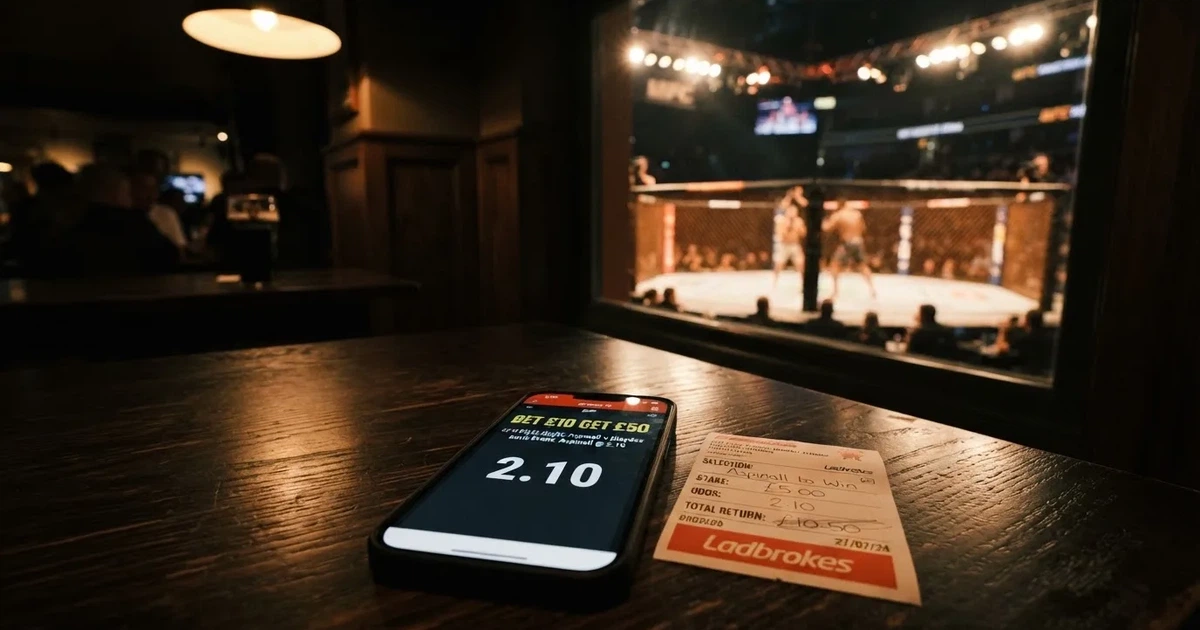
Current as of 27 October 2026 against the Gambling Commission’s public register.
Staying in control while betting on UFC
UFC cards land every weekend through most of the year, and the rhythm is part of the appeal — another event is always close. That same rhythm is the part that costs people money they had not planned to spend, because each card brings a fresh favourite, a fresh underdog and a fresh reason to “get involved”.

UK-licensed operators are required to support GAMSTOP, the multi-operator online self-exclusion register, with minimum exclusion periods of six months, one year, five years, or five years with auto-renewal. The exclusion covers every licensed online bookmaker from a single sign-up; betting shops are covered by a separate, land-based scheme. A financial vulnerability check applies to remote betting once deposits minus withdrawals exceed £150 in a rolling 30-day period — it is a public-record check, not an income or affordability check. Further financial risk assessments are announced by the Commission in a staged plan with no start date, and there is no state-set deposit or loss ceiling for betting: limits are the punter’s own choice, set through the operator’s safer-gambling tools.
If betting stops being a choice — if a chase has set in, if the Saturday night card has started to feel like a work shift — the right next move is outside any bookmaker. GamCare runs the National Gambling Helpline; GambleAware funds treatment and counselling; the NHS runs gambling clinics across the regions; Gamblers Anonymous runs local meetings. A self-exclusion through GAMSTOP is reversible only after the chosen minimum period has fully elapsed, and even then a further seven years pass before the exclusion drops off automatically.
That framing belongs at the front of any guide on UFC odds because the rest of the page assumes the reader is choosing how to bet, not whether they should.
Crypto and anonymity at UFC betting sites
UFC betting with bitcoin, with ethereum, with USDT — searches cluster around the word “crypto” because the betting industry’s pitch is that crypto solves two problems at once: faster payouts and an end to identity checks. Both pitches survive a quick read.

A UK-licensed online bookmaker is required to verify name, address and date of birth before a customer can deposit or place a bet, and that requirement covers free bets and bonuses as well as cash wagers. The verification is a licence condition under the Gambling Act 2005, not a courtesy. Crypto deposits do not exempt a punter from it: the operator still has a duty under anti-money-laundering rules to confirm who is paying and where the money came from, and at higher volumes that duty widens into source-of-funds questions. There is no anonymity at a GB-licensed site, with any payment method. Off-shore books that do offer anonymous play run on a Curaçao, Maltese or other foreign licence — and as the section on legality below sets out, those licences do not extend the British protections: no GAMSTOP coverage, no Commission complaints route, no British dispute-resolution service, no obligation to honour withdrawal requests.
On the speed point: where licensed operators have moved to instant bank transfers and Faster Payments rails, the payout times that crypto advocates point to are not always faster any more. What licensed operators do offer is a single, recoverable record of every transaction through a UK bank, a redress route if funds are withheld, and a Financial Ombudsman Service pathway for unresolved disputes. None of those follow the bitcoin.
For a UK reader comparing the two routes, the practical question is which protections the punter wants to keep. Crypto-funded offshore accounts buy speed and a thinner check-in process at the cost of every UK safeguard; bank-funded GB-licensed accounts buy the safeguards at the cost of an upfront identity check and a card-on-file. A punter who has decided that anonymity matters more than redress will find a market, but that market is not on the public register the Commission maintains.
UFC free bets and welcome offers in 2026
“Free bet” is a marketing phrase that hides two different products. One is a free bet, where the stake is not returned with a winning payout — only the profit lands. The other is a bet credit, where the stake is returned as well. The distinction is what turns a “£25 free bet” into either £25 of pure profit at best, or £50 of value at best. Reading which kind is on offer is the first task; reading the rules around it is the second.
What every welcome offer in this market shares in 2026 is a wagering requirement, a minimum price, an expiry window and a payment-method filter. Wagering requirements on bonuses are capped at 10x by the ASA’s promotion rules that came into force on 19 January 2026: a £10 bonus with a 50x wagering requirement is no longer compliant, and the practical ceiling on a £10 bonus under the cap is £100 of qualifying bets. Mixed-product promotions — an offer that requires a sports bet to unlock casino spins, for example — are banned outright. The cap does not cover free bets with no wagering condition, and there is no published cap on the headline money value of a bonus itself.
Two qualifiers recur across every welcome offer worth looking at, and both deserve a paragraph on their own.
Minimum price. A qualifying bet at 1/5 (1.20) counts for almost nothing in skill terms: it is a near-certain outcome priced so tight that the operator’s margin does the disqualifying. Most welcome offers in this market set the minimum price for the qualifying bet between 1/2 (1.50) and evens (2.00). The price floor filters out the trivial bets that would otherwise convert the bonus into an arbitrage, and it forces the punter into a market where the bookmaker’s margin can take a real bite.
Expiry. Free bets and bonuses expire — seven days from issue is common, thirty days is the long end, ninety days is rare. A punter who waits for the right card rather than betting the free bet on the next available fight is the punter most likely to lose it. The same goes for any enhanced-odds or price-boost token: if the card is two weekends away, the token may already be dead by then.
The other recurring qualifier is the payment-method filter. Most welcome offers exclude deposits made through certain e-wallets — PayPal and Skrill are the usual exclusions — because the operator cannot easily verify the source of those funds. A punter who deposits through a debit card or a Faster Payments bank transfer, by contrast, will satisfy almost any bonus’s funding rule. The promotion rules do not require that operators exclude specific e-wallets; the exclusion is in the terms and is set by the operator.
The single point the marketing rarely makes: a “100% bonus” matched on a £10 deposit is still £10 of qualifying bets before any of it is withdrawable, and £10 of bets at a margin of 5% leaves roughly 50p of expected cost. Reading the welcome offer as “free money” is reading it wrong; reading it as “a stake I have to place before I see any of it” is closer to the truth, and the punter who treats it that way is the punter who does not feel robbed when the offer expires unconverted.
UFC betting apps and the mobile experience
A UFC card runs through Saturday night in the US, which puts the main card in the UK around 3 am to 6 am on Sunday morning. Some readers will be awake for it; many will be following the undercard on a phone in the small hours, refreshing prices between rounds. The mobile experience is not a secondary channel for this sport — for many punters it is the only channel.
What matters in a UFC app in practice is four things: how fast the price updates between rounds, how a bet builder handles a same-fight multi, how the cash-out behaves when a finish is imminent, and whether the operator’s app lets the punter set a deposit limit without leaving the bet-slip screen. The best app for a given punter is the one that does not get in the way when a finish lands and the price collapses.
The Bet Builder has become the standard mobile feature on UFC cards. It lets a punter combine markets from a single fight — method of victory, total rounds, fight to go the distance — into one price. The trade-off is the margin: a Bet Builder price usually runs wider than the same selections priced separately, because the bookmaker is combining several correlated outcomes and pricing the longer tail of combinations. For the punter who wants one bet to follow from first bell to final call, that wider margin is the cost of the convenience.
Live streaming on the apps varies. The major operators run an in-play video feed on selected UFC events through a token in the account; smaller operators stream only the data feed, with a round-by-round clock and a market grid but no picture. The picture is not strictly necessary for handicap or method-of-victory markets, but it is necessary for live bets on whether a specific round ends in a finish.
Two practical points for UK punters betting through apps: an app that lets a punter log in with Touch ID or Face ID is not weaker on security than a password-only login — both rely on the same licence-level identity checks. And an app that freezes a price mid-tap because the market has moved is showing the bookmaker’s risk control working as designed; a punter who loses a placed bet to a suspended market has not been treated unfairly, the bet simply never landed.
Live UFC betting and cash out in play
Live UFC betting is the most volatile market in the sport. A fight can be priced at 1/3 for the favourite, 11/4 for the dog; a knockdown in round one can flip the favourite to 5/2 and the dog to 2/5 inside two seconds, and the in-play book has to absorb that move without freezing the entire market. The punter’s window into it is the cash-out button, which lets them lock in a return before the fight ends.
The mechanics of a UFC live bet do not differ from any other in-play live bet at a GB bookmaker. What differs is the rhythm. A price moves with every significant strike, with every takedown attempt, with every cut checked by the doctor. The bookmaker’s trading team widens the spread on volatile moments — after a knockdown, after a doctor’s stoppage check, after a point deduction — because the next move is harder to call. The punter sees that as a wider margin on the next price they are offered.
Three live markets behave differently from the rest of the card.
Method of victory. A method-of-victory market in play is partially settled at the moment a finish becomes imminent: a fighter who is rocked and being finished is no longer priced as a decision winner, and the market reorganises around KO/TKO and submission prices. The spread on these markets can move 20-30 percentage points inside a single exchange of strikes.
Total rounds. The over/under on total rounds is settled only when the fight ends, but the live price collapses towards whichever side is favoured the moment a finish is imminent. A punter who took over 2.5 rounds at 1/1 and sees a finish in round 2 sees their bet settle at zero in the time it takes the referee to step in.
Fight to go the distance. This market is the one where a cash-out makes most sense, because the price moves gradually through the rounds as each minute passes without a finish. A punter who took “fight to go the distance” at 4/5 (1.80) before round 1 can see that selection priced at 1/12 (1.08) by the start of round 5, because each round that ends without a finish is information the market has absorbed. The cash-out price at that point is barely above the stake — but it is above the stake, which is the point.
Cash-out is offered by most licensed bookmakers on UFC markets, with a bookmaker-set margin built into the offered cash-out price. A punter who cashes out is paying that margin in return for closing the bet early. The choice between holding to settlement and cashing out is the choice between accepting the original margin and accepting the cash-out margin; which is better depends on the live state of the fight, and no algorithm can tell a punter that from outside.
UFC betting tips, predictions and the discipline behind them
A UFC betting tip is a prediction. A UFC betting prediction is a tip. The market trades in both names, and the punter pays for neither in advance because the actual product the tipster sells is a story about a fighter’s form, a stylistic edge, a camp change, an injury. The story may be true; it is also a story the tipster could equally tell the other way round in another week.
What a tip does not include is the thing that makes a bet beat a margin in the long run: a model, a sample size, and a discipline. The market does not pay a punter for being right about a single fight; it pays a punter for being right more often than the price implies, across hundreds of bets, after the bookmaker’s margin has been stripped out. The model can be as simple as “bet underdogs priced above 2/1 in fights where the favourite is making a short-notice return from injury”, but it has to exist, and the discipline has to follow it across losing runs.
Bankroll management is the second half of the same point. A punter who stakes a fixed percentage of a fixed bank — one to three per cent per bet is the band serious bettors use — survives the losing runs that a flat-stake bettor does not. The flat-stake bettor who doubles up after a loss is the punter who blows the bank on the loss after the loss after the loss; the percentage-stake bettor who keeps the unit the same size is the punter who places the next bet the day after the bank recovers.
There is a third point that the tipster market avoids. The fight result the punter actually needs is not “fighter A beats fighter B” — it is “fighter A beats fighter B at a price greater than the true probability of the outcome”, which is a different statement by a margin of 3-5 percentage points on most fights. A punter who prices a fight at 60/40 for fighter A, and the bookmaker has fighter A at 1/2 (1.50), is looking at a price that already implies 67% — the punter needs to be right more often than the price says, which means the punter needs to be right more often than the model says, and that gap is where the edge either lives or dies.
Three further disciplines that work across the sport.
Form windows are short. A fighter coming off a three-fight winning streak at 155 lb is a different proposition from the same fighter after a six-month layoff; the price may not have moved enough. Method matters more than the pick. A punter confident in a KO/TKO finish has access to method-of-victory markets that pay better than the outright winner; the same confidence applied to the moneyline leaves money on the table. Card quality varies. A main-event between two ranked contenders sits in a different information environment than a preliminary fight between two debutants — less public tape, less media coverage, more variance, more value for the punter who has watched both.
The honest framing: this is a sport where a disciplined bankroll beats a hot tip every time, and the punter who treats the tip as a starting point for their own reading of the fight is the punter who keeps the edge when the tipster goes cold.
UFC bet types and how the odds are made
UFC betting odds are presented in two formats on a UK site: fractional (5/1, 11/4, evens) and decimal (6.00, 3.75, 2.00). The conversion is mechanical: a/b in fractional form becomes a ÷ b + 1 in decimal form. 5/1 is 6.00; 11/4 is 3.75; evens (1/1) is 2.00; 4/6 is 1.67. The decimal form makes the payout arithmetic easier — stake multiplied by decimal odds equals total return, including the stake.
The starting price of a UFC bet is the price, set by the bookmaker’s trading desk and moved by the weight of money on either side. The number the punter sees is not a probability; it is a probability with the bookmaker’s margin layered over it. The bookmaker’s margin — also called the overround — is the difference between what the prices imply and 100%. On a perfectly efficient market, two opposing prices that each implied 50% would add to 100%; in practice they add to 103-106% on a tight UFC fight, 107-110% on a fight the bookmaker has less information about, and 110%+ on a method-of-victory market with six outcomes.
The mechanics are visible in any pair of prices. A straight winner market priced at 4/6 (1.67) for the favourite and 6/5 (2.20) for the underdog implies a payout share — the share of every pound staked that would be returned in the long run to bettors, ignoring the margin — of (1 ÷ 1.67) + (1 ÷ 2.20) = 0.5988 + 0.4545 = 1.0533, or 105.33%. That implies an overround of 5.33%, which corresponds to a bookmaker margin of roughly 5.06%: roughly £5.06 of every £100 wagered on this market is kept by the bookmaker in expectation. A method-of-victory market with six outcomes typically shows a margin in the 8-12% range; a same-fight Bet Builder runs 12-18% because the bookmaker is pricing correlated outcomes without a deep information edge.
The return on a UFC bet is the stake multiplied by the decimal odds, and the profit is the stake multiplied by the decimal odds minus the stake. A £10 bet at 5/2 (3.50) returns £35 — £10 stake plus £25 profit. A £10 each-way bet on a fighter at 4/1 (5.00) returns the win portion at full odds and the place portion at a fraction of the odds, with the stake doubled because each-way is two equal bets: £5 on the win and £5 on the place.
Combination bets — accumulators, doubles, trebles — multiply the legs together into one price. A treble at 2/1, 5/2 and 6/4 becomes a single combined price of (3.00 × 3.50 × 2.50) = 26.25; a £10 treble returns £260, profit £250. The combined price looks attractive because it is large, but each leg carries its own margin, and the margins multiply with the prices. A treble built from three legs each at a 5% margin has a combined margin close to 15%, before any leg fails. Most accumulators fail; the punter who wins a 10-leg acca has hit a 10-margined outcome, which is rarer than the price alone implies.
A bet builder on a single UFC fight is technically an accumulator with correlated legs. The bookmaker prices it knowing the legs are not independent — a finish in round 1 makes the “over 2.5 rounds” leg lose, the “submission” leg win, the “decision” leg lose — and the price reflects that correlation. The punter’s edge over the bookmaker in a bet builder is usually smaller than the edge over a single market, because the bookmaker’s information on the correlations is wider.
Two further mechanics are worth knowing.
Rule 4 deductions. If a fighter withdraws after bets are placed but before the fight starts, the bookmaker applies a Rule 4 deduction: the price is reduced by a factor set in the operator’s house rules, and the winnings are calculated against the reduced price. The deduction is larger when the withdrawn fighter is the favourite.
Non-runner rules. If a fighter pulls out before the weigh-in or is replaced by a substitute, the bet is usually void and the stake returned; the operator’s terms state the exact threshold (often the weigh-in). The punter should read the operator’s non-runner rule before betting on a fight card with multiple late changes, because late changes are common in the UFC.
UFC events, fight cards and the tournament calendar
The UFC held its first event on 12 November 1993 in Denver, Colorado. By 2026 the promotion has held over 750 events, runs eight men’s divisions and three women’s divisions, and stages a numbered event most weekends alongside Fight Night cards through most of the calendar. Each UFC round is a maximum of 5 minutes with one minute’s rest between rounds; championship fights and non-title main events are scheduled for a maximum of 5 rounds, other bouts for 3 rounds.
UFC bouts can be won by submission, knockout, technical knockout, judges’ decision (unanimous, majority, split or technical) or disqualification; a bout can also be ruled a no contest. The ten-point must system applies to UFC fights: three judges score each round, the winner receiving 10 points and the loser 9 or fewer; 10-8 is typical for dominant rounds. If a UFC title fight ends in a draw, the defending champion retains the title.
For betting purposes the calendar shape is what matters. The numbered events — UFC 300, UFC 310, UFC 320 — run every four to six weeks, typically on pay-per-view in the US and on a mix of ESPN+ and main-card broadcasts elsewhere; the UK fight-night cards fill the weekends between. Within an event, the main card has the deepest markets and the tightest prices; the preliminary card has wider markets and more value for the punter who has watched the tape; the early prelims are thinly priced and often limited to the outright winner. Two events scheduled: UFC 334 (Gane vs. Hokit) on 14 November 2026 at Madison Square Garden, New York City, and UFC 335 (Oliveira vs. Lopes) on 12 December 2026 at T-Mobile Arena, Las Vegas.
The early prelims are also where late changes are most common. Fighters pull out on fight week, replacements sign on three days’ notice, and the weight cut is the usual culprit. A punter who has built a bet builder across the early prelims by midweek is the punter most exposed to a Rule 4 deduction or a voided bet; a punter who has waited until the weigh-in is the punter with the cleanest card to bet on.
The sport’s promotion by TKO Group Holdings — the parent that also runs WWE — has pulled more UFC events onto pay-per-view in recent years, with a corresponding reduction in the volume of fights available free-to-air. For the UK punter, the practical consequence is that more fights sit behind a paywall: betting markets still form on those fights, but the punter betting on a fight they have not seen relies on the betting site’s write-up, the weigh-in footage and the pre-fight press conference for information.
The licensed UK bookmakers reviewed
Every brand below holds a Gambling Commission remote licence and appears on the Commission’s public register. The comparison covers the offer each brand runs, the markets each book carries, and the choice each one suits. None of the entries is ranked above another.
Bet600 — BOG and the horse-racing-friendly card
Bet600’s stand-out feature for the racing punter is Best Odds Guaranteed: if the starting price is bigger than the price taken, the bet is paid at the SP. For UFC the price is set by the bookmaker and not by the racecourse, so BOG does not apply on fight cards. What does apply is a smaller, sharper book with the BOG discipline carried across: prices move quickly with weight, the site does not over-promise enhanced odds, and the welcome is structured around horse racing rather than MMA. A UFC punter who only bets the sport will find a clean site with tight prices and limited fight-night promos; a racing-and-UFC punter who wants one book for both will find a reasonable compromise.
Gambling Commission remote licence 044731-R-323941-016 (account 44731); licence holder Tyche Tech Limited.
BoyleSports — the £20 free-bet welcome on a £10 trigger
BoyleSports runs a sports welcome offer for UK players: £20 in free bets when a £10 bet is placed (€30 in free bets for a €10 bet for Irish players). The qualifying bet is the part to read: it is a single bet, settled at minimum odds that the operator’s terms set, on any sports market — UFC included. The free bet itself expires on the operator’s stated timetable, and any winnings from the free bet are paid back without the free-bet stake, as usual. A punter weighing this welcome against the rest of the market should compare the qualifying-bet minimum price, the free-bet expiry, and whether the offer excludes payment methods they want to use.
Gambling Commission remote licence 039469-R-319383-025 (account 39469); licence holder Boylesports Enterprise.
Matchbook — the betting exchange for UFC bettors
Matchbook runs as a betting exchange, where customers bet against other users rather than against the bookmaker. The exchange model changes the price the punter sees: instead of the bookmaker’s margin built in, the exchange price reflects the matched bets between users, with the exchange taking a small commission on net winnings. UFC markets on a betting exchange typically run a 2-3% margin at peak liquidity, against a 5-7% margin at a traditional bookmaker — a meaningful gap on a tight fight. Matchbook also runs Bet Builder, multiples, in-play betting and live streaming of horse racing and greyhounds; for UFC the in-play is the relevant feature, and the live data feed is fast enough to support between-round bets. The trade-off is liquidity: a UFC prop market on a Fight Night undercard that would carry £10,000 of liquidity at a major bookmaker may carry £200 on an exchange, and the punter’s stake may not match at the displayed price.
Gambling Commission remote licence 039504-R-319407-024 (account 39504); categories: remote general betting standard (real events), remote betting intermediary; licence holder Triplebet Limited.
Betboro — the £25 matched free bet with a 3-selection trigger
Betboro’s sports welcome offer is a 100% matched free bet of up to £25 on the first qualifying wager. The qualifying conditions are specific: a debit card deposit of at least £10, a first bet of between £5 and £25, and at least three selections on that bet each priced at 3/5 (1.60) or higher. The three-selection floor makes this a same-stake acca trigger, not a single trigger, and the minimum price of 1.60 is set high enough that a 1/4 (1.25) favourite does not qualify. For the punter who already plans to place a small Saturday-night acca on a UFC card, this is a clean match: place the acca, take the matched free bet, use the free bet on a later card. For the punter who wants to place a single £10 bet to qualify for a welcome, this is the wrong offer.
Gambling Commission remote licence 044181-R-324363-007 (account 44181); licence holder Webmedia Development N.V.
Tote — the pool-betting heritage on a UFC card
Tote is the digital home of the Tote, the pool-betting operation that has run UK and Irish racing for decades. On UFC the Tote card is a traditional bookmaker offering rather than a pool — Tote’s pool product sits on horse racing. The UFC offering is a tight winner market with limited methods and props, reflecting a bookmaker whose strength is pool betting on racing rather than sharp MMA pricing. For the racing-led punter dipping into UFC, the Tote site has the familiarity and the safer-gambling tools that come with a long-established brand. For the dedicated UFC bettor looking for the widest prop menu, Tote is not where the action is.
Gambling Commission remote licence 054779-R-331321-008 (account 54779); licence holder TDCO Limited.
Fitzwilliam Sports — the capped-membership Dublin book
Fitzwilliam Sports describes itself as a Dublin bookmaker with capped membership, which sets the brand apart from the rest of this list: membership is not open to everyone, and the welcome — described as a “High Stakes Welcome” — is subject to compliance criteria. The site offers instant deposits, fast withdrawals, timeouts and deposit limits, with links to GambleAware, GamStop and Gamblers Anonymous. For a UK punter, Fitzwilliam is a bookmaker whose appeal is the high-stakes welcome and the smaller-membership book: tighter prices because less money is being matched, a higher-stake ceiling on the main events, and a welcome that targets the bigger-stake punter rather than the casual £10 bettor. It is not a book for everyone; it is a book for the punter who has been invited and accepts the compliance criteria.
Gambling Commission remote licence 048760-R-335434-009 (account 48760); licence holder SBKI Limited.
Bet Ahoy — the £10-for-£10 split-token welcome
Bet Ahoy’s welcome offer is “Bet £10 & Get £10 in Free Bets”, made up of a £5 sports bet token and a £5 acca token. The split structure matters: one token is meant for a single-bet use, the other for an accumulator. The qualifying bet is a £10 stake on a sports market at the minimum odds the operator’s terms set. For the punter who plans to bet the £10 on a UFC main card outright winner, the £5 sports token is the one to use; the £5 acca token sits better on a same-fight Bet Builder or a multi-fight treble. Expiry windows and payment-method filters are the usual reading; what is unusual here is the split, which gives a punter two small free bets rather than one larger one.
Gambling Commission remote licence 100094-R-341742-003 (account 100094); licence holder Bet Ahoy Ltd.
Unibet — the £40-free-bet welcome with a 2.0 floor
Unibet’s sports welcome offer is “Get £40 in Free Bets when you bet £20”: a deposit and sports bet of £20 or more at minimum odds of 2.0 (1/1), with free bets expiring within 7 days of issue, for new GB customers using a debit card or instant bank transfer. The £40 against a £20 trigger is a 2x match, the headline is generous, and the minimum odds of 2.0 (1/1) is on the higher end of the welcome-offer range. The seven-day window is short; the debit-card or instant-bank-transfer filter rules out PayPal and Skrill deposits. Unibet’s UK site has operated since 1999 under Platinum Gaming Limited, Gibraltar, with Gambling Commission account 45322. The UFC offering carries the standard winner, method-of-victory and total-rounds markets, plus the Bet Builder on selected fights.
Gambling Commission remote licence 045322-R-324275-019 (account 45322); licence holder Platinum Gaming Limited.
Kalooki Sportsbook — the GAMSTOP-verified new-entrant
Kalooki Sportsbook is operated by Kalooki Sports Book Ltd (company number 12938274), licensed by the Gambling Commission under account number 57730, and is a GAMSTOP member. The brand is a recent entrant to the UK market and is one of the smaller books on this list by liquidity. For the punter who prefers a less-trafficked book with a tighter safer-gambling posture, Kalooki is a reasonable pick; for the punter hunting the widest prop menu on a UFC pay-per-view card, the bigger books carry more markets.
Gambling Commission remote licence 057730-R-333396-005 (account 57730); licence holder Kalooki Sportsbook Limited.
Copybet — BOG all day on UK and Irish racing
Copybet’s stand-out feature is Best Odds Guaranteed all day, every day on all UK and Irish racing, with first-past-the-post paid even if the winner is later disqualified. For the racing-led punter, this is one of the most generous BOG offerings on a UK site. For the UFC punter, Copybet carries the standard winner market and the main method-of-victory markets, but is not the deepest MMA book on this list. A punter who bets both sports and prizes the BOG offer will keep Copybet in the account; a punter betting only UFC will find tighter prices elsewhere.
Gambling Commission remote licence 053774-R-330743-010 (account 53774); licence holder Copybet UK Limited.
The UK regulatory picture for UFC odds
UFC odds sit inside the same regulatory frame as any other UK sports betting market, because the framework does not name individual sports. The Gambling Commission licenses the whole commercial market under the Gambling Act 2005, which covers Great Britain — England, Scotland and Wales; Northern Ireland runs under separate legislation and a GB licence is not a Northern Ireland licence. An operator whose remote facilities are used in Great Britain needs a Commission licence wherever it is based, since the Gambling (Licensing and Advertising) Act 2014 closed the previous white-list loophole; a Curaçao or Malta licence is not a substitute. The Commission’s public register, searchable by business name, trading name, domain or account number, is the whole test of whether a brand holds a licence; a .com domain proves nothing, because licensed operators use .com as well as .co.uk.
Three points sit at the heart of the regulatory picture for a UFC punter.Identity checks. Name, address and date of birth are verified before a customer can deposit or gamble, including with a free bet or bonus, and the verification covers every payment method including crypto-funded deposits at a licensed site. No anonymity. The verification duty is a licence condition under the Gambling Act 2005 and is not waived by any payment rail. No British offshore play. A punter who uses an offshore book accepts the loss of every UK safeguard: no GAMSTOP coverage, no Commission complaints route, no approved dispute-resolution body, no British consumer redress if funds are withheld, and no obligation on the operator to honour the 10x bonus cap or the £150 vulnerability check. The offshore book is not “illegal to use” in a customer-facing sense — the offence under section 33 of the Gambling Act 2005 is aimed at the operator, not the punter — but the practical difference is that the punter’s protections are gone.
On the betting side, in-play betting on UFC is offered by GB bookmakers under their own licence conditions and customer-protection duties; the framework does not treat it as “unrestricted” in a legal sense. There is no statutory list of permitted bets or markets: an operator holds a licence for a category (remote general betting standard for real events is the relevant one for UFC) and offers markets under its own rules and the Licence Conditions and Codes of Practice. No statutory cap on stakes in sports betting exists; operators set their own maximum stakes and may restrict individual customers.
On the promotional side, the promotion rules in force since 19 January 2026 cap wagering requirements on bonuses at 10x and ban mixed-product promotions. The 10x cap covers the bonus’s wagering requirement, not its headline money value; free bets with no wagering condition are not within the cap, and the practical ceiling on a £10 bonus under the cap is £100 of qualifying bets. A welcome offer that offers £40 of free bet for £20 of qualifying bet, with no wagering requirement on the free bet itself, sits inside the rules.
On the tax side, the player pays no tax on betting winnings in Great Britain. General Betting Duty is the operator’s tax on gross profits, currently 15%; from 1 April 2027 a new remote betting rate of 25% applies within it, while remote bets on UK horse racing, bets on self-service betting terminals in licensed premises, pool betting and in-person betting stay at 15%. Until 1 April 2027 the remote rate stays at 15%; whether operators pass duty on through odds is not established, and the punter’s return is unaffected either way for now.
The honesty the regulator itself asks for: a GB licence buys the safeguards — checks, limits, GAMSTOP, bonus cap, dispute resolution — at the cost of upfront identity verification and a card-on-file at a UK bank. An offshore account buys speed and a thinner check-in at the cost of every safeguard and the risk of withheld funds. Neither is “the safe choice” by default; the punter chooses which trade-off to make.
How the margin sits inside a UFC price
The margin is the part of every UFC price the bookmaker keeps in expectation. It is not a fee charged on winning bets, it is not visible on the slip, and it is the reason a £10 bet at 5/2 (3.50) is worth £35 in total only if the fighter wins — and is worth £0 if the fighter loses, which on most UFC favourites happens more often than the price alone implies.
The arithmetic is mechanical. For a market with two outcomes priced at decimal odds o₁ and o₂, the payout share — the share of every pound staked that would be returned to bettors in the long run — is 1 ÷ (1/o₁ + 1/o₂), and the margin is 1 minus the payout share. Take a UFC winner market priced at 1.90 / 1.90 (fractional 9/10 on both sides): the payout share is 1 ÷ (1/1.90 + 1/1.90) = 1 ÷ (0.5263 + 0.5263) = 1 ÷ 1.0526 = 0.95. The margin is 1 − 0.95 = 0.05, or 5%.
That 5% is what the bookmaker expects to keep of every unit staked on this market in the long run, before any individual punter’s outcome. A punter who bets on this market and wins gets the full price; a punter who bets and loses gets nothing; the bookmaker’s 5% comes from the difference, weighted by the volume on each side. A market at 1.80 / 2.00 (a slight favourite/underdog split) carries a payout share of 1 ÷ (1/1.80 + 1/2.00) = 1 ÷ (0.5556 + 0.50) = 1 ÷ 1.0556 = 0.947, or roughly 94.7%, and a margin of about 5.3%. The tighter the prices, the lower the margin; the wider the prices, the higher the margin.
On UFC winner markets the margin sits in a band — typically 5% to 7% on a main-card fight with a clear favourite, 6% to 8% on a closely priced fight, and 8% to 12% on a prelim fight the book has priced thinly. Method-of-victory markets with six outcomes run wider because the bookmaker is pricing more uncertain combinations: a method-of-victory market can show a 9% to 12% margin, and a same-fight Bet Builder can reach 12% to 18% because the book is pricing correlated outcomes.
The band, stated with its condition: on a two-way UFC winner market priced symmetrically around 1.90, the bookmaker’s margin sits at roughly 5%; a real UFC winner market with a favourite/underdog split typically sits in the 5%–7% range; method-of-victory and Bet Builder markets run wider, in the 8%–18% band.
A punter who knows how to read the margin beats one who does not, because the punter who reads it chooses the market with the lowest margin that suits their read on the fight. A two-way winner market at 5% margin is the cheapest market to bet on for the punter who wants exposure to the outright outcome. The same punter paying 12% margin on a Bet Builder is paying the convenience of one slip for the price of an extra 7 percentage points of expected cost per unit staked.
The rule that follows is not to avoid higher-margin markets but to know the cost of them. A Bet Builder at 15% margin on a £10 bet is expected to cost the punter £1.50 in the long run; a winner market at 5% margin on the same £10 is expected to cost 50p. The same bet, on the same fight, on the same outcome, costs three times as much through the Bet Builder. The punter who does not see that gap has paid it; the punter who does has chosen.
UFC bookmakers at a glance — licence and offer
| Brand | Gambling Commission licence | Licence holder | What the operator’s terms state on the key’s subject |
|---|---|---|---|
| Bet600 | 044731-R-323941-016 (account 44731) | Tyche Tech Limited | Best Odds Guaranteed on horse racing: bets paid at the SP if the SP is bigger than the price taken |
| BoyleSports | 039469-R-319383-025 (account 39469) | Boylesports Enterprise | Sports welcome offer: £20 in free bets when a £10 bet is placed (€30 / €10 for Irish players) |
| Matchbook | 039504-R-319407-024 (account 39504) | Triplebet Limited | Betting exchange: customers bet against other users; Bet Builder, multiples, in-play, live streaming on racing |
| Betboro | 044181-R-324363-007 (account 44181) | Webmedia Development N.V. | Sports welcome offer: 100% matched free bet up to £25; qualifying bet £5–£25, 3+ selections each at 3/5 (1.60) or higher |
| Tote | 054779-R-331321-008 (account 54779) | TDCO Limited | Pool betting heritage on UK and Irish racing; sportsbook offer on UFC and other sports |
| Fitzwilliam Sports | 048760-R-335434-009 (account 48760) | SBKI Limited | Dublin bookmaker with capped membership; “High Stakes Welcome” subject to compliance criteria |
| Bet Ahoy | 100094-R-341742-003 (account 100094) | Bet Ahoy Ltd | Welcome offer: Bet £10 & Get £10 in Free Bets, split into a £5 sports token and a £5 acca token |
| Unibet | 045322-R-324275-019 (account 45322) | Platinum Gaming Limited | Sports welcome offer: £40 in Free Bets when you bet £20; minimum odds 2.0 (1/1); 7-day expiry; debit card or instant bank transfer |
| Kalooki Sportsbook | 057730-R-333396-005 (account 57730) | Kalooki Sportsbook Limited | Operator’s own pages confirm GC licence 57730 and GAMSTOP membership |
| Copybet | 053774-R-330743-010 (account 53774) | Copybet UK Limited | Best Odds Guaranteed all day on UK and Irish racing; first past the post paid even on disqualification |
Every brand above is on the Gambling Commission’s public register at the access date noted at the top of this guide. The offers are described only as each operator’s own terms state them, and the punter should re-check the live terms on the operator’s site before claiming.
Frequently asked questions about UFC betting odds in 2026
Where can a UK punter bet on UFC fights?
Every brand reviewed above holds a Gambling Commission remote licence and appears on the Commission’s public register. A punter choosing among them is choosing between a traditional bookmaker, a betting exchange (Matchbook), and apps with different market depth and welcome offers — not choosing between licensed and unlicensed, because every brand in this comparison is licensed for Great Britain.
Which is the best app to bet on UFC fights from the UK?
The best app is the one that does not get in the way when a finish lands and the price collapses. Practically, that means an app with fast in-play price updates, a usable Bet Builder on same-fight markets, a cash-out that reflects the live state, and a way to set a deposit limit without leaving the bet-slip. Most UK punters will find at least three of the apps in this comparison meet that bar; the test is the punter’s own usage pattern, not a single ranking.
How can a punter check that a bookmaker holds a Gambling Commission licence?
The Commission’s public register, searchable by business name, trading name, domain or account number, is the only authoritative check. A licensed brand will show its licence number and the licence holder’s name on the register, with the licence categories (remote general betting standard for real events, remote betting intermediary for exchanges) stated on the entry. A brand that is not on the register is not licensed for Great Britain, regardless of where else it is licensed.
How is the return on a UFC bet worked out from the stake and the odds?
Return is the stake multiplied by the decimal odds, and profit is the stake multiplied by the decimal odds minus the stake. A £10 bet at decimal odds 3.50 returns £35 total — £10 stake plus £25 profit. On a combination bet the decimal odds of each leg multiply into one combined price, and the same arithmetic applies to the combined price. Free bets are different: the free-bet stake is usually not returned with a winning payout, so a £10 free bet at 3.50 returns £25 of profit, not £35.
What is a bookmaker’s margin and how can a punter see it in the odds?
The margin is the share of every unit staked on a market that the bookmaker keeps in expectation, and it is the difference between the sum of the implied probabilities and 100%. For a two-way market priced at 1.90 and 1.90, the implied probabilities sum to about 105.3%, and the overround is about 5.3%, which corresponds to a bookmaker margin of about 5.0%. For a UFC winner market, a 5%–7% margin is typical; method-of-victory markets run 8%–12%, and same-fight Bet Builders 12%–18%. The punter reading it chooses the market with the lowest margin that suits their view.
Combat & motorsport – UK betting
Content created by the «UK betting» team
