
Reading the odds on British horse racing — what the price actually pays
 Available in US
*Updated 27 October 2026 · Licence status checked against the Gambling Commission’s public register.*
A price on a horse is a number, but it is a particular kind of number. It tells the backer what a winning pound returns, encodes the bookmaker’s margin on the race, and — in each-way form — doubles the stake before the first fence is jumped. For bettors in Great Britain the question of *who* sets that price sits on top of everything else, because a Gambling Commission licence is what brings GAMSTOP, the £150 vulnerability check and the 10x bonus cap along with the odds. This page is the bridge between those two readings: the arithmetic a price carries, and the regulatory frame the price sits inside.
The pages that follow cover the lot. Responsible-gambling tools and where to find help, then how a crypto-only or no-account approach fits — or does not fit — the British framework. Bonuses, free bets and the rollover that quietly turns “free” into expensive. Mobile apps and what an in-play screen actually shows. Live betting and cash out. The strategy pages that promise a system. The bet types a British racecourse price covers, from single to accumulator to each-way. The meetings that make up a British racing year. Then the top-ten comparison of operators licensed to take your bet, and finally the legality of the whole arrangement.
Responsible gambling on British horse racing
A horse racing bet is one of the simplest products on a British licensed site: pick a horse, set a stake, settle after the race. It is also the one most bettors place at speed, between other bets, while watching a meeting — and speed is exactly what the safer-gambling framework is built to interrupt. The tools below are not optional extras at a GB-licensed bookmaker; they are licence conditions under the LCCP, and GAMSTOP is a separate mandatory scheme covering every online operator.

Self-exclusion. GAMSTOP is the national multi-operator online self-exclusion register. A bettor registers once and every GB-licensed online operator must close the account and refuse to open a new one for the duration. The minimum period is six months, and the bettor chooses one of four: six months, one year, five years, or five years with auto-renewal. After the minimum period the exclusion does not simply lapse — it stays in force for a further seven years unless the customer asks GAMSTOP to remove it. That is the rule a reader who thinks “I’ll come back in six months” first meets: the request to come back has to be made by them, not the operator, and the protection is long. Betting shops run a separate scheme, so excluding online does not exclude over the counter.
Deposit limits. Licensed remote operators must offer customers a gross deposit limit on a fixed time frame. Phases have rolled out across 2026 and into next year — the second-phase changes were postponed to 30 September 2026, and whether the new structure is live for the brand a bettor uses is not established here. The point for now is the one that has applied since 31 October 2025: a bettor can set a limit and the operator has to honour it.
Financial vulnerability check. Since 28 February 2025, when a customer’s deposits minus withdrawals exceed £150 in a rolling 30 days, a licensed remote bookmaker must run a public-record check — bankruptcy or county court judgments, for instance. It is not an income check and not a credit-reference check; it is a way of catching signals that are already in the public domain. Announced financial risk assessments (the “affordability checks” of the press) sit in a staged plan with no start date, so they are not in force today.
Where help is found. GamCare runs the National Gambling Helpline. GambleAware funds treatment and education. The NHS runs specialist gambling clinics in several regions. Gamblers Anonymous runs meetings. These are the four places a reader in difficulty should know about by name; the page does not rank them, because the right first step depends on the person.
For horse racing specifically, the obvious point is that every licensed site above is GAMSTOP-covered by virtue of being licensed. The next section looks at what happens when a reader tries to step outside that frame — and why the unlicensed route costs them every tool above.
Crypto, anonymity and the British licensing question
A recurring search around horse racing is for a “crypto horse racing” or “non-Gamstop” experience — deposits in Bitcoin or another coin, no identity check, no self-exclusion register in the way. The pull is obvious: speed at sign-up, and a bookmaker outside the British database. The cost is the one to weigh before the wallet is opened.
The licensing rule is at the point of consumption, not the point of incorporation. Under the Gambling (Licensing and Advertising) Act 2014, an operator whose remote facilities are used in Great Britain needs a Gambling Commission licence wherever it is based. A Curaçao, Maltese or Gibraltar licence is not a substitute for a Commission licence in this country — it is a different licence for a different jurisdiction. Section 33 of the Gambling Act 2005 (as amended) is the offence: providing gambling facilities in Great Britain without the licence the Act requires. The fine is up to level 5 on summary conviction, the sentence up to 51 weeks (six months in Scotland), and the offence is aimed at the operator, not the customer.
What a bettor actually loses by going outside the frame. The marketing word is “anonymous” — the page calls it the absence of the protective layer. No GAMSTOP self-exclusion, no Commission complaints route, no approved dispute-resolution service if the operator refuses to pay, no British consumer redress if funds are withheld, the 10x bonus cap and the £150 vulnerability check do not apply. Spread betting on a financial product is regulated by the FCA, not the Commission, and the operator will state that spread-betting losses can exceed deposits — that note is a statutory warning, not a footnote.
Identity verification is not optional at a GB-licensed site. Since 7 May 2019, a licensed operator must verify name, address and date of birth before the customer can deposit or gamble, including with a free bet. There is no anonymous play at a licensed bookmaker in Great Britain. That is the rule that pushes a reader who wants anonymity towards the offshore route; the previous paragraph sets out what they trade for it.
Crypto deposits at licensed sites are not established. Research finds no British named-account rule, no state list of permitted payment methods, and no specific rule for or against cryptocurrency at licensed operators. The honest framing is qualitative: payments at a licensed operator follow that operator’s terms and the AML rules; an offshore crypto bookmaker follows its own. Where a price sits on a British racecourse, the difference is regulatory, not technical.
Bonuses and free bets on horse racing
Bonuses and free bets are the marketing loudest on the racing pages, and they are also the ones the LCCP has tightened up. The shape of a UK horse racing offer is settled by two rules: wagering is capped at 10x, and an offer that demands play on more than one product type — say, “bet on the 3.10 to get free spins” — is banned. Promotion rules in force since 19 January 2026 put those two pieces on the page.
The 10x cap, written out. Wagering requirements on bonuses are capped at 10 times the bonus amount. A £10 bonus at 50x would have needed £500 of qualifying bets; under the cap the same bonus needs no more than £100 of qualifying bets. Free bets with no wagering condition and any cap on the money value of a bonus are not established here. The takeaway for a racing punter: the number to read first is not the headline — “£30 in free bets” — but the rollover that sits underneath it.
Each offer keeps its type. A cash bonus is a cash bonus, credited to withdrawable balance subject to wagering. A free bet is a free bet: the stake is usually not returned with a win, the winnings are the offer, and the value is the bonus amount multiplied by (odds minus 1) divided by odds, scaled by the market’s payout share. The bookmaker’s word “risk-free” usually means a refund as a free bet — the original stake is gone if the bet loses, and the refund cannot be withdrawn as cash. A price boost, an accumulator insurance and a cashback each stay what they are. A deposit-gated package — “deposit £10, get £15 in free bets” — is deposit-gated, and the £10 deposit is the qualifying condition. Restyling any of these into a different shape on this page would be a factual error.
Best Odds Guaranteed is the racing-specific term. William Hill’s terms state BOG applies to UK and Irish horse racing from 8 AM on the day of the race, on both single and multiple bets; it does not apply to ante-post, tote or pari-mutuel bets. Other bookmakers carry equivalent terms. The marketing word is “best” — the mechanism is a payout at the SP if the SP is higher than the price the punter took at the time of the bet. Read the race-day cut-off (8 AM is the William Hill figure; each operator sets its own) and the bet-type list before relying on it.
What the calculation does to a “free” bet. A free bet whose stake is not returned is worth the bonus amount multiplied by (odds − 1), divided by odds, multiplied by the payout share of the market. A £10 free bet at decimal odds 6.00 on a horse race with a payout share of 0.85 is worth about £10 × (5/6) × 0.85 ≈ £7.08 on average. That is the headline figure to compare against the qualifying wagering, and the comparison almost always favours the lower free bet with the smaller rollover.
Deadlines and expirations. Free bets come with clocks. A 7-day expiry is typical; the stake-not-returned note above is what makes an expired free bet worth nothing. The 10x cap on bonus wagering does not change the expiry — it changes the size of the wagering barrier, not the time to clear it.
Mobile apps and the British racing bookmaker
The horse racing audience is, by market share, a phone audience. The comparison that follows uses the Apple App Store descriptions as a snapshot of how each operator presents itself at the time of writing; the licence data sits separately, on the Gambling Commission’s public register. Two points to keep separate when reading a store page: the marketing description (which is the brand’s own terms, written to win the download) and the licence status (which is the regulator’s, written to win the audit).
Native app versus mobile site. A native app is downloaded and lives on the handset; a mobile site is the bookmaker’s web product in a phone browser. The store descriptions below tell the reader which one the brand pushes. Native apps give push notifications — race reminders, price alerts, BOG triggers — and a smoother in-play screen, which matters when a meeting is unfolding and the price is moving. Mobile sites give nothing to install and nothing to update, and they leave the user in the browser’s session rather than in a stored app. The honest comparison is feature-by-feature, not “app versus site” in the abstract.
Bet builders and in-play on a phone. Several apps describe their Bet Builder feature as combining markets from one event into a single bet. bet365’s store page describes Bet Builder+ as combining markets from one event pre-match and in-play, with Super Boosts and Winnings Boosts on Bet Builders. LiveScore Bet’s help page describes its Bet Builder as allowing up to 10 selections and covering match result, both teams to score, corners, total goals, player scoring and card markets — though those markets are football-shaped, not racing-shaped, and the racing equivalent is single-race markets, not a builder. Midnite’s site describes an acca builder, popular accas and price boosts with maximum-stake limits, and shows in-play events.
Live streaming on racing apps. Live streaming of horse racing in Great Britain is run through individual rights deals; some bookmakers stream races they sponsor or hold rights for, others stream only their partner tracks, others offer none. The British Horseracing Authority’s media-rights structure shapes what each app can show. The honest description is what each operator’s terms say — not a generic “all licensed apps stream racing”.
Touchscreen ergonomics. A racing bet is built fast: a tap on the horse, a tap on the stake, a tap on place. Slips with three or four selections and an each-way toggle need to be readable on a phone screen in motion. The apps that handle this well keep the stake input above the fold and the place button away from accidental taps. The point matters because a misclick on a six-horse each-way double is a real loss, not an interface quibble.
Offline and login. Native apps store a session token; mobile sites do not. A punt at the course with intermittent signal is a different experience on the two. The store descriptions don’t always say which is which, and the reader is the one who finds out.
Live betting and cash out on racing
In-play betting on horse racing in Great Britain is not legally restricted — there is no statutory prohibition of in-play markets — but it is operationally narrow. A race takes between one and several minutes to run, the prices collapse to a longshot-or-favourite spread near the off, and then the market closes. The “in-play” page on a racing app is mostly non-runner markets between races and exchange-style place markets during a race where the operator offers them.
What live betting looks like on a British racing screen. The market a bettor actually sees is race-to-race, not second-to-second within a race. Between races, the next-race book opens, prices move on form, going and non-runner news, and the in-play tab is a different market for a different meeting. Midnite’s home page describes in-play events in this sense — a list of meetings with live markets — and is a fair sample of what “in-play” means on a UK racing book.
Cash out. Cash out is the operator’s offer to settle a bet before the race finishes, at a price the operator sets. The price is a function of the live market minus the operator’s margin. Some operators offer auto cash-out, where the bet settles when a price threshold the bettor sets is hit. Sporting Index’s store page describes auto cash-out alongside its spread-betting offering, which is the racing-relevant feature. The honest framing is that cash out is the bookmaker’s price, not the market’s, and the spread between cash-out and fair value is the bookmaker’s take on the second the bettor presses the button.
Live betting shows. A “live betting show” on British racing is, in practice, a tipping broadcast overlaid on a betting platform — a presenter, a price ladder, a link from the show to the slip. The RACING POST, At The Races and individual bookmaker channels run them; the licence for a tipping show sits separately from the licence for taking bets, and the betting platform the show sits on is the one that matters for the wager.
The market gap a bettor should know. In-play on horse racing is thin compared with in-play on football. Fewer selections, faster markets, less time to think. The bettor who wants live-betting depth should expect to find it on football and tennis, not on a 2m4f handicap at Kempton.
Predictions, tipsters and “systems”
“Today’s horse racing betting” is a search because horse racing is a daily product — there is a meeting somewhere in Britain most afternoons, often two — and a tip arrives with a price attached. The honest framing of a tip is the price it carries, the form behind it, and the part of the tip that is the tipster’s edge and the part that is just the favourite.
Tipsters and the edge question. A tipster is paid for an opinion; the opinion is not a probability. The Racing Post publishes form and ratings; individual tipsters publish selections; bookmakers publish their own. None of those three is a forecast. The honest reading of a tip is as one input among several — going, draw, jockey, trainer statistics, market move — and not as a substitute for the price.
Systems. A “system” in horse racing is a staking plan, usually a version of level stakes or a progression, applied to a set of selection criteria. The plan is the part the bettor controls; the selection criteria are the part the plan cannot rescue. A staking progression on losing selections does not turn losing selections into winners. The honest framing is that a system decides how much is bet, not which horse wins, and the expected cost of the betting is the bookmaker’s margin on the race.
Today and tomorrow. “Today’s racing” pages exist on every major bookmaker and on the Racing Post. They list the meetings, the going, the non-runners, the times. The page a bettor is reading at 12:30 is the page that matters; the one at 13:30 is the one that pays if the selection is right and the price is taken before the off.
Forecast and tricast. A forecast is a 1-2 prediction in the order of finish; a tricast is a 1-2-3 in the order of finish. Both are exotic bets paid as a unit stake or as a percentage of the pool. The price is long and the bet is, in effect, a lottery ticket on the minor places. The honest framing is that the stake is small relative to the payout when the bet lands, and zero otherwise.
Bet types and how horse racing odds are built
A horse racing bet type is a way of structuring a stake around a number of horses and a number of outcomes. The structure changes the price; it does not change the horse. The arithmetic below is what every price a British bookmaker offers is built on, and it is also what every payout is worked out from.
Decimal odds and fractional odds, with the conversion. British bookmakers quote odds in fractional form by default (5/1, 11/4, evens, 4/6), and decimal form on the slip. The conversion a/b → a ÷ b + 1: 5/1 is 6.00, 11/4 is 3.75, evens is 2.00, 4/6 is 1.67. The decimal form is what a payout is worked out from; the fractional form is what the price board reads. Return equals stake × decimal odds; net profit equals stake × (decimal odds − 1). A £10 stake at 5/1 (6.00) returns £60 and pays £50 profit; the same stake at evens (2.00) returns £20 and pays £10 profit.
Single, double, treble, accumulator. A single is one selection, one outcome. A double is two selections, both must win. A treble is three. An accumulator (“acca”) is four or more. The odds of an accumulator are the odds of the legs multiplied together, so a treble at 6.00, 3.00 and 2.00 is 36.00. The multiplication compounds the bookmaker’s margin, which is why a long-odds acca pays more but keeps more — the expected cost of the bet is the product of the legs’ margins, not their sum.
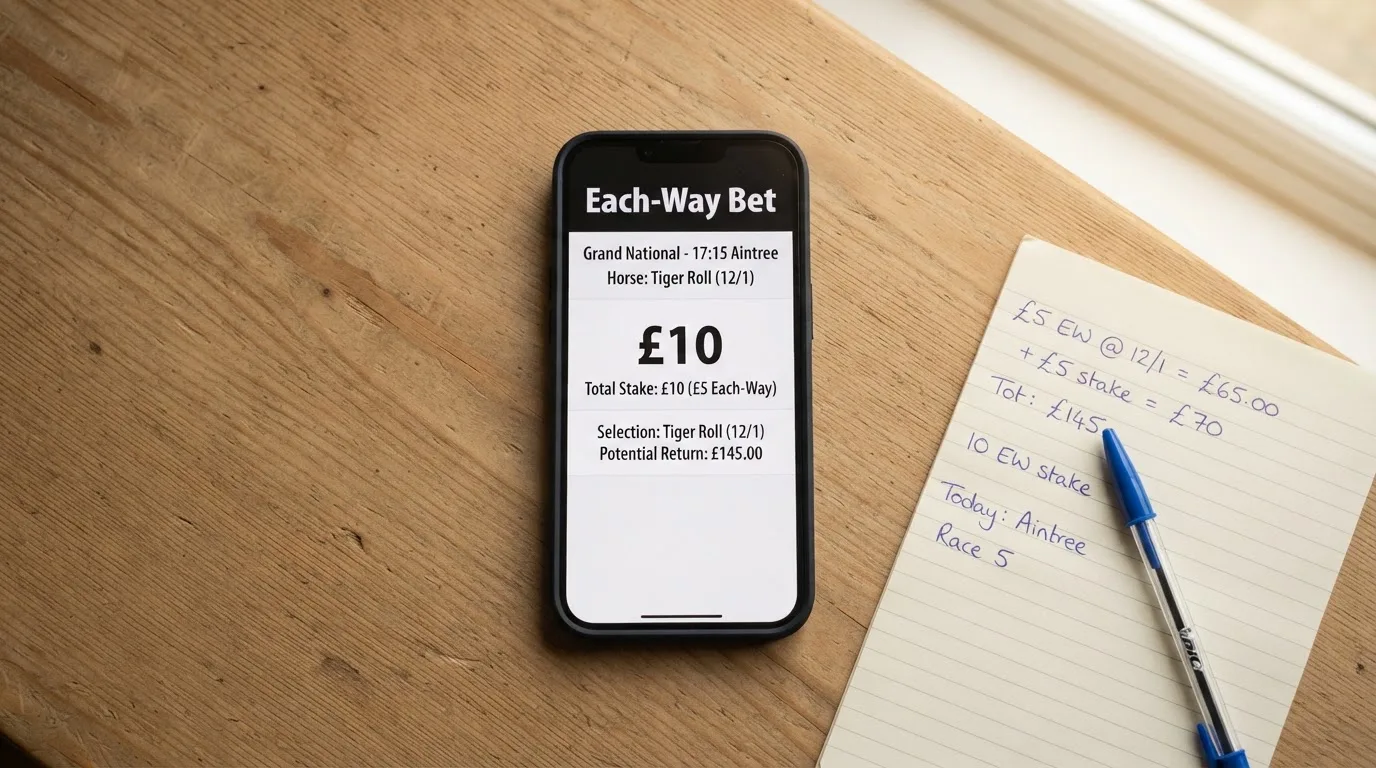
Each-way. An each-way bet is two bets of equal stake: a win bet and a place bet. A £5 each-way bet costs £10. The place bet pays at a fraction of the win odds — 1/4 or 1/5 is typical — on a smaller number of places, depending on the race and the operator’s terms. The place terms for British racing are settled by race type and field size: handicaps with more than 15 runners pay 1/4 odds for 4 places; 12–15 runners pay 1/4 for 3 places; other races with more than 7 runners pay 1/5 for 3 places; 5–7 runners pay 1/4 for 2 places; fewer than 5 runners pay only on a win. A worked example: a £10 each-way bet on a 10-1 horse at 1/4 place terms (3 places) costs £20, returns £110 for the win part and £35 for the place part, £145 in total if it wins. The stake doubles; the payout, when the horse wins, is not double the win payout.
Spread betting, separately. Spread betting on horses is a different product. The bettor buys or sells at a level; the level is the index (finishing position, time, length, beaten-by distance); the stake is multiplied by the difference between the level and the index. Losses can exceed the deposit — that note is a statutory warning on financial-spread betting, regulated by the FCA, and on other spread betting, regulated by the Commission. The store pages for Spreadex and Sporting Index describe both — fixed odds and spread on the same login — and the regulation differs by what is being spread. Read which licence applies to the bet being placed.
Ante-post. An ante-post bet is a bet placed before the final declarations, days or weeks ahead of the race. The price is larger because the field is unsettled, and the bookmaker’s rule is that the stake is lost on a non-runner. BOG does not apply to ante-post, and a Rule 4 deduction may apply if a horse is withdrawn. The honest framing is that ante-post is a higher price for higher risk, and the rule on non-runners is the rule that bites.
Bet builder on a single race. A racing bet builder is, in effect, a same-race accumulator: pick the winner, the placed finish, the margin of victory, perhaps a head-to-head, and the legs are multiplied. Not every operator offers a racing builder — football gets more attention in this respect — and the legs should be checked for correlation before the price is taken.
The margin, written once. The bookmaker’s margin is the share of every pound bet on a market that the bookmaker keeps on average. For a two-way market, payout share is 1 ÷ (1/odds₁ + 1/odds₂); margin is 1 minus that. A 1.90 / 1.90 two-way market has a payout share of 1 ÷ (1/1.90 + 1/1.90) = 1 ÷ (2/1.90) = 0.95 — a 95 % payout share, a 5 % margin. That is the band the calculation below returns. The honest framing of a margin is that it is the cost of the betting, averaged over many bets, and it is invisible on any single slip.
British horse racing: the meetings, the formats, the year
British racing is the daily product underneath every odds board. There is a meeting most afternoons in Britain, often two; there is a major festival almost every month between March and November; the flat season and the jump season do not overlap, and the formats are different.
Flat and jump. Flat racing is run directly between two points around a straight or oval track. Jump racing — steeplechasing and hurdling — is called National Hunt racing in Great Britain and Ireland, run over fences or hurdles at courses from Cheltenham to Aintree. Flat distances range from 440 yards (400 m) to more than four miles (6.4 km); five to twelve furlongs (1.0 to 2.4 km) is the most common. The two codes do not share a season: the flat runs roughly from March to November, the jumps from October to the following April, with summer jumping at the smaller courses.
Handicap and conditions. A handicap is a race in which each horse carries a different weight, assigned by the handicapper based on the horse’s ability — the idea is to bring the field to a level. A conditions race gives horses the same weight with allowances for younger horses and for fillies and mares against colts. Handicaps are the bread-and-butter of British racing; conditions races are where the prizes and the reputations are made.
The Classics and the Crown. The British Classics are the five most prestigious flat races for three-year-olds: the 2000 Guineas and the 1000 Guineas (Newmarket, early May), the Derby and the Oaks (Epsom, early June), and the St Leger (Doncaster, September). The British Triple Crown, for colts and fillies, is the 2000 Guineas, the Derby and the St Leger — three races, three courses, a single horse winning all three across the season. No horse has won the British Triple Crown since Nijinsky in 1970. The Cheltenham Gold Cup, the Grand National and the Champion Hurdle are the equivalent milestones in jump racing.
The handicap route and the festivals. A handicapper’s job is the race-by-race assessment of ability; the betting market’s job is the price on that assessment. The two diverge most on a big-field handicap at a festival, where the prices look long and the market is wide. The Cheltenham Festival in March, the Grand National meeting at Aintree in April, Royal Ascot in June, the Ebor Festival at York in August, the St Leger meeting at Doncaster in September, and the Cheltenham November meeting close the jump season. A bettor who follows a meeting knows the race type (handicap, conditions, listed, group); a bettor who follows a horse knows the trip, the going and the class.
Going and non-runners. Going is the state of the ground — firm, good to firm, good, good to soft, soft, heavy — and is read off the course report on the morning of the race. Non-runners are declared on the morning; the price of every other horse shortens, a Rule 4 deduction may apply to bets already taken, and the each-way terms may change if the field drops below a threshold (a 5–7-runner race paying 1/4 for 2 places becomes win-only below 5 runners). The morning of the race is the morning that settles the slip.
Top 10 UK horse racing bookmakers in 2026
The ten operators below hold a Gambling Commission remote licence for general betting on real events, as recorded on the Commission’s public register at the time of writing. The list is not a ranking and not a recommendation — the regulation is the test of who is licensed, not of who is best. Several brands run under a single licensee, and that licence is the licence under which all of them operate.
The comparison table gathers the licence number, the licensee and what each operator’s own terms state on the key questions for this page — what BOG covers, what the welcome offer is, what the in-play product looks like, what the racing-specific features are.
| Brand | Gambling Commission remote licence | Licence holder | Operator’s terms on the key questions |
|---|---|---|---|
| Tote | 054779-R-331321-008 (account 54779) | TDCO Limited | Pool betting on British racing is the core product; tote.co.uk is the brand’s own domain. |
| BetGoodwin | 002927-R-327985-008 (account 2927) | Goodwin Racing Limited | Sports welcome offer is Bet £10 & Get £15 in Free Bets, made up of a £5 sports bet, a £5 acca and a £5 Sub-Cover bet. |
| Geoff Banks | 054095-R-330366-010 (account 54095) | GB Sports Advisors Limited | App offers live in-play prices and ante-post prices on future events; the publisher is GB Sports Advisors Ltd. |
| VBet | 044662-R-324273-022 (account 44662) | SCGO Limited | Sports welcome offer is a £10 free bet if a new, verified customer stakes £10 or more on a first-ever bet that loses. |
| Sporting Index | 027343-R-308898-011 (account 27343) | Sporting Index Limited | Customers can switch between fixed odds and spread betting; in-play betting, Bet Builder for football, auto cash-out and Multi-Markets are listed in the store description. |
| Kalooki Sportsbook | 057730-R-333396-005 (account 57730) | Kalooki Sportsbook Limited | Operated by Kalooki Sports Book Ltd (company number 12938274), GAMSTOP member; identity verified before the first deposit. |
| LiveScore Bet | 056859-R-332720-005 (account 56859) | LiveScore Betting and Gaming (Gibraltar) Limited | Bet Builder allows up to 10 selections and covers match result, both teams to score, corners, total goals, player scoring and card markets (help-centre description). |
| Dabble | 065677-R-340363-005 (account 65677) | Dabble Sports UK Ltd | Welcome offer is Bet £10, Get £10 in Free Bets on a first deposit for new customers, with minimum odds applying, a 7-day free bet expiry and the stake not returned. |
| 10bet | 043173-R-322899-023 (account 43173) | Blue Star Planet Limited | Sportsbook covers football, tennis and horse racing, with Cash Out, Bet Builder and Live Streaming listed in the store description. |
| Betfred | 039544-R-319290-010 (account 39544) | Petfre (Gibraltar) Limited | Sports, Casino & Games app is published by Done Brothers (Cash Betting) Ltd and covers 21 sports plus over 2,000 casino-style games. |
What the licence means in practice: a remote general betting standard (real events) licence is the licence category under which an operator takes bets on real sporting events online. The categories also include remote general betting standard (virtual events), remote general betting limited, remote pool betting and remote betting intermediary. Pool betting on horse racing is a separate category — Tote is the most visible example — and pool betting on horse or dog racing is a separate licence and duty. The Commission’s register can be searched by business name, trading name, domain or account number, and the entry above is the whole test of who holds the licence.
What the terms above do not say: no operator in this list sets out a complete racing product in its store description. The Bet Builder on LiveScore Bet is described in football terms; the Bet Builder on a racing screen is a different product. The point for a punter is to open the racing tab on the operator’s site and read the markets before relying on the marketing.
Tote
Tote runs pool betting on British racing, which is the legacy product of the Horserace Totalisator Board — the operator’s own history is the marketing. A pool bet is a bet into a pool with other bettors, with the payout determined by the pool’s size and the winning tickets; the takeout is the operator’s share, not a margin in the fixed-odds sense. For racing bettors, Tote is the place where the bettor can bet *with* the pool rather than *against* the bookmaker; the trade-off is the takeout and the dividend uncertainty. The remote betting licence is held by TDCO Limited, account 54779, and the brand’s domain is tote.co.uk.
The verdict: Tote is the pool-betting side of the British racing market, and the comparison above sits inside it. For a reader who wants pool betting specifically, Tote is the licensed route.
BetGoodwin
BetGoodwin’s store page describes the sports welcome offer as Bet £10 & Get £15 in Free Bets, made up of a £5 sports bet, a £5 acca and a £5 Sub-Cover bet — three free bets triggered by one qualifying stake. The licence is held by Goodwin Racing Limited, account 2927, and the brand’s domain is betgoodwin.co.uk. The £15 free-bet stack is mid-sized by the market; the qualifying bet is a single £10 stake at minimum odds; the Sub-Cover component suggests a horse-racing-specific product line.
The verdict: a moderate welcome offer with a racing-shaped twist, and a smaller operator by brand recognition. The Sub-Cover bet is the part to read in the terms before the qualifying stake is placed.
Geoff Banks
Geoff Banks’ app is published by GB Sports Advisors Ltd and offers live in-play prices and ante-post prices on future events, per the store description. The licence is held by GB Sports Advisors Limited, account 54095, and the brand’s domain is Geoff Banks. The Geoff Banks name in the British racing market is a tipster-turned-bookmaker, with a brand built on selections as much as on prices. Ante-post is the racing-relevant feature for a tipster audience — bets taken weeks ahead, with the Rule 4 and non-runner rules applying.
The verdict: a tipster-led bookmaker with ante-post depth, useful for the bettor who wants to take a future-race price. Read the non-runner rule before placing an ante-post stake.
VBet
VBet’s sports welcome offer is a £10 free bet if a new, verified customer stakes £10 or more on a first-ever bet that loses, per the store description. The licence is held by SCGO Limited, account 44662, and the brand’s domain is vbet.co.uk. “Risk-free” in this construction is a refund as a free bet — the original £10 stake is gone if the first bet loses, and the refund cannot be withdrawn as cash. The honest framing is that a losing first bet plus a winning free bet still leaves the bettor £10 down on the original stake.
The verdict: a “risk-free” first bet that is a refund as a free bet. The cost is the original stake’s loss; the upside is the free-bet value at the price taken.
Sporting Index
Sporting Index’s store page describes the product as letting customers switch between fixed odds and spread betting, with in-play betting, Bet Builder for football, auto cash-out and Multi-Markets. The licence is held by Sporting Index Limited, account 27343, and the brand’s domain is Sporting Index. The dual fixed-odds / spread-betting offering is the unique feature here, and the regulatory note is the one in Spreadex’s terms — spread-betting losses can exceed the deposit. The FCA regulates financial spread betting; the Commission regulates other spread betting.
The verdict: a hybrid fixed-odds and spread-betting bookmaker, with auto cash-out on the fixed-odds side. The spread-betting side is a separate product with a separate licence and a separate risk profile — read which applies to the bet being placed.
Kalooki Sportsbook
Kalooki Sportsbook is operated by Kalooki Sports Book Ltd (company number 12938274), licensed by the Gambling Commission under account 57730, and is a GAMSTOP member, per the brand’s homepage. The licence is held by Kalooki Sportsbook Limited, account 57730, and the brand’s domain is kalookisportsbook.co.uk. Identity verification before the first deposit is the rule at every licensed site; Kalooki’s homepage restates it, which is good practice. The brand is a smaller operator by British racing recognition, and the homepage framing is GAMSTOP and verification rather than a racing-specific product.
The verdict: a smaller licensed operator with the full British safety net attached. For a reader who wants the licensing frame and a less crowded racing app, this is the shape of it.
LiveScore Bet
LiveScore Bet’s help page describes its Bet Builder as allowing up to 10 selections and covering match result, both teams to score, corners, total goals, player scoring and card markets — football-shaped features. The licence is held by LiveScore Betting and Gaming (Gibraltar) Limited, account 56859, and the brand’s domain is LiveScore Bet. The Bet Builder, as described, is a football product. LiveScore’s racing product sits in the racing tab and is a separate feature set; the store description does not foreground it.
The verdict: a strong in-play scores product with a Bet Builder built for football, not for racing. A bettor looking for a racing-specific builder will find it under the racing tab, not in the store description.
Dabble
Dabble’s welcome offer is Bet £10, Get £10 in Free Bets on a first deposit for new customers, with minimum odds applying, a 7-day free bet expiry and the stake not returned, per the store description. The licence is held by Dabble Sports UK Ltd, account 65677, and the brand’s domain is dabble.co.uk. The 1:1 free bet on a £10 qualifying deposit is a small offer by headline; the 7-day expiry is tight, and the stake-not-returned note is the standard free-bet value calculation. The expected value of a £10 free bet at typical horse-racing odds (3.00) and a typical racing payout share (0.85) is roughly £10 × (2/3) × 0.85 ≈ £5.67.
The verdict: a small, tight free-bet offer with a 7-day clock. The expected value is modest against the qualifying deposit; the trade is the headline simplicity.
10bet
10bet’s sportsbook covers football, tennis and horse racing, with Cash Out, Bet Builder and Live Streaming listed in the store description. The licence is held by Blue Star Planet Limited, account 43173, and the brand’s domain is 10bet.co.uk. Horse racing is in the listed sports; the rest of the description is feature-led (Cash Out, Bet Builder, Live Streaming) rather than racing-specific. The Live Streaming note is the one that needs a check — what is streamed is the operator’s rights, not the whole racing calendar.
The verdict: a multi-sport bookmaker with horse racing in the catalogue and the standard feature set. The Live Streaming line is the one that benefits from a check before a meeting is followed.
Betfred
Betfred’s Sports, Casino & Games app is published by Done Brothers (Cash Betting) Ltd and covers 21 sports plus over 2,000 casino-style games, per the store description. Petfre (Gibraltar) Limited holds the licence, account 39544, and the brand’s domain is Betfred.com. Betfred is the largest of the British high-street names on this list, with the racing product built around Best Odds Guaranteed and a long-standing on-course presence. The Done Brothers publishing entity sits inside the same Betfred group; the Gambling Commission’s register records the licensee.
The verdict: the biggest name on this list by British high-street recognition, with the standard racing-product feature set and a multi-sport app. For a reader who wants a familiar British name on the licence, Betfred is the shape of it.
How horse racing betting is regulated in Great Britain
The regulatory frame underneath every bookmaker above is the Gambling Act 2005, the Gambling Commission, and the LCCP. This section reads the frame in the order a reader would meet it.
The Commission and the Act. The Gambling Commission is the regulator for commercial gambling in Great Britain, a non-departmental public body sponsored by the Department for Culture, Media and Sport. The framework is the Gambling Act 2005, covering Great Britain (England, Scotland and Wales); Northern Ireland is outside the Act and has its own older law, so a GB licence does not regulate Northern Ireland. The Gambling (Licensing and Advertising) Act 2014 made a Commission licence compulsory at the point of consumption — an operator whose remote facilities are used in Great Britain needs a Commission licence wherever it is based.
The licence categories. Remote general betting standard (real events) is the licence that takes bets on real sporting events online; the list above sits inside it. Other categories are remote general betting standard (virtual events), remote general betting limited, remote pool betting and remote betting intermediary (the licence for betting exchanges). There is no statutory list of permitted sports or markets — what may be bet on is set by each operator’s licence conditions and its own terms.
Identity, age and verification. The minimum age is 18. Since 7 May 2019, a licensed operator must verify name, address and date of birth before a customer can deposit or gamble, including with a free bet or a bonus. No anonymous play at a licensed site. The verification is the rule that pushes readers who want anonymity towards the offshore route; the offshore route is the route that loses every tool in the previous section.
Bonuses and advertising. Wagering requirements on bonuses are capped at 10x, in force since 19 January 2026. Mixed-product promotions — an offer that requires gambling on two or more product types, such as “bet on football to get free spins” — are banned. Advertising is not licensed by the Commission; it runs through the CAP Code (non-broadcast) and the BCAP Code (broadcast), enforced by the ASA, alongside the LCCP marketing conditions. CAP Code section 16: marketing must be socially responsible, must not be of strong appeal to under-18s, and no one who is or seems to be under 25 may be featured gambling or play a significant role (with an exception for marketing placed where a bet can be made directly); that rule is about who appears in the ad, not who may bet. “Whistle-to-whistle” — no betting ads on TV five minutes before to five minutes after a live sporting event, before the 9pm watershed, horse and greyhound racing excluded — is an industry code, in force since 1 August 2019. The Premier League clubs’ withdrawal of gambling sponsorship from the front of matchday shirts (from 2026/27; sleeves and hoardings remain) is voluntary, not law.
Player protection. GAMSTOP, the £150 vulnerability check and the deposit-limit requirement are covered in the responsible-gambling section above. The financial-risk-assessment staged plan (the affordability check) is announced with no start date — write “announced, staged, no start date”, never “in force”. The Commission’s register and the operator’s own complaints process are the routes for a complaint that cannot be resolved with the operator directly.
Tax. The player pays no tax on betting winnings in Great Britain. General Betting Duty is the operator’s tax on gross profits, currently 15%. From 1 April 2027 a new remote betting rate of 25% applies within it, while remote bets on UK horse racing, bets on self-service betting terminals in licensed premises, pool betting and in-person betting stay at 15% (HM Government policy paper of 26 November 2025); spread betting has its own rates (3% financial, 10% other). Until 1 April 2027 the remote rate stays at 15%; whether operators pass duty on through odds is not established, and never write that the player is charged duty. The Commission’s statutory levy is a separate charge, not a tax.
Payments. Credit cards are banned for gambling in Great Britain since 14 April 2020 (LCCP condition 6.1.2), including credit-card-funded payments through an e-wallet. Debit cards and bank-based payments are not covered by the ban. There is no British named-account rule and no state list of permitted payment methods; the payments the operator takes follow the operator’s terms and the AML rules.
Offshore. Section 33 of the Gambling Act 2005 is the offence of providing gambling facilities in Great Britain without the licence the Act requires; the penalty is up to 51 weeks’ imprisonment, a fine up to level 5, or both (six months in Scotland) on summary conviction. No offence aimed at a customer who merely bets on an unlicensed site was found. The honest framing is the loss of protection — no GAMSTOP coverage, no Commission complaints route, no approved dispute-resolution body, no British consumer redress if funds are withheld, not bound by the 10x bonus cap or the £150 vulnerability check. Enforcement is disruption, not blocking — cease-and-desist notices, search-engine referrals, work with registrars, hosts and payment providers — and the Commission has been given, or is about to receive, court-order DNS blocking powers; never write that ISP blocking is in operation. Licensed means checks, limits, GAMSTOP and the bonus cap; unlicensed means none of those and possible loss of funds. Neither is the safe choice by default.
Worked margin: a 1.90 / 1.90 two-way market
The margin a bookmaker keeps is invisible on a single slip and visible across many. The calculation below is the arithmetic that turns a price board into a cost.
For a two-way market at decimal odds 1.90 / 1.90, the payout share is 1 ÷ (1/1.90 + 1/1.90) = 0.95, so the bookmaker’s margin is about 5%. That is a typical margin on a tight horse-racing book before the off. Where a market is wider — a 5.00 favourite and a 50.00 longshot — the margin is larger; the 1.90 / 1.90 is the band a balanced book sits in.
A typical in-running market — between races, after a non-runner — sits nearer 1.50 / 3.00, which is a payout share of 1 ÷ (1/1.50 + 1/3.00) = 1 ÷ (2/3 + 1/3) = 0.75, a 25% margin. The reason is liquidity: the in-running book is small, and the operator keeps a larger share of every pound to cover the price-move risk. The cost to the bettor is the cost of the in-running product, and it sits well above the cost of the pre-off product.
Read on a single slip: a £10 bet at 1.90 returns £19 if it wins (£9 profit). The 5% margin is not £0.50 on the slip; it is the expected cost of the betting averaged over many bets at that margin. The honest framing is that the margin is the operator’s take on the market, not a fee on the slip, and it is the number a sharp bettor compares across operators before the bet is placed.
Frequently asked questions about horse racing betting odds
How does a bet on horse racing work?
A bettor picks a horse, sets a stake, and chooses a market — win, place, or each-way. The bet settles after the race at the SP or at the price taken, depending on the operator’s BOG terms. A win bet pays the stake multiplied by the decimal odds if the horse finishes first; a place bet pays a fraction of the win odds if it finishes in the places; an each-way bet is a win and a place bet at equal stakes, so the stake doubles.
How are horse racing bets worked out?
A single’s return is stake × decimal odds; a double’s return is stake × odds of leg 1 × odds of leg 2; an accumulator’s return compounds the legs. An each-way bet is two bets, so the stake doubles: a £10 each-way stake costs £20 and pays the win part if the horse wins and the place part if it places, at the place terms set by the race type and the field size.
How do betting odds on horse racing work?
British bookmakers quote fractional odds by default (5/1, 11/4, evens) and decimal odds on the slip. Decimal odds are stake ÷ odds, plus 1: 5/1 is 6.00, evens is 2.00. Return is stake × decimal odds; profit is stake × (decimal odds − 1). The shorter the odds, the bigger the implied probability and the smaller the payout per pound staked.
How can it be checked that a bookmaker holds a Gambling Commission licence?
The Commission’s public register can be searched by business name, trading name, domain, or account number. The licence number, the licensee and the categories on the register are the test; the register entry is the whole answer. A GB-licensed brand runs under one of the remote licence categories — general betting standard (real events), general betting standard (virtual events), general betting limited, pool betting, or betting intermediary — and the entry shows which.
How is the return on a bet worked out from the stake and the odds?
For a single bet: return = stake × decimal odds; net profit = stake × (decimal odds − 1). For a combination bet (a double, an accumulator), the odds of the legs multiply into one price and the formula applies once: return = stake × (odds of leg 1 × odds of leg 2 × …). For an each-way bet, the formula applies twice — once for the win part at the win odds, once for the place part at the place fraction.
What is the bookmaker’s margin and how can it be seen in the odds?
The margin is the share of every pound bet on a market that the bookmaker keeps on average. For a two-way market it is 1 minus 1 ÷ (1/odds₁ + 1/odds₂); a 1.90 / 1.90 market has a margin of about 5%. A 1.50 / 3.00 market has a margin of about 25%. The margin is not a fee on the slip — it is the cost of the betting averaged over many bets at that margin, and it is the comparison that matters when two bookmakers’ prices sit side by side.
Horse racing & greyhounds – UK betting
Content created by the «UK betting» team
