
Hurling betting odds for the 2026 season — choice, price and where each bookmaker sits
 Available in US
Data current as of 27 October 2026, cross-checked against the Gambling Commission’s public register of remote betting licence holders.

A licensed bookmaker takes its cut of every market before the first bet is struck, and the odds the punter sees on a Limerick–Galway final are built on top of that margin whether the match is a dead rubber or a championship decider. Hurling sits in a small corner of the British sportsbook — Gaelic games are not on every site, and where they are, the menu runs thinner than it does for football — but the operators that carry it price to a recognisable template. The question for anyone considering a wager is which bookmaker, which market and at what cost. This guide walks through the markets the All-Ireland Senior Hurling Championship brings, the sites that hold a Gambling Commission remote licence to take bets on it, and the arithmetic that sits underneath every price.
The All-Ireland Senior Hurling Championship is the blue riband of the GAA calendar, and 2026 was the year Limerick faced Galway in the final at Croke Park on 19 July. That fixture sits behind the prices a licensed bookmaker publishes, and so does the structure of the championship that produced it: Leinster and Munster run round-robin groups with six and five teams respectively, the top two in each go to a provincial final and the third side drops into the All-Ireland quarter-finals. Round-robin fixtures are the meat of the early-season book, because three teams in a group of five meet twice and the matches that matter come thick. By the time a final is set, the market narrows to the outright winner, the handicap line and a handful of in-play prices.
How bookmakers price a hurling match
A bookmaker does not gamble on hurling. It compiles a market — a 1X2 on the match, a handicap line, a total — and prices every outcome at decimal odds shorter than the “true” probability of that outcome. The shortfall between what the bettor would receive if every outcome paid at its true probability and what the bookmaker actually offers is the margin, also called the overround. A two-way market priced at decimal odds 1.90 / 1.90 — the figure the calculation in this guide works through — gives a payout share of 1 ÷ (1/1.90 + 1/1.90) = 1.0526, which rounds to 105.3 %, an overround of about 5.3 %, and a margin of 5.0 %. On a market where every outcome pays 5.3 % more than a fair price, a £100 stake returns £95 in expectation across the book. That is what the margin costs over a long run of bets on this market. It is built into the odds the punter sees, and it never advertises itself.
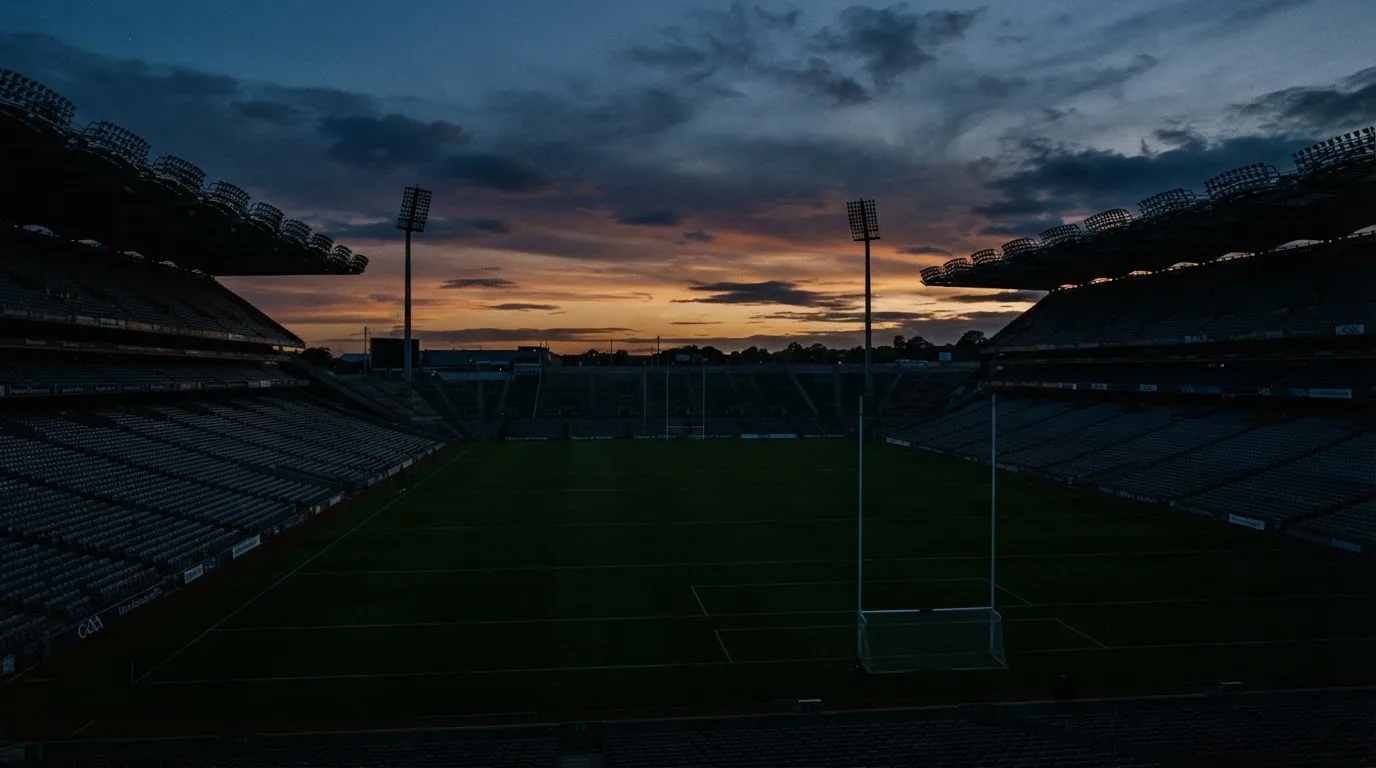
Hurling’s scoring system sits behind the second layer of the price. A goal — the ball struck into the net below the crossbar — counts for three points. A point — the ball sent over the crossbar between the uprights — counts for one. So a team that scores two goals and fifteen points has 2 × 3 + 15 = 21 points on the board. The total-points market a bookmaker sets runs in steps that match hurling’s natural scoring bands. A senior inter-county match lasts 70 minutes in two halves of 35, plus stoppage. Bets settle on the official result at the end of normal time including injury time; extra time is excluded unless the bookmaker’s rules state otherwise. A reader who treats a final as 70-plus minutes of straight play is on solid ground; a reader who assumes extra time counts is not.
The price a bookmaker publishes on any hurling match reflects three things: the assessed probability of each outcome, the margin it wants to keep, and the weight of money already taken on either side. Where the money lies heavily on one side the price shortens; where the book is exposed it lengthens. On a quiet round-robin fixture in a Leinster group with no provincial consequence, the book is thin and the margin is wider. On the All-Ireland final the book is deep and the margin compresses, but it never disappears.
The 2026 final itself is fixed history now — Limerick beat Galway, the championship ended on 19 July at Croke Park — and the outright winner market settled then. Outright prices on the next championship, the Munster and Leinster championships that precede it, and the Joe McDonagh and Christy Ring cups that run alongside, are the live book throughout the winter and spring. Tipperary won the 2025 All-Ireland, the year before Limerick’s win. The previous winner sets a benchmark for the early outright market, but the outright market does not survive the first round-robin weekend in May; prices move with injuries, form and the Munster and Leinster championships that act as qualifiers.
Markets a GB bookmaker runs on hurling
The menu at most GB-licensed bookmakers divides into three layers. The first is the match market: 1X2 (home win, draw, away win — hurling draws are possible in the group stage but not in a knock-out championship game, where extra time is played), handicap, total points and team totals. The second is the outright market: winner of the All-Ireland, winner of Munster, winner of Leinster, top scorer, top scorer in the final, sometimes the Joe McDonagh Cup and the Christy Ring Cup. The third is the in-play market: next team to score, next scoring play, method of next score (goal, point, wide, sixty-five converted), player markets and a running total-points line that updates throughout the match.

A match market on a round-robin fixture may carry 30 to 50 selections. A bookmaker with a thin Gaelic offering may carry the 1X2, the handicap and the total, with no team totals or method-of-next-score market. A bookmaker with a deep offering carries the whole menu, and the prices on team totals move faster than the 1X2 because money on team totals is less liquid. The reader who wants a bet on Kilkenny to score over 18.3 points at a particular price needs to find a bookmaker that publishes that market at all, and the price they find may differ by ten per cent from one bookmaker to the next.
A bet builder, sometimes sold as a same-game multi, lets the punter combine markets from one match into a single price. Galway to win, over 21.5 total points, and Conor Whelan to score over 0.5 goals become one bet at a multiplied price. The price multiplies because the leg prices multiply, and the margin on the multiplied product is the compounded margin of each leg. A bet builder on a hurling match typically carries a heavier margin than the 1X2 because the legs are correlated and the bookmaker is taking on a position that is harder to lay off. A punter who builds a same-game acca on a final should treat the multiplied price as a compounded margin, not as a free ride.
Each-way betting, the British habit of splitting a stake into a win portion and a place portion, applies to outright winner markets on the All-Ireland and the provincial championships. The place terms vary by bookmaker and by field size: a place on a six-team outright at a quarter of the odds is more generous than a place on a four-team outright at a third. Each-way doubles the stake — a £10 each-way bet costs £20 — and the place portion pays out whether the selection wins or finishes in the placed positions. On outright markets with no stated place terms, each-way is not available and the bet is win-only.
The fixture list a GB punter actually wagers on
The 2026 championship has already run its course, so the live book for the rest of the calendar year runs on the club championship and the inter-county pre-season competitions that begin in early 2026. The All-Ireland Senior Hurling Championship proper opens in May with the Munster and Leinster round-robin groups. A reader planning to back Kilkenny outright in 2026 should think about three things: the provincial round-robin in which Kilkenny plays, the Leinster final, and the All-Ireland series that follows. Each leg has its own book, and the outright market opens the whole sequence into one price.
The Joe McDonagh Cup, the Christy Ring Cup and the Nicky Rackard Cup run alongside the Liam MacCarthy Cup at lower tiers of senior inter-county hurling, and most GB-licensed bookmakers leave them out. The All-Ireland Intermediate Hurling Championship and the All-Ireland Junior Hurling Championship run further down. Where a bookmaker publishes prices on these, the menu is short — usually 1X2 and total — and the margin wider, because the betting interest is much smaller. A reader looking for value at long prices on a Joe McDonagh Cup tie should expect the market to be thin and the bookmaker’s margin wider than on a Munster round-robin game.
Club hurling runs from October through March, the AIB All-Ireland Senior Club Hurling Championship being the competition the GB bookmaker carries in March. The 2026 final has been played. For the 2026/27 club season — running from late 2026 into the spring — the outright market is open through the autumn and narrows as the county championships finish. Ballyhale Shamrocks, Na Fianna, Sarsfields and the other senior clubs form the shortlist a bookmaker publishes, and the early book is set by the form those clubs showed in the previous season.
Each GB bookmaker sets its own list of markets and carries hurling through to its own depth. The reader who wants team totals, method of next score, player markets and a deep outright book will not find all four at one site. A 1X2, a handicap and a total is the minimum.
How ten GB-licensed bookmakers compare for hurling
The comparison below covers ten bookmakers that hold a Gambling Commission remote licence and publish hurling markets. Each card states the Commission’s remote licence number and the licence holder named on the register, then what the operator’s own terms say about the matter the guide turns on — hurling coverage, market depth, the welcome offer or the trading style. A bookmaker that holds a remote general betting standard (real events) licence may publish markets under the conditions of its licence and its own terms; a betting intermediary (Smarkets) runs an exchange rather than a traditional book. The exchange sets its own rules and the trade is between customers rather than against the house.
| Brand | Licence (account / holder) | What the operator’s terms say on hurling |
|---|---|---|
| Hollywoodbets | 53028 — Hollywoodbets International UK Limited | Sports welcome on the first qualifying losing accumulator (stake £10+, 3+ legs, odds 4/1 or greater, settled within 7 days): stake returned as a free bet up to £30, one per customer |
| Smarkets | 39173 — Smarkets (Malta) Limited | Betting intermediary: open bank transfer deposits instant from £10 to £10,000; withdrawals processed within 6 hours from £10 to £100,000; debit card deposits instant from £10 to £15,000 |
| Bar One Racing | 56516 — Bar-One Racing Limited | Irish independent bookmaker trading as BAR 1 Betting; shop presence across Ireland with racing sponsorships at Dundalk, Fairyhouse, Navan, The Curragh, Curraheen Park and Cork |
| London Bet | 66162 — Thistle Bet Limited | App combines sports betting (football, tennis, horse racing, greyhounds, darts, golf, cricket, NFL, NBA, MLB, snooker) with Pragmatic Play casino slots and live in-play |
| Swifty Sports | 58957 — Swifty Global (UK) Ltd | Best Odds Guaranteed, Cash Out on horse racing and football markets, daily price boosts, live streaming, in-play betting; Bet Builder listed as coming soon |
| Spreadex | 8835 — Spreadex Limited | Combines fixed-odds and spread betting in one app; FCA-regulated for spreads, Gambling Commission for fixed odds; spread losses can exceed deposits; one-click, auto and partial cash out; Bet Builder across fixed odds and spreads; live streaming of UK and Irish racing, greyhounds, tennis, NFL and selected football |
| Sporting Index | 27343 — Sporting Index Limited | Switches between fixed odds and spread betting; in-play betting, Bet Builder for football, auto cash-out, Multi-Markets |
| BetMGM | 39198 — LeoVegas Gaming PLC | Sports welcome for new UK customers who deposit £10 or more and place a sports bet within 7 days: four £10 free bets (two football accas of 4+ selections and two sports multiples of 2+), valid 7 days, minimum odds apply, opt-in required |
| DragonBet | 64908 — DragonBet Ltd | Welsh football and rugby markets as the centre of the menu, racing, American football, in-play betting, bet builder markets |
| Fitzwilliam Sports | 48760 — SBKI Limited | Dublin bookmaker with capped membership; “High Stakes Welcome” subject to compliance criteria; instant deposits, fast withdrawals, timeouts and deposit limits; links to GambleAware, GamStop and Gamblers Anonymous |
Hollywoodbets is a fit for the punter whose first wager on hurling is an outright winner or a Saturday accumulator on a round-robin weekend and who wants a refund path if the acca loses. The 7-day settlement window is short and the 4/1 minimum odds on the qualifying bet filter out low-priced singles, so the offer rewards a particular kind of stake rather than every one. The trade-off sits in the qualifier: a £10 single at evens does not qualify; a £10 treble at 9/2 does.
Smarkets is an exchange, which is a different shape from the rest of this list. The punt is against other customers at the price the market clears, the commission is on net winnings rather than baked into the margin on every bet, and the open bank transfer withdrawal window runs to six hours. A hurling market on an exchange tends to be shallower than on a traditional book, because the money sits on football and horse racing. A reader who values the price on a Munster round-robin game more than the menu should weigh the exchange first.
Bar One Racing, now trading as BAR 1 Betting, sits close to the Irish shop circuit — Dundalk, Fairyhouse, Navan, The Curragh, Curraheen Park and Cork — and the GB-facing online product mirrors that horse-racing orientation. Hurling markets on a shop-rooted Irish bookmaker may run more deeply on the bigger All-Ireland rounds and the Munster championship than on a round-robin group game in April. The customer the brand fits is one whose betting is split between horse racing and the bigger hurling fixtures of the summer.
London Bet carries a wide sports menu — football, tennis, horse racing, greyhounds, darts, golf, cricket, NFL, NBA, MLB and snooker — alongside a Pragmatic Play casino. A hurling offering sits inside that menu rather than at the heart of it, and the book on a round-robin game may be thinner than at a hurling-led bookmaker. The fit is the punter who keeps hurling on a wider slip rather than betting on it as a standalone sport.
Swifty Sports is in the middle of the pack on menu depth: Best Odds Guaranteed, Cash Out on racing and football, daily price boosts, live streaming, in-play and a Bet Builder that is still to launch. A punter who reads the price-boost listing carefully should remember that boosted odds are usually capped at a maximum stake and the maximum win is constrained by the cap, not by the published price. The Bet Builder slot is the gap on a hurling punter’s slip until it opens.
Spreadex sits in a category of its own. The app combines fixed-odds betting and spread betting in one account, which is unusual among GB-licensed bookmakers. The fixed-odds book is the more familiar shape and trades under a Gambling Commission licence; the spread book trades under FCA regulation, and spread losses can exceed deposits. A reader who backs a hurling outcome as a spread sees a different price shape — a tighter bid-offer on a popular match, a wider quote on a thin one — and the cost of being wrong is the full spread loss, not the fixed-odds stake.
Sporting Index carries the same fixed-odds / spread split as Spreadex and adds auto cash-out, Multi-Markets and an in-play book. The fit is similar to Spreadex: a punter who wants both modes under one roof and reads the spread side as a separate product. A hurling outright market may sit on the fixed-odds side only, with the spread book concentrating on football and horse racing.
BetMGM’s welcome offer rewards an early acca rather than a single bet. Four £10 free bets land after the qualifying wager — two for football accas of four or more legs, two for any-sport multiples of two or more — and the free bets expire in seven days. The minimum odds the qualifying wager sits at filter the offer toward a particular stake shape. A hurling-only punter who places the qualifying wager on a hurling single rather than an acca will not unlock the football-acca free bets, and the seven-day window forces the free bets to be used quickly.
DragonBet centres on Welsh football and rugby, with racing, American football and bet builder markets around that core. A hurling market sits in the wider menu, and the depth on an All-Ireland round-robin fixture may not match a hurling-led bookmaker. The fit is the Welsh punter who wants hurling on a slip alongside the sports the brand already serves, rather than as a standalone interest.
Fitzwilliam Sports is a Dublin bookmaker with capped membership and a High Stakes Welcome gated by compliance criteria. The cap on membership is the unusual feature on this list — the book is not open to every applicant, and the criteria for opening an account are not the standard affordability-check shape. The instant deposits, fast withdrawals, timeouts and deposit limits sit alongside links to GambleAware, GamStop and Gamblers Anonymous. The fit is the punter who qualifies under the brand’s membership criteria and wants a Dublin-rooted book with a clear safer-gambling footprint.
The bookmaker’s licence and what it actually covers
Every brand on the comparison list holds a Gambling Commission remote licence for Great Britain, and the Commission’s public register is the only test of who holds one. An open quote from a Curaçao, Maltese or Gibraltar licence is not a substitute; since the Gambling (Licensing and Advertising) Act 2014, an operator whose remote facilities are used in Great Britain needs a Commission licence wherever the operator itself is based. The Commission licences the whole commercial market under the Gambling Act 2005, which covers Great Britain (England, Scotland and Wales); Northern Ireland is outside the Act and sits under its own older law, so a “GB licence” regulates English, Scottish and Welsh customers, not Northern Irish ones.
The licence categories that matter for a hurling punter are remote general betting standard (real events) — the licence most of this list holds — and remote betting intermediary, the exchange licence held by Smarkets. Remote general betting standard (virtual events) is a separate category for virtual fixtures; pool betting is its own licence; the financial spread side of Spreadex and Sporting Index is regulated by the Financial Conduct Authority rather than the Commission. A spread bet is a different product from a fixed-odds bet and the rules settle differently. Where a brand sits across two regulators the punter is dealing with two products, not one with two licences.
Licensed operators run name, address and date-of-birth verification before the first deposit or wager — including with a free bet or a bonus — so anonymous play is not available at any licensed site. Licensed operators take part in GAMSTOP, the national multi-operator self-exclusion scheme, and any punter registered with GAMSTOP is excluded from every GB-licensed online bookmaker for the chosen period and for a further seven years after the minimum period unless removal is requested. The minimum age for betting is 18.
A credit card cannot fund gambling at a GB-licensed operator — the ban has been in force since 14 April 2020 and includes credit-card-funded payments through an e-wallet. Debit cards and bank-based payments are not covered by that ban. Identity verification before the first deposit means source-of-funds questions at higher spend are part of the normal operation of the account.
Player protection at a GB-licensed bookmaker
The safer-gambling controls the reader uses at a GB-licensed bookmaker come in three layers: the national scheme, the operator’s own tools and the Commission’s licence conditions. GAMSTOP is the national layer — six months, one year, five years or five years with auto-renewal — and a registered punter is excluded across the GB-licensed online market, not only at the brand they joined through. The Commission’s licence conditions set the floor on what the operator must offer: timeouts, deposit limits, self-exclusion at the operator level, reality checks and access to information about the help services — GamCare, the National Gambling Helpline, GambleAware, NHS gambling clinics and Gamblers Anonymous.
A financial vulnerability check, in force since 30 August 2024 under LCCP condition 3.4.4 and applied to remote betting since 28 February 2025, is a public-record check — bankruptcy and county court judgments, for instance — that runs when a customer’s deposits minus withdrawals exceed £150 in a rolling 30 days. It is not an income check and not a credit reference check. Financial risk assessments — the affordability checks of the press — have been announced in a staged plan, and the Commission’s article of 7 July 2026 sets out the phasing but no start date. The shape is announced, staged, with no live date.
Deposit limits fall under RTS 12 of the Remote Technical Standards: the operator must offer a gross deposit limit on a fixed time frame. The first changes applied from 31 October 2025; a second phase has been postponed to 30 September 2026. Whether that second phase is live is not established. There is no state-set ceiling on deposits or losses in sports betting; the limit is the customer’s own choice, set inside the operator’s interface and enforced by the operator.
A reader who finds that the controls at any one operator are not enough can register with GAMSTOP and is excluded across the GB-licensed online market. A reader who bets at an unlicensed site has none of these protections: no GAMSTOP coverage, no Commission complaints route, no approved dispute-resolution body, no British consumer redress if funds are withheld, no 10x bonus cap and no £150 vulnerability-check trigger. The Commission does not prosecute the customer who places a bet on an unlicensed site; the operator is the target of enforcement, and enforcement works through cease-and-desist notices, search-engine referrals, registrars, hosts and payment providers, with court-order DNS blocking powers in prospect.
Bonuses and the actual cost of a free bet
A “free bet” is not free in the everyday sense: the bookmaker credits the punter with a stake of, say, £10, and a winning bet pays the winnings — stake × (odds − 1) — rather than the winnings plus the stake. A £10 free bet at decimal odds 4.00 wins £30; a £10 cash stake at the same price wins £40. The free bet returns the winnings only, the cash bet returns winnings plus stake. That is the shape of every free bet in the comparison above unless the operator states otherwise.
The promotional rules in force at GB-licensed bookmakers since 19 January 2026 cap wagering requirements on bonuses at 10x. A £10 bonus at 50x wagering used to require £500 of qualifying bets; under the cap no bonus can demand more than £100 of qualifying bets per £10 of bonus. Mixed-product promotions — an offer that requires gambling on two or more product types such as betting, casino, bingo and lottery, the “bet on football to get free spins” shape — are banned. Whether the cap applies to free bets with no wagering condition, and whether there is a cap on the money value of a bonus, are not established; the operator’s own terms settle those questions.
A welcome offer looks generous on the headline but costs more in turnover than the headline suggests. Hollywoodbets’ sports welcome on the first qualifying losing accumulator pays the stake back as a free bet of up to £30 if the acca loses — stake £10 or more, three or more legs, odds 4/1 or greater, settled within seven days, one free bet per customer. The qualifier filters the offer toward a particular stake shape: a single bet at evens does not qualify, a treble at 9/2 does. The free bet returned is up to £30, so a punter who stakes £10 on a treble at 9/2 and loses gets £10 back, and a punter who stakes £30 on a treble at 9/2 and loses gets £30 back. The punter who wins does not get the free bet at all, because the free bet is paid on a losing qualifier. A reader who reads the offer as “free £30 if I lose” has read half of it.
BetMGM’s sports welcome rewards a winning one. A new customer who deposits £10 or more and places a sports bet within seven days receives four £10 free bets — two football accas of four or more selections and two any-sport multiples of two or more — valid for seven days. The minimum odds the qualifying bet sits at filter toward the same shape as Hollywoodbets’. The free bets, if won, pay winnings only; the stake on each free bet is not returned. A punter who uses one of the four £10 free bets on a football acca at 10.00 and wins gets £100, not £110.
The real cost of any offer sits in three numbers: the wagering requirement, the minimum odds and the deadline. A reader who signs up for a bonus and treats the headline as the whole picture has misread the small print, and the small print is what determines whether the bonus pays anything at all.
Live betting and cash out on hurling
In-play betting on hurling runs at every GB-licensed bookmaker that carries the sport at all, and the menu inside the live product is shorter than the pre-match menu. The 1X2 stays in play throughout. The handicap moves with the score. The total points line moves with the score. Method of next score — goal, point, wide, sixty-five — is the live market a bookmaker with a deep offering carries. Player markets — next player to score, player to score over 0.5 goals — come and go with the live price feed.
The cash out feature settles a bet before the event is over, at a price the bookmaker sets in real time. A punter who has backed Galway at 2.20 before the match can cash out at 1.90 mid-way through the second half, locking in a smaller profit or a smaller loss than waiting for the final whistle. One-click, auto and partial cash out are three flavours the bookmaker may offer: one-click settles the bet at the live price, auto settles when a pre-set trigger is hit, and partial cashes out a proportion of the stake and leaves the rest to run. Swifty Sports offers Cash Out on horse racing and football markets, and the same feature on hurling matches where the bookmaker runs an in-play book. Spreadex offers one-click, auto and partial cash out across fixed odds and spreads. Sporting Index adds auto cash-out. The reader who values certainty on a bet that is winning but not yet settled should weigh a brand with auto cash-out against one without.
Live streaming changes the calculation on a cash out. A punter watching the match on a stream can read the game in a way a punter without a stream cannot, and the price on a cash out moves faster on the streamed book than on the unstreamed one. Spreadex streams UK and Irish horse racing, greyhounds, tennis, NFL and selected football; the hurling streaming list is short and most brands do not include it. Swifty Sports lists live streaming in its feature set without naming the sports covered. A reader who wants to watch the match while betting should check the operator’s streaming page before the off, because the streamed book is not the same shape as the unstreamed one.
Bet Builder in-play is the deeper version of the same product. bet365 runs Bet Builder+ across markets from one event pre-match and in-play, with Super Boosts and Winnings Boosts on bet builders and selected singles. The other bookmakers on the comparison list vary: Spreadex runs a Bet Builder across fixed odds and spreads, Sporting Index runs one for football, DragonBet carries bet builder markets, Swifty Sports lists Bet Builder as coming soon. A punter who builds a same-game multi in-play is taking on a multiplied price and a compounded margin, and the brand’s coverage of in-play bet builder markets is the test of whether that product is available at all.
The margin behind the price
The bookmaker’s margin is built into every price on every market, and the size of it depends on the market and the liquidity of the book. A two-way match market — Galway to win, draw, Limerick to win — at decimal odds of 1.90 / 3.50 / 4.50 gives a payout share of 1 ÷ (1/1.90 + 1/3.50 + 1/4.50) = 1 ÷ (0.5263 + 0.2857 + 0.2222) = 1 ÷ 1.0342 = 0.9670, which rounds to 96.7 %, a margin of about 3.3 %. The same market priced at 1.80 / 3.40 / 4.20 produces 1 ÷ (0.5556 + 0.2941 + 0.2381) = 1 ÷ 1.0878 = 0.9193, a margin of about 8.1 %. The difference between 3.3 % and 8.1 % is the difference between a book that has been priced with one eye on the competition and a book that has been priced to take more.
A round-robin fixture in the Leinster championship in April carries a wider margin than the All-Ireland final in July. The All-Ireland final is a deep book, the money sits on both sides, and the price moves tighter. A round-robin game in a six-team group, where the market is thin and the betting interest is local, is a wider book and the margin sits at the upper end of what the bookmaker is willing to publish. The reader is presented with the same match-result market, but the price on a quiet fixture costs more in margin than the price on a noisy one.
The illustration below is an example, not a quoted price. A two-way market at decimal odds 1.90 / 1.90 — 9/10 in fractional odds — has a payout share of about 95.0 % and a margin of 5.0 % across the two outcomes. For every £100 staked on the market in aggregate, the bookmaker expects to retain about £5.00 in the long run. The margin is the same whether the stake lands on one outcome or the other; what changes is which side of the book the money sits on. The exact figure depends on the event, the bookmaker and the moment the bet is struck; a brand that holds a thinner book on hurling will sit at the wider end of that range, and a brand that has a deeper book on the All-Ireland final will sit at the tighter end. The cost of every bet on the market is the margin times the stake, and the cost of a season of betting on hurling is the margin times the turnover.
Frequently asked questions
How can I check that a bookmaker holds a Gambling Commission licence?
Search the Commission’s public register by business name, trading name, domain or account number. The register lists the licence holder, the licence number, the licence categories and the licence status. The Commission’s website is the only authoritative source for the test; a brand page that asserts “Gambling Commission licensed” is a statement from the brand, not a verification. The licence categories that cover a GB-licensed bookmaker offering bets on real sporting events are remote general betting standard (real events) and remote betting intermediary (the exchange licence). A GB licence regulates English, Scottish and Welsh customers only — Northern Ireland sits under its own law.
How is the return on a bet worked out from the stake and the odds?
For a single bet, the return is stake × odds and the net profit is stake × (odds − 1). A £10 bet at decimal odds 3.50 returns £35 and yields £25 in profit; the same bet at fractional odds 5/2 returns £35 on a £10 stake and yields £25 in profit. For an accumulator, the leg odds multiply into one price and the calculation is stake × (odds₁ × odds₂ × …). The bookmaker’s margin sits inside each leg’s odds, so the multiplied margin is the compounded margin of the legs and is heavier than the margin on any single leg.
What is the bookmaker’s margin and how can I see it in the odds?
The margin is the share of every unit staked the bookmaker keeps on average across a market. It is calculated as 1 minus the payout share, where the payout share is 1 ÷ (1/odds₁ + 1/odds₂ + …) summed across every outcome of one market. A two-way market priced at decimal odds 1.90 / 1.90 has a payout share of about 95.0 % and a margin of 5.0 %. The margin is not stated on the betting slip; it is read off the prices by the calculation above. Markets with low liquidity and a wide book carry a heavier margin than markets with deep liquidity and a tight book, so the same sport carries different margins at different prices.
How do fractional odds such as 5/1 convert to decimal odds such as 6.00?
The formula is a ÷ b + 1, where a/b is the fractional form. Fractional odds 5/1 become 5 ÷ 1 + 1 = 6.00; fractional odds 9/10 become 9 ÷ 10 + 1 = 1.90. The decimal odds include the stake in the return; the fractional form states the profit only. “Odds-on” describes fractional odds shorter than evens — 4/6 is odds-on, 6/4 is odds-against. The bookmaker’s terms state the odds in one form or both; a reader who understands both forms can compare prices across the bookmaker’s slip and against the exchange.
What tools for controlling play does a licensed bookmaker have to offer?
A licensed bookmaker must offer deposit limits, timeouts, self-exclusion at the operator level and reality checks, with access to information about the help services — GamCare, the National Gambling Helpline, GambleAware, NHS gambling clinics and Gamblers Anonymous. GAMSTOP is the national multi-operator self-exclusion scheme and a registered punter is excluded across every GB-licensed online bookmaker for the chosen period. A financial vulnerability check triggers at £150 of net deposits in a rolling 30 days and is a public-record check rather than an income check. A reader who needs more than the operator’s own controls can register with GAMSTOP and is excluded across the GB-licensed online market, not only at the brand where they joined.
Are betting winnings taxed in Great Britain, and who pays General Betting Duty?
Betting winnings are not taxed at the player’s level in Great Britain. General Betting Duty is the operator’s tax on gross profits and is currently 15 %; from 1 April 2027 a new remote betting rate of 25 % applies within it, while remote bets on UK horse racing, bets on self-service betting terminals in licensed premises, pool betting and in-person betting stay at 15 %. The duty is the operator’s cost of doing business; whether an operator passes it on through tighter odds is not established. The Commission’s statutory levy is a separate charge, not a tax, and a professional gambler should ask HMRC or an adviser rather than rely on general information.
Rugby, cricket & Gaelic – UK betting
Content created by the «UK betting» team
