
Where to Bet on Snooker Online in 2026: A UK Guide to Sites, Markets and Real Costs
 Available in US
Snooker rewards patience. The frames move slowly, the breaks build, and a single visit can change a session — which is why the betting around the sport works the way it does. The choices a UK punter faces in 2026 include: where to bet, which bonus is worth the wagering it carries, how in-play markets are priced, what crypto-friendly and non-GAMSTOP routes really offer, and how to read the margin baked into every set of odds.
The data below is current as of 27 October 2026 and was checked against the Gambling Commission’s public register of remote operating licences.
Crypto, Pseudonymous Wallets and the Question of Anonymity
Crypto deposits land somewhere different in a UK punter’s calculation than they do in a casino player’s. Snooker is a thin market with long tournaments, so a wallet that settles quickly and does not need a UK debit card has obvious appeal. The question is what crypto at a snooker book actually buys you, and what it costs.
What “crypto” means on a snooker betting site
Three things can be meant by a “crypto snooker betting site,” and they are not the same. A bookmaker that takes Bitcoin and Ethereum as a deposit method but settles back to pounds sterling is a pound account with a crypto front end: the price on Ronnie O’Sullivan to win the UK Championship is built the same way, the margin is taken the same way, and the licence conditions are the same. A bookmaker that lets the punter hold a Bitcoin or Tether balance between bets is closer to a betting exchange, and the bet is placed and settled in crypto. A bookmaker licensed nowhere in Great Britain may accept only crypto, which means the funds never touch a UK bank at all.
The first two are GB-licensed, identity-check the punter before the first deposit under the Commission’s rules, and report a licence number against the brand on the public register. The third is the route the press calls “non-GAMSTOP,” and it is treated separately in the legality section below. The distinction is not academic: a crypto deposit that is converted at the cashier is a payment-method question, while a crypto balance is a regulatory question.
What the punter trades for that route
Crypto at a licensed bookmaker gives faster settlement, sometimes near-instant withdrawals, and no name on the bank statement. It does not give anonymity. Name, address and date of birth are verified before the first deposit by every operator on the Commission’s public register, and the verification extends to free bets and bonuses. A crypto-funded account is verified the same way a debit-card account is. What it gives is a thinner paper trail at the bank, which is its own kind of privacy and nothing more.
The licensed bookmakers listed below all support standard UK payment rails. Whether a given brand also accepts Bitcoin, Ethereum or stablecoins at the cashier is a question the punter answers on the brand’s own payments page, because the answer changes when a partner processor is added or dropped.
Crypto, the margin, and the long tournament
Snooker tournaments run for weeks. A punt at the start of the World Championship sits on a wallet for a month, and an outright bet on a ranking event may not settle until the final in May. Crypto’s quiet advantage in a market like this is that the punter is not earning or paying overnight funding on a pounds balance, and the cashier is not batching withdrawals to a bank cut-off. The disadvantage is conversion spread: turning pounds into Tether and back again, twice a year, is not free. The punter who keeps a single fiat balance pays no conversion at all.
Bonuses, Free Bets and What They Cost the Punter Who Claims Them
The press writes “free bet” the way a casino writes “bonus,” which is to say loosely. The arithmetic is fixed, and on snooker the arithmetic is unforgiving because the sport’s best-known markets — match outright, frame handicap, total frames — carry a healthy margin to start with.
The shape of a snooker welcome offer
A snooker welcome offer at a GB-licensed bookmaker in 2026 takes one of a few forms. A “bet £10, get £30 in free bets” promotion pays the punter a fixed value in bet credits, settled as one or more free bets after the qualifying bet settles. A deposit-match bonus credits the punter’s account with extra cash, which is then subject to a wagering requirement before it can be withdrawn. A boosted-odds offer lifts the price on a named outright — usually the World Snooker Championship or the UK Championship — for new customers only, with the stake paid back in cash and the winnings paid in cash. Enhanced-odds and acca-insurance offers sit on top of the welcome package, sometimes on the same event.
What the offer does not state is what it costs to clear. The 10x wagering cap in force on bonuses since 19 January 2026 (HM Government policy paper, Gambling Commission enforcement) means a £10 bonus now needs at most £100 of qualifying bets before the winnings are withdrawable; a £50 bonus needs at most £500. The cap is on wagering requirements, not on the value of the bonus itself, so a £200 bonus at 10x is £2,000 of betting. The cap is also not in force on free bets with no wagering condition — only on bonuses that hold the punter’s money hostage to a turnover.
The two numbers to compare
Every snooker bonus has two numbers. The first is the headline value, the £30 or the “100% match” the marketing leads with. The second is the effective cost, which is the wagering requirement multiplied by the margin of the market the punter clears it on. A £30 free bet used on a snooker outright at decimal odds 3.00 (fractional 2/1) is worth about £20 in expected return, because the stake is not returned with a win and the margin of the market is taken from the price. The same £30 free bet at odds 1.50 (1/2) is worth about £10, because the lower price pays back less even before the margin is taken. The arithmetic is the same whether the bonus is in cash, in free bets or in price boosts; the conversion is the difference between a real offer and a marketing claim.
Snooker-specific promotional patterns
The free-bet calendar at GB bookmakers tracks the snooker calendar. Free bets cluster around the World Snooker Championship (April–May, the Crucible), the UK Championship (December, York), the Masters (January, Alexandra Palace), and the Champion of Champions (November, Bolton). The price-boost calendars are the same. Enhanced odds on the outright are routine for the four majors, less common for ranking events. A punter who wants value on a free bet is best off placing it on a heavy outsider at the majors, where the margin is widest and the price boost is largest, rather than on a heavy favourite in a small-field event.
A live-deposit bonus is rare in the snooker market because the sport’s tempo does not lend itself to it. Acca insurance — a refund as a free bet if one leg of a snooker accumulator lets down — appears at the bigger brands during the majors and is the closest the snooker market comes to a casino-style safety net.
The audit on the back of the offer
A “risk-free” bet is a free bet with marketing. A “no-deposit” bonus is a small credit with full wagering attached, and the £5 on the offer page may be £4 of effective value after the multiplier. A “guaranteed” price is guaranteed only against the starting price, not against a withdrawn market, and a “boosted” odds offer pays the boost as winnings, not as cash. Every marketing word on a snooker offer is a contract term, and the punter who reads the small print before placing the qualifying bet is the punter who does not return a “free” bet to the cashier.
In-Play Snooker, Cash Out and the Frame-by-Frame Market
Snooker is one of the few sports where a single visit can swing a frame in a few seconds. The best breaks are over in minutes, and a 147 is a session-defining event. The in-play market around the sport reflects that tempo, and so do the cash-out and bet-builder tools layered on top of it.
How in-play snooker is priced
A snooker match is a series of frames. Each frame is a discrete event with a winner, a possible century break, and a points total if the bookmaker offers it. The in-play book on the match winner refreshes after every frame, and the price on the next frame opens the moment the colours are potted. The margin on an in-play snooker market is wider than on the pre-match equivalent, because the bookmaker has less time to balance the book and less data on the playing conditions. The punter who knows the players’ break-building tendencies in the afternoon session of a long match sees value the closing line does not.
The bigger the field in a frame-handicap market, the worse the value, because the bookmaker sets more outcomes with a wider margin. A handicap on the frame winner is more efficient than a handicap on the total frames in the match, because the latter has more outcomes and a wider margin to clear.
Cash out on snooker
Cash out is offered on snooker at the bigger bookmakers, but it is not offered on every market. A cash out on the match outright is routine; a cash out on the next-frame winner is rarer, because the bookmaker is pricing a 30-minute event in real time and would rather close the position than buy it back. The cash-out value the punter is offered reflects the live price minus a wider margin, so cashing out a winning position is a way to take less than the bet would have paid at settlement. The trade is that the punter is not exposed to a visit, a kick, or a fluked double that turns a won match into a session-ending one.
Cash out on an accumulator is a separate product. The bookmaker offers to settle the multi-leg bet at the live combined price, again at a wider margin than the legs would carry individually. Cashing out a winning snooker acca on the first day of the World Championship is a different bet than letting it ride to the final.
What a snooker bet builder does
A bet builder is the same bet as a multi-leg accumulator, built on one match instead of across several. The bigger bookmakers (bet365, Ladbrokes, William Hill, LiveScore Bet) offer a snooker bet builder on the bigger tournaments, with selections on the match winner, the total frames, the player to make the first century, and the highest break of the match. LiveScore Bet’s builder, for instance, allows up to 10 selections and covers match result, BTTS-equivalent markets, and a range of player and total markets.
The bet builder is a margin-extending product. Each selection adds the bookmaker’s margin to the combined price, so a five-leg snooker builder carries roughly five times the margin of a single bet. The trade is convenience: one stake, one payout, one bet to track. The punter who wants value places the legs as singles, accepts the inconvenience, and keeps the margin.
Live streaming, score feeds and the data side
The bigger GB-licensed brands stream the World Championship, the UK Championship, the Masters, and the Champion of Champions live, with a funded account or a recent bet as the qualification. Score feeds and frame-by-frame statistics are standard. Live video on smaller events — the British Open, the Scottish Open, the German Masters — is rarer, and some events have no live data feed at all, which means the in-play market is suspended or offered on a delay. The punter who bets in-play on a long-tail snooker event is betting on what the bookmaker is willing to price, which is often less than what the match is showing.
Predictions, Tips and the Limits of a “Snooker Betting Tip”
The press publishes “snooker betting tips” the way it publishes horse-racing tips: as a list of selections, an analysis, and a recommended stake. The arithmetic is fixed and the conclusion is the same as for every sport. A tip is a forecast, not a price; a price is a forecast with a margin taken from it; and a margin is the bookmaker’s cut, taken whether the tip wins or loses.
What a tip actually says
A snooker tip is a probability claim with two layers. The tipster says a player is, in their reading, 60% to win a best-of-11 match. The bookmaker prices the same player at decimal odds 1.80 (4/5), which implies 55.6%. The 4.4-point gap is the value, and the punter’s job is to bet when the value is positive and pass when it is not. The “today” in “snooker betting tips today” is the calendar; the “tips” are the probability claims; the value is the gap.
The probability claim is not a fact. No published model has access to the data a bookmaker has on a frame-by-frame basis, and the bookmaker is also pricing the other side of the line. A tip is a bettor’s read of the match with a closing price attached, and the closing price is set by the market rather than by the tipster.
Why the closing line matters
The closing line — the last price the bookmaker offers before the match starts — is the sharpest estimate of the true probability the market has produced. The closing line value (CLV) is the difference between the price the punter took and the closing price, and a punter who consistently beats the closing line is, on average, beating the bookmaker. The exercise is the same in snooker as in football or horse racing: take the price when it is wide, accept that the price narrows as the event approaches, and measure the bet by the price taken rather than by the outcome.
A tip is useful as a steer, not as a wagering instruction. A tip that says “Ronnie O’Sullivan to beat Luca Brecel at the UK Championship” at 1.50 (1/2) is a price the market already prices, and the punter’s edge is whatever gap the price offers. The tip is the news, not the bet.
The bankroll and the staking plan
Snooker’s tempo suits a flat-staking punter. A £10 stake on the next-frame winner at 1.90 (9/10) and another £10 on the match winner are the same bet in probability terms, but the frame bet is settled in 30 minutes and the match bet is settled in two hours. A staking plan of 1–2% of the bank per selection is the standard for a long tournament, because the variance of an outright bet on a 32-player draw is high and the bank should outlast a losing streak.
The bookmaker does not care about the staking plan, but the punter’s bank does. A bank that loses 20% on a bad week is a bank that should not be placing £50 singles. The punter who measures the bank in months, not in bets, is the punter who is still betting at the end of the season.
What the tipster does not know
The tipster does not know the playing conditions, the referee’s tempo, the cue ball’s behaviour on a humid afternoon in Sheffield, or whether the player has a wrist injury that will surface on the third day of a long match. The bookmaker does not know these either, but the bookmaker is also pricing the other side. The honest framing is that no model and no tipster can predict a single match, and a punter who treats tips as probabilities rather than as instructions will last longer than a punter who treats them as the latter.
Bet Types, Odds and How the Bookmaker’s Margin Works
A snooker bet is a contract. The contract names the selection, the stake, the price, and the condition under which the bet pays out. The price is the only part the punter can move; the condition is fixed by the market and the bookmaker.
The basic snooker markets
Match outright is the most common snooker market, with two runners (the two players) and a price on each. Frame handicap is a market on the margin of victory, expressed in frames: a -3.5 handicap on Ronnie O’Sullivan to win the match means O’Sullivan must win by four frames or more for the bet to pay. Total frames is a market on the sum of frames in the match, with a line set at 9.5, 10.5, 11.5, 12.5 or thereabouts depending on the format. Highest break is a market on the highest break of the match, with named lines (over/under 100, over/under 127). First-frame winner is a market on the outcome of the opening frame. To make a century is a market on whether a named player will score 100 or more in a single visit during the match.
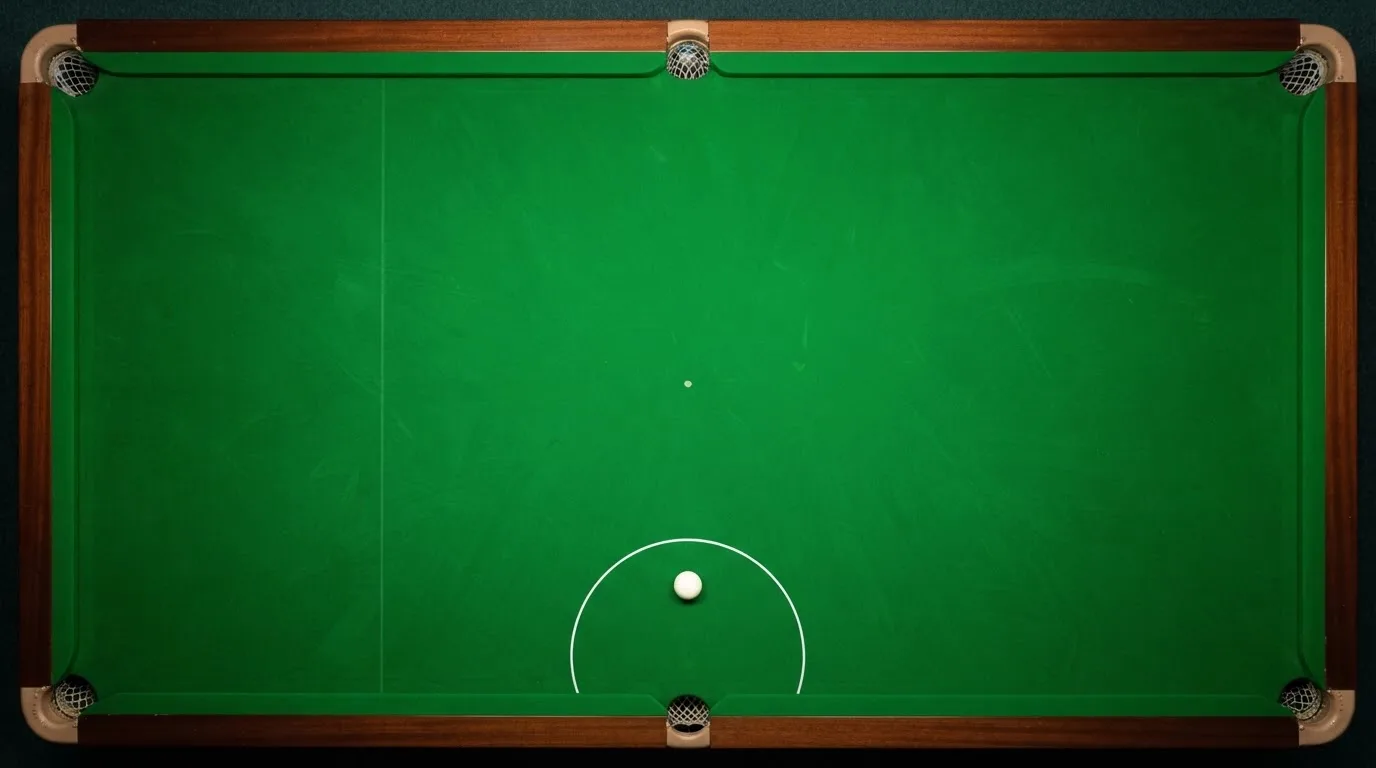
A century is a visit of 100 or more, scored by potting reds with blacks and clearing the colours. The maximum break is 147, scored by potting all 15 reds with blacks and then the six colours in order, and a 147 is rare enough that a bookmaker offering a market on it is offering a long-odds price. The maximum break is 147, the table is 12 ft by 6 ft, and most professional matches are best of 7, 9 or 11 frames, with the World Championship running to best of 35 in the final.
The margin and the overround
A bookmaker’s margin is the cut the book takes from every unit bet on a market, expressed as a percentage of the stake. It is calculated from the prices the book offers on every outcome of a market. For a two-way market with decimal odds 1.90 and 1.90, the payout share is 1 ÷ (1/1.90 + 1/1.90) = 0.5263, and the margin is 1 − 0.5263 = 47.4%. The same calculation at decimal odds 1.95 and 1.95 gives a payout share of 0.5128 and a margin of 48.7%. At decimal odds 1.91 and 1.91 — a tighter line — the payout share is 0.5236 and the margin is 47.6%.
The margin is not a fee on a winning bet. It is a built-in cut on every bet, taken whether the bet wins or loses. A punter who places a £10 single at 1.90 with a 47.4% margin is paying 47.4% of the expected value of the bet to the bookmaker, and the bet’s expected return is 52.6% of the stake. The arithmetic is the same whether the market is snooker, football or horse racing, and the punter who places a bet on a market with a 47% margin is paying a heavier fee than a punter who places a bet on a market with a 5% margin.
The punter’s job is to find markets with the lowest margin, which is the bookmaker’s “best odds” on a given outcome, and the bookmaker’s job is to set the margin high enough to make a profit on the book as a whole. A snooker outright with a 6% margin is sharper than a football outright with an 8% margin, and the punter who reads the margin rather than the headline price is the punter who finds the value.
Fractional and decimal odds
Snooker odds are published in both fractional and decimal formats at UK bookmakers. Fractional odds, such as 5/1, reflect the profit on a £1 wager, while decimal odds represent the total return (stake plus profit) on a £1 stake. For instance, 5/1 equates to 6.00 in decimal form (5 units of profit plus the unit stake). Similarly, 11/4 equates to 3.75, 1/1 (evens) to 2.00, and 4/6 (odds-on) to 1.67. The formula to convert fractional a/b to decimal is (a ÷ b) + 1. Both formats price the same bet, and once comfortable with the conversion, either can be used.
The decimal price is the total return on a £1 stake, including the stake. The fractional price is the profit on a £1 stake, excluding the stake. The two forms price the same bet, and the punter who is comfortable in one form is comfortable in the other. The conversion is the formula, and the formula is decimal = (a ÷ b) + 1 for fractional odds a/b.
Each-way, accumulators and the wider markets
Each-way betting is a snooker outsider’s friend. An each-way bet is two equal-stake bets, one on the win and one on the place, with the place terms set by the bookmaker. A £10 each-way bet is a £20 stake. Each-way terms on snooker are typically 1/2 the outright odds for the place (places 1, 2 and 3 in a 32-player field), so a £10 each-way bet at 50/1 pays the win at 50/1 if the player wins and at 25/1 if the player finishes in the places. Each-way is the right product for a long-odds punt on a tournament winner.
An accumulator is a single bet on multiple selections, with the prices multiplied into a single combined price. A four-leg acca at 1.90, 1.90, 1.90 and 1.90 has a combined price of 1.90^4 = 13.03, and a £10 stake returns £130.30 if all four legs win. The margin on a four-leg acca is wider than on any single leg, because each leg carries its own margin and the multipliers compound. The punter who wants the same stake on four singles at 1.90 has four bets at £10 each, with a combined probability of 0.5263^4 = 7.7% and a return of £76.40 on a successful run. The acca pays more for the same probability because the bookmaker is also selling the convenience of one stake.
Trixie, Patent, Yankee, Lucky 15, Heinz and Goliath are the system bets layered on top of accumulators. A Lucky 15 is 15 bets on 4 selections (4 singles, 6 doubles, 4 trebles, 1 four-fold acca), with the total stake = unit stake × 15. A Goliath is 247 bets on 8 selections. System bets are a way to cover a multi-leg selection with a win on a subset, and the trade is the wider margin the bookmaker takes on the additional bets.
Ante-post, Rule 4 and non-runners
Ante-post betting is betting on an event before the field is final, and the bookmaker’s terms state the conditions: a non-runner voids the bet (most books), a withdrawal after a certain date changes the terms (some books), and a Rule 4 deduction reduces the payout when a runner is withdrawn from a horse race. Snooker ante-post markets are offered on the majors months in advance, and a withdrawal is rare but possible. The punter who places an ante-post bet on the World Championship in March on a player who withdraws in April loses the stake under most books’ rules.
Rule 4 is a horse-racing term that does not generally apply to snooker, and the deduction mechanism is not a feature of the snooker market. The bookmaker’s terms state the position on a non-runner outright, and the punter reads the terms before placing the bet.
Sports and Tournaments: The Snooker Calendar a UK Punter Bets On
Snooker is a 10-month calendar with four majors, a cluster of ranking events, and a long tail of invitational and amateur tournaments. The punter’s calendar is the calendar of the sport, and the betting volume follows the events the public watches.
The World Snooker Championship
The World Snooker Championship has been held at the Crucible Theatre, Sheffield since 1977, and the format runs from best of 19 frames in the first round to best of 35 in the final. The 2026 World Championship ran from 18 April to 4 May 2026, with Wu Yize beating Shaun Murphy 18-17 in the final. The winner’s cheque was £500,000 from a total prize fund of £2,395,000.
The Crucible is the snooker punter’s flagship event, and the betting around it is the deepest in the calendar. Outright markets, match markets, frame markets, century markets, and session markets are all offered. The field is 32 players, the matches are long, and the in-play market runs for the duration. The session market — betting on the outcome of a single afternoon or evening session — is a snooker speciality and is offered at the bigger bookmakers.
The UK Championship
The UK Championship runs in late November and early December at the York Barbican, and is one of snooker’s Triple Crown events alongside the World Championship and the Masters. The format is best of 11 in the early rounds, best of 19 in the semi-finals and best of 19 in the final. The 2025 UK Championship is the most recent completed event, with the 2026 edition running in late 2026. The punter treats the UK Championship as the second-biggest outright market of the season, with deeper in-play coverage than a ranking event and a longer price on the heavier outsiders.
The Masters
The Masters runs in mid-January at Alexandra Palace, London, and is an invitational event for the top 16 players in the world. The format is best of 11 in the early rounds, best of 19 in the final. The field is small, the matches are high-quality, and the in-play market is rich. The Masters is the third leg of the Triple Crown, and the bookmakers price it accordingly.
The Champion of Champions and the ranking events
The Champion of Champions runs in November at the Bolton Arena and is an invitational event for the winners of the preceding season’s ranking events. The format is short, the field is competitive, and the outright market is sharp. The ranking events — the British Open, the Scottish Open, the English Open, the German Masters, the Welsh Open, the Players Championship, the Tour Championship, and the others on the World Snooker Tour calendar — make up the rest of the season. Each carries an outright market, a match market on the televised matches, and a frame market on the bigger sessions.
The punter who follows the ranking events closely finds prices that are wider than the World Championship prices, because the public bets on the majors and the bookmaker is less sure of the ranking-event lines. The trade is that the in-play market on a ranking event is thinner, and the cash-out and bet-builder products are less rich.
The rules and the governing body
The WPBSA (World Professional Billiards and Snooker Association) governs professional snooker and owns the official rules of the game. The IBSF (International Billiards and Snooker Federation) governs amateur competition. A punter who reads the WPBSA’s rules on a disputed frame — a miss, a snooker, a foul, a re-spot — has the same source the referee at the match is using. The bookmaker settles bets by the official ruling, and the ruling is the WPBSA’s.
The history in the betting
Stephen Hendry and Ronnie O’Sullivan have seven world championships each in the modern era, and Joe Davis won 15 world championships in a row from 1927 to 1946. The punter who follows the sport knows that O’Sullivan’s price at the start of the World Championship is shaped by 23 years of professional play and a record seven Crucible titles, and that a bookmaker pricing him at 5/1 in 2026 is pricing both the player and the field. The history is the context; the price is the bet.
The Top 10 UK-Licensed Snooker Betting Sites in 2026
The ten brands below all hold a Gambling Commission remote operating licence for general betting on real events, and all take part in GAMSTOP. The list is not in a preference order — the comparison is the punter’s, and the rankings are the punter’s. The licence number against each brand is the brand’s entry on the Commission’s public register, which is the whole test of who holds a GB licence.
DAZN Bet
DAZN Bet’s remote licence is registered against Commission account 48756, with DZBT Limited as the licence holder. Deposits start at £5 by debit card, Apple Pay, Paysafecard, Trustly and Skrill, and at £20 by PayPal, with no processing fees. The site is a newer entry to the UK market and offers a standard sportsbook with snooker coverage on the major events. The draw is the low deposit floor for most methods, which suits the punter with a small bankroll who wants to bet on a single frame at the Crucible.
Swifty Sports
Swifty Sports’ remote licence is registered against Commission account 58957, with Swifty Global (UK) Ltd as the licence holder. The app lists Best Odds Guaranteed, Cash Out on markets including horse racing and football, daily price boosts, live streaming and in-play betting, with a Bet Builder listed as coming soon. The snooker coverage sits on the major events, and the price-boost calendar is the marketing hook.
Ladbrokes
Ladbrokes’ remote licence is registered against Commission account 54743, with LC International Limited as the licence holder. The Ladbrokes app is one of the most-downloaded sports betting apps in the UK App Store, with a 4.66 rating from over 100,000 reviews. The snooker coverage is broad, with outright, match, frame and session markets on the majors, and Best Odds Guaranteed is offered on horse racing. The same LC International licence covers Coral, and the two brands share a wallet.
QuinnBet
QuinnBet’s remote licence is registered against Commission account 61011, with QuinnBet (Gibraltar) Limited as the licence holder. Best Odds Guaranteed is offered on Irish and UK horse racing from 10:00am daily on singles, multiples and system bets, with a maximum benefit of £150 per customer per race. The snooker market is offered on the major events, and the welcome offer is a free-bet package rather than a deposit match. The maximum BOG benefit is the limit to watch on a multi-leg acca.
DragonBet
DragonBet’s remote licence is registered against Commission account 64908, with DragonBet Ltd as the licence holder. The app lists Welsh football and rugby markets, racing, American football, in-play betting and bet builder markets. The brand is Welsh-facing in its marketing but covers the major snooker events, and the bet builder is the live product.
Copybet
Copybet’s remote licence is registered against Commission account 53774, with Copybet UK Limited as the licence holder. The app offers Best Odds Guaranteed all day, every day, on all UK and Irish racing, and pays first past the post on horse racing even if the winner is later disqualified. Snooker markets are available for major events, though the brand’s BOG promotion focuses primarily on racing.
Bet600
Bet600’s remote licence is registered against Commission account 44731, with Tyche Tech Limited as the licence holder. Best Odds Guaranteed is offered on horse racing: if the starting price is bigger than the early or show price taken, the bet is paid at the SP. The snooker market is offered on the major events, and the BOG mechanism is the brand’s marketing hook on racing.
Sporting Index
Sporting Index’s remote licence is registered against Commission account 27343, with Sporting Index Limited as the licence holder. Customers can switch between fixed odds and spread betting, with in-play betting, Bet Builder for football, auto cash-out and Multi-Markets. The snooker market runs on the majors, and the spread-betting option is the brand’s point of difference. Financial spread betting is regulated by the Financial Conduct Authority rather than the Gambling Commission, and the fixed-odds side is regulated by the Commission.
William Hill
William Hill’s remote licence is registered against Commission account 39225, with WHG (International) Limited as the licence holder. Best Odds Guaranteed is offered on UK and Irish horse racing from 8am on the day of the race, on both single and multiple bets, and does not apply to ante-post, tote or pari-mutuel bets. The snooker market is broad, with outright, match, frame and session markets on the majors, and the price history is deep enough to support closing-line analysis.
LiveScore Bet
LiveScore Bet’s remote licence is registered against Commission account 56859, with LiveScore Betting and Gaming (Gibraltar) Limited as the licence holder. The Bet Builder allows up to 10 selections and covers match result, both teams to score, corners, total goals, player scoring and card markets. The snooker market is offered on the majors, and the bet builder is the live product the brand is marketing.
The spread at a glance
The licence number and the licence holder are the columns that matter for a UK punter, because the licence is the only thing the regulator verifies. The punter who opens the Gambling Commission’s public register, types the brand name, and confirms the licence status before opening an account is the punter who is not surprised six months later. The table below sets the spread at a glance.
| Brand | Gambling Commission remote licence | What the operator’s own terms state on snooker |
|---|---|---|
| DAZN Bet | Account 48756, DZBT Limited | Snooker outright and match markets on the major events; deposits from £5 by most methods, £20 by PayPal |
| Swifty Sports | Account 58957, Swifty Global (UK) Ltd | Major-event snooker markets, daily price boosts, in-play and live streaming |
| Ladbrokes | Account 54743, LC International Limited | Broad snooker coverage on the majors; Best Odds Guaranteed on horse racing |
| QuinnBet | Account 61011, QuinnBet (Gibraltar) Limited | Major-event snooker markets, free-bet welcome, BOG on horse racing to £150 per race |
| DragonBet | Account 64908, DragonBet Ltd | Major-event snooker markets, in-play and bet builder |
| Copybet | Account 53774, Copybet UK Limited | Major-event snooker markets, all-day BOG on UK and Irish racing |
| Bet600 | Account 44731, Tyche Tech Limited | Major-event snooker markets, BOG paid at SP on horse racing |
| Sporting Index | Account 27343, Sporting Index Limited | Major-event snooker markets, fixed-odds and spread-betting options |
| William Hill | Account 39225, WHG (International) Limited | Broad snooker coverage, BOG on UK and Irish racing from 8am |
| LiveScore Bet | Account 56859, LiveScore Betting and Gaming (Gibraltar) Limited | Major-event snooker markets, bet builder to 10 selections |
The spread of brands is wide, and the punter’s choice comes down to three questions: which brand has the deepest snooker market, which brand has the best welcome offer for a single punter, and which brand’s payment methods suit the punter’s bank. The licence is the floor; the price is the ceiling.
How the UK Regulates Online Snooker Betting
The legal frame around a snooker bet in Great Britain is the Gambling Act 2005, enforced by the Gambling Commission, with a separate regime in Northern Ireland. The frame is the same for snooker as for football, tennis or horse racing, because the Act does not list permitted sports: it lists permitted operators, and the operator’s licence is the test of legality.
The Gambling Commission and the public register
The Gambling Commission is a non-departmental public body sponsored by the Department for Culture, Media and Sport. It licenses the whole commercial betting market in Great Britain under the Gambling Act 2005, which covers England, Scotland and Wales; Northern Ireland is outside the 2005 Act and has its own older law, so a “GB-licensed” operator is licensed to serve customers in Great Britain rather than the United Kingdom as a whole. Since the Gambling (Licensing and Advertising) Act 2014 an operator whose remote facilities are used in Great Britain needs a Commission licence wherever it is based; a Curaçao, Maltese or Gibraltar licence is not a substitute for a GB licence at the point of consumption.
The Commission’s public register can be searched by business name, trading name, domain or account number, and is the whole test of whether a brand holds a GB licence. The register also lists the categories the licence covers: remote general betting standard (real events), remote general betting standard (virtual events), remote general betting limited, remote pool betting, and remote betting intermediary. Every snooker bet at a GB-licensed bookmaker is offered under one of these categories, and the category is named on the register.
There is no state monopoly and no cap on the number of licences. The Commission does not license advertising, which is regulated by the Advertising Standards Authority under the CAP Code (non-broadcast) and the BCAP Code (broadcast), alongside the Commission’s LCCP marketing conditions. Operators are responsible for the marketing their affiliates run, and the affiliate’s marketing is read against the same CAP Code as the operator’s own.
The age and the identity check
The minimum age for any gambling product in Great Britain is 18. Name, address and date of birth are verified before a customer can deposit or gamble at a licensed operator, including with a free bet or bonus, and the verification has been in force since 7 May 2019. The verification is a regulatory requirement, not a marketing choice, and a licensed bookmaker that allows a customer to deposit without verifying their identity is breaking its licence conditions.
The verification extends to the source of funds at higher spend. A financial vulnerability check (LCCP condition 3.4.4, in force since 30 August 2024) applies to licensed remote betting when a customer’s deposits minus withdrawals exceed £150 in a rolling 30 days (since 28 February 2025), and is a public-record check (for example bankruptcy or county court judgments) rather than an income or credit check. Financial risk assessments, the “affordability checks” of the press, are announced in a staged plan with no start date as of 2026.
In-play, virtual and exchange betting
In-play snooker betting is offered at GB bookmakers under the same licence conditions as pre-match betting, and there is no statutory cap on in-play stakes. The bookmaker is bound by its own licence conditions and customer-protection duties, and a bet on a frame in the seventh session of the World Championship is settled under the same rules as a bet on a Premier League football match.
Esports and virtual events are treated separately. Esports are treated like any other real event for licensing purposes, and snooker is not an esports. Virtual events — virtual horse racing, virtual football, virtual greyhounds — are a separate licence category, and a bookmaker licensed for virtual events but not real events is not licensed to offer snooker.
Betting exchanges run under a remote betting intermediary licence, and the rates and rules specific to exchanges are set by each exchange’s own terms. Spread betting is split between the Gambling Commission (sports spread betting) and the Financial Conduct Authority (financial spread betting), and a financial spread bet on a financial instrument is regulated by the FCA, not the Commission.
The bonus cap and the marketing rules
A wagering requirement on a bonus is capped at 10x, in force since 19 January 2026. A £10 bonus at 50x wagering needed £500 of qualifying bets before the cap; under the cap, no more than £100. A £50 bonus at 10x needs £500 of qualifying bets, and a £200 bonus at 10x needs £2,000. The cap is on wagering requirements rather than on the money value of the bonus itself, and the cap does not apply to free bets with no wagering condition — only to bonuses that hold the punter’s money hostage to a turnover.
Mixed-product promotions — an offer that requires gambling on two or more product types such as betting, casino, bingo and lottery, for example “bet on football to get free spins” — are banned under the same set of rules. The rule is designed to keep casino-style wagering from being cross-subsidised by sports betting, and a snooker welcome offer that requires a casino side-bet is on the wrong side of the rule.
The “whistle-to-whistle” ban on TV advertising around live sporting events has been in force since 1 August 2019, and the Premier League clubs’ withdrawal of gambling sponsorship from the front of matchday shirts from 2026/27 (with sleeves and hoardings remaining) is a voluntary code, not a law. The CAP Code section 16 governs the rest of the marketing: socially responsible, no strong appeal to under-18s, no one who is or seems to be under 25 featured gambling or playing a significant role. The rule is on who may appear in the advertisement, not on who may bet.
Payments: cards, wallets and credit
Credit cards are banned for gambling in Great Britain since 14 April 2020, including credit-card-funded payments through an e-wallet. Debit cards and bank-based payments are not covered by the ban. The ban is enforced at the cashier, and a licensed bookmaker that processes a credit-card deposit is breaking its licence conditions. A punter who deposits with a credit card is on the wrong side of the rule, and the licensed book will not let the deposit through.
Crypto at the cashier is not banned, but the licensed book verifies the punter’s identity before the first deposit, and the crypto route is a payment-method question rather than an anonymity question. A British named-account rule, a state list of permitted payment methods, and any rule for or against cryptocurrency deposits at licensed operators are not established in the regulatory frame; the punter reads the operator’s own payments page for the answer.
Tax
The punter pays no tax on betting winnings in Great Britain, and a winning snooker bet at a GB-licensed bookmaker is paid in full (general information, not tax advice; a professional gambler should ask HMRC or an adviser). General Betting Duty is the operator’s tax on gross profits, currently 15%; from 1 April 2027 a new remote betting rate of 25% applies within it, while remote bets on UK horse racing, bets on self-service betting terminals in licensed premises, pool betting and in-person betting stay at 15% (HM Government policy paper of 26 November 2025). Spread betting has its own rates: 3% financial, 10% other. Until 1 April 2027 the remote rate stays at 15%, and whether operators pass duty on through odds is not established.
The offshore question
A GB licence is compulsory at the point of consumption, and providing gambling facilities in Great Britain without the licence the Act requires is an offence under section 33 of the Gambling Act 2005 — aimed at the operator, not the customer. The honest framing for a punter weighing an offshore bookmaker is the loss of protection: no GAMSTOP coverage, no Commission complaints route, no approved dispute-resolution body, no British consumer redress if funds are withheld, and not bound by the 10x bonus cap or the £150 vulnerability check. The punter is not committing an offence by placing the bet, but is also not protected when the offshore bookmaker does not pay out. The licensed book carries the identity check, the deposit limit, the GAMSTOP coverage, the bonus cap and the dispute-resolution route; the offshore book carries the price and the speed, and the rest is the punter’s problem.
Enforcement is disruption rather than blocking: cease-and-desist notices, search-engine referrals, work with registrars, hosts and payment providers, and the Commission has been given, or is about to receive, court-order DNS blocking powers. ISP blocking is not yet in operation, and the punter reading a “blocked” message on a snooker site is more likely looking at a domain takedown than a national block.
Responsible Gambling and the Tools a UK Punter Should Use
Snooker is a low-tempo sport, and the long tournaments invite the long bet. The punter’s risk is not the single visit but the long session, and the tools a GB-licensed bookmaker offers are the tools that work.
GAMSTOP
GAMSTOP is the national multi-operator online self-exclusion scheme, and a mandatory licence condition for every online operator licensed by the Gambling Commission since 31 March 2020. The exclusion periods are six months, one year, five years, or five years with auto-renewal, and after the minimum period the exclusion stays in place for a further seven years unless the customer asks GAMSTOP to remove it. GAMSTOP covers online sites and apps; betting shops use a separate service. A punter who registers with GAMSTOP is locked out of every GB-licensed online bookmaker for the chosen period, and the lock is the punter’s own.
The deposit limit and the stake limit
A licensed remote operator must offer a gross deposit limit on a fixed time frame, and the first changes to the deposit limit have applied since 31 October 2025. A second phase was postponed to 30 September 2026, and whether it is live is not established at the time of writing. The deposit limit is the punter’s choice: a punter who wants to cap a snooker tournament at £200 sets the deposit limit to £200 over the duration of the event, and the licensed book enforces it.
There is no state-set deposit or loss ceiling for sports betting, and the stake limit is the bookmaker’s own. A bookmaker may restrict a customer’s stake for any reason, including a long winning streak, and the restriction is set out in the bookmaker’s terms.
The financial vulnerability check
A financial vulnerability check is a public-record check the bookmaker runs when a customer’s deposits minus withdrawals exceed £150 in a rolling 30 days. The check looks for markers of financial difficulty (bankruptcy, county court judgments, IVA registrations) and is in force since 28 February 2025. It is not an income check, and it is not a credit reference check. A punter who crosses the £150 threshold is asked to confirm a public-record check, and the bookmaker acts on the result. A punter who cannot place a bet because of a vulnerability check is being asked the right question at the right threshold.
Where to get help
GamCare runs the National Gambling Helpline and is the first port of call for a punter who feels the betting is running away. GambleAware funds treatment and research. The NHS runs gambling clinics in several regions. Gamblers Anonymous runs peer-support meetings. The punter who needs help gets help on the same day, and the helpline is free from any UK phone.
A practical note on the long tournament
The World Snooker Championship runs for 17 days. A punter who plans to bet on the tournament from start to finish has set a budget, set a deposit limit, and stopped when the limit is hit. The punter who has not done those three things is the punter who finds a quiet afternoon in the second week and bets more than planned. The frame will be over in 30 minutes; the deposit will not be back.
The Working Margin on a Two-Way Snooker Market
The margin is the cut the book takes from every unit bet on a market, and the calculation is fixed. The punter who knows the margin knows the price, and the price is the bet.
The formula
The payout share of a market is 1 ÷ (1/odds₁ + 1/odds₂ + … + 1/oddsₙ) over all outcomes. The margin is 1 minus the payout share. For a two-way market with decimal odds 1.90 and 1.90, the payout share is 1 ÷ (1/1.90 + 1/1.90) = 1 ÷ 1.0526 = 0.9499 (95.0%) and the margin is 1 − 0.9499 = 0.0501 (5.0%). The same calculation at 1.91 and 1.91 gives a payout share of 1 ÷ (1/1.91 + 1/1.91) = 0.9541 (95.4%) and a margin of 4.6%. At 1.95 and 1.95, the payout share is 0.9487 (94.9%) and the margin is 5.1%.
A bookmaker pricing a snooker match at 1.90/1.90 is taking a 5% margin on the market. A bookmaker pricing the same match at 1.95/1.95 is taking a 5.1% margin, and a bookmaker pricing it at 1.91/1.91 is taking a 4.6% margin. The narrower the price, the lower the margin and the higher the payout share, and the punter’s expected return on a winning bet at 1.91/1.91 is higher than at 1.95/1.95, even though the headline price on each outcome is the same shape.
Reading the margin in the field
The margin is not published. The bookmaker publishes the prices, and the punter does the arithmetic. The exercise takes a few seconds on a calculator, and the result is the cut the book is taking on the market. A snooker match at 1.90/1.90 carries a 5% margin; the same match at 1.83/1.83 carries an 8.5% margin; the same match at 1.95/1.95 carries a 5.1% margin. The punter who places a £10 bet at 1.95/1.95 is paying 5.1% of the expected value to the bookmaker; the punter who places the same £10 at 1.83/1.83 is paying 8.5%.
The margin widens on in-play markets, on long-odds outrights, and on exotic markets. The 1.90/1.90 example is a sharp pre-match price; the same match in-play may be 1.85/1.85, and the in-play margin is wider. The punter who takes a long-odds outright at 50/1 is paying a margin that is the cut on a thin market with a long-shot outcome, and the price is the price.
The trade-off
A bookmaker with a 4% margin on snooker is sharper than a bookmaker with a 6% margin on the same match. The punter who holds accounts at two or three GB-licensed bookmakers and compares the prices before placing a bet is the punter who finds the value. The bookmaker with the deepest snooker market is not always the bookmaker with the lowest margin, and the bookmaker with the best welcome offer is rarely the bookmaker with the best price on a single frame. The punter’s job is to read the margin, take the lowest one, and accept that the welcome offer is not the price.
Conclusion: The Punter’s Choice in 2026
Snooker betting in 2026 is a sharper market than it was five years ago. The in-play coverage is richer, the bet builders are common, the streaming is on the bigger bookmakers, and the live data feeds the frame-by-frame market. The licensed bookmakers listed above all hold a Gambling Commission remote licence for general betting on real events, and the punter who opens an account with one of them has the protection of the LCCP, the GAMSTOP coverage, the 10x bonus cap, and the £150 vulnerability check.
The crypto-friendly bookmaker is on the list, and the punter who wants a Bitcoin deposit can use one. The non-GAMSTOP route is offshore, and the punter who goes that way trades the protection for the price. The welcome offer is a marketing contract, and the punter who reads the small print knows the wagering, the minimum price and the deadline before claiming. The in-play market is sharper than it looks, and the punter who watches the price in the late session of a long match sees the value the closing line does not.
The margin is the cut the book takes on every bet, and the punter’s job is to find the book that takes the smallest cut on the market the punter wants to bet on. The license is the floor; the price is the ceiling. The rest is the punter’s read of the match.
Frequently Asked Questions
How do I bet on snooker?
Pick a licensed bookmaker from the public register, open an account, complete the identity check, and choose a snooker market from the list the book offers. The most common markets are match outright, frame handicap, total frames, first-frame winner, and highest break. Place a stake at the price the book shows, confirm the bet on the slip, and wait for the match to settle. The settlement follows the WPBSA’s official ruling on the match, and the book pays out the return at the price the bet was placed.
Can I bet on snooker in the UK?
Yes, at any bookmaker licensed by the Gambling Commission for remote general betting on real events. Snooker is not on a permitted-events list because no such list exists in the Gambling Act 2005; the bookmaker’s licence is the test of whether the bet is offered legally. Offshore bookmakers without a GB licence also accept UK customers in practice, but the punter loses the protection of the Commission’s rules by placing the bet there.
How can I check a bookmaker’s Gambling Commission licence?
Open the Commission’s public register, search by the brand name, the trading name, the domain or the account number, and confirm that the brand is listed against a current remote general betting standard (real events) licence. The licence entry also names the licence holder, which may be a parent company rather than the trading name. A licence that is “suspended” or “revoked” is not a current licence, and a bookmaker that cannot be found on the register is not licensed.
How is a bet’s return worked out from the stake and the odds?
The return on a winning single bet is the stake multiplied by the decimal odds. A £10 stake at decimal odds 1.90 returns £19 (a £9 profit plus the £10 stake). A £10 stake at 3.00 returns £30 (a £20 profit plus the stake). A combination bet multiplies the odds of the legs into a single price and applies the stake to the combined price; a four-leg acca at 1.90, 1.90, 1.90 and 1.90 has a combined price of 13.03, and a £10 stake returns £130.30 if all four legs win.
What is the bookmaker’s margin, and how do I see it in the odds?
The margin is the cut the book takes from every unit bet on a market, expressed as a percentage of the stake. It is calculated as 1 minus the payout share, where the payout share is 1 divided by the sum of the reciprocals of the odds on every outcome. For a two-way market at decimal odds 1.90 and 1.90, the payout share is 1 ÷ (1/1.90 + 1/1.90) = 0.9499 and the margin is 5.0%. A punter who works out the margin from the prices on the screen is reading the book’s cut, and the lowest margin is the sharpest price.
Understanding Odds Conversion
Fractional odds a/b convert to decimal odds (a ÷ b) + 1. Fractional odds 5/1 become 5 ÷ 1 + 1 = 6.00. Fractional odds 11/4 become 11 ÷ 4 + 1 = 3.75. Fractional odds 1/1 (evens) become 1.00. Fractional odds 4/6 (odds-on) become 4 ÷ 6 + 1 = 1.67. The decimal price is the total return on a £1 stake, including the stake; the fractional price is the profit on a £1 stake, excluding the stake.
Tennis, darts & cue sports – UK betting
Content created by the «UK betting» team
