
Hurling betting tips, read like a bookmaker
 Available in US
Anyone chasing “hurling betting tips” this season is, by definition, looking for a shortcut. The honest answer is that there isn’t one. What there is, is a way to weigh what the odds imply, decide whether the price is worth taking, and then manage a stake across a Championship where one bad quarter can sink a ticket built on nine previous wins. This guide works through how a price is built, where its hidden cost lives, and which bookmakers on the UK list look worth the time of a hurling fan — for the markets they actually offer, not the markets their homepage advertises. Every figure, licence and rule below was checked against the operators’ own terms and the public register of the Gambling Commission, current as of 27 October 2026.

What “betting tips” actually means on a hurling Saturday
A tip is a prediction. The work behind it is the same whether the tipster is a friend, a paid service or a model on a forum: compile the form, check the team news, settle on a most likely outcome, then compare that probability with the implied probability of the odds. If the implied probability is shorter than the tipster’s read, the bet is a value bet; if it’s longer, the bet is a punt for love of the county.
Gaelic games are awkward to model. Senior inter-county hurling matches last 70 minutes, in two 35-minute halves, with fifteen players a side. Goals are worth three points, points over the crossbar worth one, which means a side trailing by five points can be a goal and a point from level after one attack. The scoreboard compresses big swings in a way the odds don’t always reflect — particularly early in a season when form is thin and news of injuries lighter still. The natural market for hurling is the match winner, often paired with a handicap or a total points line, and most UK-licensed bookmakers offer match odds, the outright All-Ireland market, and the provincial championships ahead of the summer.
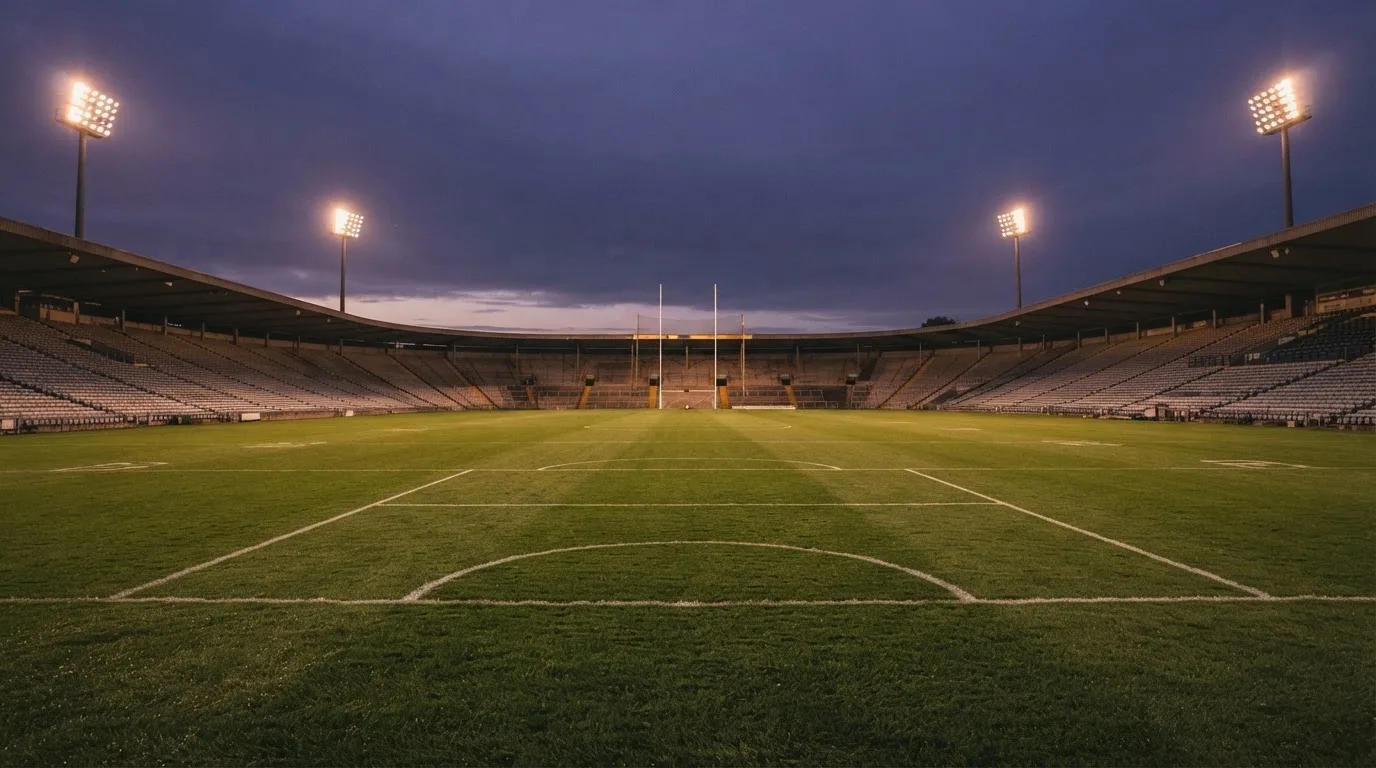
The GAA’s calendar is the constraint around which every hurling market is built. The Allianz League runs from February to the spring finals; the Munster and Leinster championships run over May and June; the All-Ireland quarter-finals and semi-finals fill July; and the final sits at Croke Park at the end of the same month. Outright markets on the Liam MacCarthy Cup open months before a ball is struck, and that long horizon is exactly what makes them lucrative for the bookmaker — the ante-post favourite is, almost by definition, the team the public already knows about.
The bookmaker’s margin, hidden in plain sight
Every set of odds carries a margin, and “no margin” is a marketing claim not a market fact. The margin is the slice of every pound wagered the bookmaker keeps regardless of who wins. It is the reason even the smartest tipster loses on average when prices are fair, because “fair” here is a market-specific word: fair for the bookmaker, not fair for the punter.

For a two-way market at decimal odds of 1.90 against 1.90 — a balanced handicap, half the betting community on each side of the line — the arithmetic is straightforward. The implied probability of 1.90 is 1 ÷ 1.90, or about 52.6 %; price two outcomes at that and the implied probabilities add to 105.3 %. Hold a tidy 5.3 % on every unit wagered, in other words, before a result has even been recorded. That is the overround, or, viewed from the other side, a payout share of 94.7 % of stakes. On a Championship weekend with five thousand bets priced at this kind of overround, the bookmaker’s take is mechanical, indifferent to who wins the Liam MacCarthy.
It is roughly the band that GAA match odds actually trade at — close to a 95 % payout on a balanced book, drifting toward the low 90s on outright markets where the favourite is short and the field is long. A headline price like “best odds” on the All-Ireland winner is just a smaller margin on the same bet everyone else is offering; the marketing word does not change the maths. The margin sits behind every price the page touches from here on in, and any offer that looks free is paying for itself out of that margin before the rest is given back.
The way the punter uses this is to look at the implied probability of the price and ask whether the tipster’s probability beats it. If the model says Limerick are 55 % to win at home and the bookmaker has them at 1.90 (52.6 %), there is a thin edge; if the same match is priced at 1.70 (58.8 %), the price is short and the bet is off, no matter which county the heart says. The edge is the difference between two probabilities, and it is what “value” actually names.
How a return is worked out, in decimal odds
Decimal odds make the arithmetic plain. A £10 stake at odds of 2.50 returns £25 — the stake of £10 plus £15 of profit — when the bet lands. The rule is return = stake × odds and profit = stake × (odds − 1). Stake a fiver on Cork at 4.00 and a winning day returns £20, of which £15 is profit. Stake the same five pounds on a four-fold accumulator where each leg has been priced at 2.00 and the combined odds are 16.00: a winning day returns £80, of which £75 is profit, and four correct calls are exactly what has to happen.
There is no commission taken from winnings at a UK-licensed bookmaker — the operator pays General Betting Duty out of its own margin, and the punter keeps the lot. Conversion from the fractional odds a bookmaker’s old guard still use is the same arithmetic with a different starting point: 5/1 fractional is 5 ÷ 1 + 1 = 6.00 decimal, 11/4 is 11 ÷ 4 + 1 = 3.75, evens are 2.00. The conversion only goes in one direction at a time, and the punter who reads both forms pays exactly the same price on whichever row the slip shows.
The price in front of you on the cup final, on a Munster Saturday, on the Allianz League in February, is the price. It is set against thousands of bets, settled against one match result, and pays the same whether the bet was a Tuesday-evening flutter or a season-long ante-post. The arithmetic is the entire job; the rest of the page is the longer version.
Where the bookmakers stand on the Championship
The book’s most useful job, on a sport this compact, is to keep a Championship-wide market open and a price moving. The ten UK-licensed operators with GAA markets on their books for this season sit on the Commission’s public register, every one of them, and the table below shows what each holds for the hurling fan.
| Bookmaker | Gambling Commission licence | What the operator’s own terms say |
|---|---|---|
| Kalooki Sportsbook | Remote licence under account 57730, held by Kalooki Sportsbook Limited | GAMSTOP member; no listed in-play or streaming feature for GAA in the on-site terms reviewed |
| William Hill | Remote licence under account 39225, held by WHG (International) Limited | Football Acca Boost scales from 3 % on a double to 200 % on 20+ legs, max £10,000 per online bet; runs to 30 May 2027 |
| Fafabet | Remote licence under account 57385, held by Taichi Tech Limited | Best Odds Guaranteed on UK and Irish racing from 9 AM on race days, paid at SP if bigger |
| Bet600 | Remote licence under account 44731, held by Tyche Tech Limited | Best Odds Guaranteed on racing, paid at SP if bigger than the price taken |
| Swifty Sports | Remote licence under account 58957, held by Swifty Global (UK) Ltd | Cash Out on racing and football; live streaming and in-play listed; Bet Builder marked coming soon |
| bet365 | Remote licence under account 55148, held by Hillside (UK Sports) ENC | Super Boosts, Bet Builder+ on pre-match and in-play, daily Boosts, in-play and live streaming worldwide |
| Paddy Power | Remote licence under account 39439, held by PPB Counterparty Services Limited | Money-back specials on major GAA football fixtures; a free-bet club for settled stakes on a chosen sport |
| BoyleSports | Remote licence under account 39469, held by Boylesports Enterprise | Welcome offer of £20 in free bets on a £10 qualifying bet for UK players |
| 888sport | Remote licence under account 39028, held by 888 UK Limited | Cash Out, Bet Builder, racing streams, daily boosted odds, BetFinder form tools |
| QuinnBet | Remote licence under account 61011, held by QuinnBet (Gibraltar) Limited | Best Odds Guaranteed on UK and Irish racing from 10 AM, max benefit £150 per customer per race |
A licence on the Commission’s public register is a licence, full stop. Spreadex, for completeness, is regulated by the FCA for spread betting and by the Commission for fixed-odds betting, and that brand is named here only because spread betting losses can exceed the deposit — a different product with a different regulator and a different arithmetic. The Commission’s licence types are remote general betting standard (real events) and four siblings the hurling fan will never need; the betting-exchange licence covers Betfair and a small set of peers, which would otherwise look identical to a fixed-odds bookmaker to the reader. Each of the ten above holds the remote general betting standard (real events) licence, none of them is licensed for Northern Ireland under the older regime, and each of them is a GAMSTOP member by the licence they hold.
Reading a Championship the bookmakers will let you bet on
Hurling has a regular season and a knockout season, and the markets around them behave differently. The Allianz League runs from February to the spring, the provincial championships through May and June, and the All-Ireland takes over July; the Liam MacCarthy Cup final, in this season at Croke Park, ends the summer. Outrights are priced ahead of the season and move on league form; the All-Ireland final market is one bet per team, paid at the end of the summer.
The 2026 Championship ran with Leinster a six-team round-robin and Munster a five-team round-robin, the top two meeting in the provincial final and the third-placed team going into the All-Ireland quarter-finals. Limerick beat Galway in the 2026 final at Croke Park on 19 July 2026, having followed Tipperary’s 2025 win. A long ante-post ticket on Limerick in November paid handsomely; the same ticket on the day of the final paid the price on the day. Ante-post markets are price-and-rule products — the stake is lost when a team is eliminated, with no refunds on knocked-out counties — and a Championship that runs three months is the bookmaker’s natural home ground.
Each leg of the Championship settles on the official result at the end of normal time including injury time; extra time does not count unless the market rules state otherwise. That is the rule on most UK books reviewed here, but it is a rule that varies for a market that runs on the All-Ireland hurling final itself: outright tickets settle with the cup, while match odds on a final that goes to extra time will list extra time as counting on the slip or they will not, and the punter reads the slip before staking. A bookmaker’s terms are part of a bet, not a postscript to one.
Live hurling markets and the cash-out option
GAA games move quickly and the in-play markets on the bigger matches are usually deep — next team to score, total points bands, handicap lines that move with the lead — and the slip can be cashed out at any time, in full or in part, at a price the bookmaker sets on its own platform. Cash out is not a hedge; it is the bookmaker paying the punter to leave, and the price carries the same margin the pre-match line did. Cash out locks in a position the punter would otherwise be holding, and on a sport where a five-point lead evaporates in one attack it is a useful button to have, particularly on a Saturday with multiple bets running. The button’s price is the bookmaker’s; the punter decides whether to take it.
In-play on hurling is the easy part of the live calendar: markets are settled at the whistle, the rules are GAA rules, and the price moves with the score. Live streaming of the matches themselves is rarer — rights sit with RTÉ and the GAAGO service for overseas viewers, and UK books do not hold a broadcast window for the Championship at large. What most UK-licensed books do offer is in-play data, animations and a betting feed that runs alongside the published TV coverage, which is its own kind of live product and carries its own kind of margin.
Bonuses, free bets and the cost behind the headline
A welcome offer is paid for out of the margin the rest of the page is built around. UK-licensed bookmakers can offer bonuses, free bets and enhanced odds within the rules the Commission and the CAP Code lay down: wagering requirements are capped at 10x, so a £10 bonus at 50x is now illegal, and mixed-product offers that ask the punter to bet on two different products to claim a single reward are banned. The headline number is the rebate the punter would receive if every condition were met; the conditions are the price the punter pays in turnover to get there.
A £20 free bet on a £10 qualifying stake is the shape of most welcome offers reviewed this season. The stake of a free bet is not paid back with the winnings — the slip is settled as profit only — so a £20 free bet at odds of 3.00, when it wins, returns £40 of profit. Over thousands of such bets the value of the free bet on average, at a market with a 95 % payout share, is the free-bet amount times the odds minus one, divided by the odds, multiplied by the payout share. At 3.00, that is £20 × 2 ÷ 3 × 0.947 = roughly £12.6 of expected value — about 63 % of the headline number. A welcome offer is, on average, a discount on the first bet; it is not free money, and the headline never says so.
Best Odds Guaranteed on racing is a different product: if the starting price is bigger than the price taken, the book pays the bigger number, on a single bet or a multiple. It does not apply to ante-post or pari-mutuel bets, the cap varies — QuinnBet caps the BOG benefit at £150 per customer per race — and the offer is not in place on hurling at most UK books, which is why a GAA punter reads the racing promo with one eye and the hurling rules with the other.
Acca insurance and acca boosts are the same product family. William Hill’s Football Acca Boost covers two-leg accas and above, with a 3 % boost on a doubling rising to 200 % on 20+ legs and a £10,000 cap per online bet. bet365’s Super Boosts and Bet Builder Winnings Boosts run on selected singles. 888sport publishes boosted odds daily. None of these is value-add in the long-run sense; all of them are a marketing cost priced into the line elsewhere. A punter who reads the small print treats the boost as a small positive on a bet they would have placed anyway; a punter who chases the boost adds turnover for the sake of the marketing headline.
Staking and bankroll discipline on a Championship
Bankroll discipline is where most losing tips are born, and it has nothing to do with picking the winner. A bankroll is the money earmarked for betting across a season, and a unit is a fixed percentage of that bankroll — one or two per cent for the cautious bettor, five for the confident one. The same bet is a different size depending on the bankroll, and a winning streak at one per cent does not justify switching to five mid-Championship.
The shape of a Championship is what makes bankroll rules harder than they look. Each match is a chance to act, a single bet is a single act, and the temptation to chase a settled slip with one of the day’s other fixtures is the same impulse that makes ante-post markets attractive in February and corrosive in May. The discipline, in practice, is to set a unit size at the start of the season, stick to it, and treat the All-Ireland final as one match in a season rather than the season’s reward. The punter who sets a £50 unit on the Munster final and a £50 unit on the third Allianz League game of April has, in both cases, acted on the same discipline; the punter who sizes up to £250 on the final is betting a different tournament entirely.
The bankroll is also the limit on losses. A licensed UK bookmaker offers a deposit limit on a fixed time frame, and the customer sets it; the limit is the customer’s, not the regulator’s. The Commission’s affordability checks come at higher spend — a public-record financial vulnerability check applies from the moment deposits minus withdrawals exceed £150 in a rolling 30 days — and the check is a public-record check, not an income check, so it does not ask the punter what they earn. It is a check on whether the punter is, on the records, the kind of customer a bookmaker is permitted to keep gambling.
What licensed means in practice
A UK-licensed bookmaker is one whose name and licence number appear on the Gambling Commission’s public register, and the test of a licence is the register. The Commission itself is a non-departmental public body sponsored by the Department for Culture, Media and Sport, and it regulates the commercial market under the Gambling Act 2005 — which covers Great Britain (England, Scotland and Wales), with Northern Ireland sitting outside the Act and operating under its own older law. Since the Gambling (Licensing and Advertising) Act 2014 an operator whose remote facilities are used in Great Britain needs a Commission licence wherever it is based, and a Curaçao, Maltese or Gibraltar licence does not substitute.
The minimum age is 18, and identity is verified before the first deposit. Name, address and date of birth are checked; a free bet or bonus is gated by the same check; no anonymous play is offered at a licensed site. The credit-card ban covers gambling in Great Britain and any credit-card-funded e-wallet top-up. General Betting Duty is paid by the operator at 15 % of gross profits, with a new remote rate of 25 % set to apply from 1 April 2027 within the duty on remote bets other than those on UK horse racing, pool betting or in-person bets; the punter pays no tax on winnings. Spread betting is a separate product under the FCA, with its own rates, and Spreadex is the prominent UK name that straddles the two regulators.
The risks of an unlicensed brand are not legal in the criminal-law sense for a customer who bets on one — there is no offence aimed at the punter. The risks are loss of protection: no GAMSTOP, no Commission complaints route, no British consumer redress if funds are withheld, no 10x bonus cap, no £150 vulnerability check. That is the framing, without “illegal to use” attached to it — because it isn’t.
Limits, time-outs and the rest of the safer-gambling kit
A licensed UK bookmaker offers deposit limits, time-outs, reality checks, product restrictions, and self-exclusion through GAMSTOP. Deposit limits are set by the customer in fixed time frames, with a first set of changes having applied since 31 October 2025; a second phase was postponed to 30 September 2026, and whether it is live is not established. The financial vulnerability check kicks in once deposits minus withdrawals exceed £150 in any rolling 30 days, a public-record check that reads bankruptcy and county-court judgments rather than payslips. The “affordability checks” of the press coverage are a staged plan announced by the Commission in July 2026 — they have no start date, and the page does not write them as in force.
GAMSTOP itself is the multi-operator online self-exclusion scheme and a mandatory licence condition for online operators since 31 March 2020. Exclusions of six months, one year, five years, or five years with auto-renewal are available, and after the minimum period the exclusion stays in place for a further seven years unless the customer asks GAMSTOP to remove it. GAMSTOP covers online sites and apps; betting shops use a separate service. GamCare runs the National Gambling Helpline; GambleAware funds treatment; the NHS runs gambling clinics; Gamblers Anonymous runs meetings. These are the routes a punter takes when the bankroll rule has stopped being enough.
The point of the kit is that the bookmaker is not the right body to set the limits — the customer is, and the operator offers the controls but does not decide them. That division is what the licence is for.
Markets a hurling fan will actually use
The market list on the All-Ireland Saturday is shorter than the market list on the Premier League Saturday, but the products that do exist are useful. Match odds on the senior match are universal — home, draw, away, with the draw at a long price because hurling draws are rare — and the over/under on total points, handicaps on the lead, and any-time-score markets for the named forwards round out the slip. Outrights on the Liam MacCarthy and the provincial championships are deep at most UK books, with each team priced ahead of the season and the favourites moving on league form. The minor and U20 championships are priced at fewer books; smaller books can be more generous on the long shot, and that generosity is a function of the bookmaker’s limited liability rather than its generosity of spirit.
Each-way betting, a staple of horse racing, exists at most GAA books at the bigger end of the market. The mechanics differ: each-way stakes are split into a win bet and a place bet, and the place terms are set by the bookmaker (usually a third of the outright field, a quarter of the outright odds) — but on hurling, where each-way terms mirror those on racing, the stake doubles in cash terms. The punter who backs Limerick each-way at 4.0 has £10 on the win and £10 on the place, total £20 of stake; if Limerick reach the final, the place bet pays out at the place terms, the win bet stays live.
The bet builder is newer and at this stage variable. bet365’s Bet Builder+ combines markets from one event into a single bet pre-match and in-play. 888sport lists Bet Builder on its app alongside racing streams. Swifty Sports marks the feature as coming soon. Midnite lists an acca builder in the same part of the app. The product is a real convenience on a sport where a single game’s markets are smaller and harder to combine by hand; the price carries the same margin the underlying markets do, with the bookmaker building a margin on top of it for the convenience.
Building a tipping routine around a short Championship
A tipping routine is a process the punter can repeat. The minimum useful version is: write down the price on the morning of the match, write down the implied probability and the assessed probability, bet the unit only when the assessment is more than the price, write down the result, and reset. The habit of writing it down does two things — it forces a number to be on the page, and it makes the punter a customer of their own record instead of their own memory.
The longer version is: track closing odds at two or three books, watch the line move between Tuesday and the throw-in, and note which side of the move the tip was taken on. The bookmakers are competing for the same bets and the line is the visible residue of the competition; the side of the move is rarely the whole story but it is usually some of it. Then: track the bankroll, the unit, and the season’s running total. The discipline of reading a weekly total is the difference between a bettor and a customer of a product.
The Championship is short enough to make a routine visible across a season, which is its main value for the purposes of learning. Three months on, the punter can read the record: how many bets, what unit size, what average odds, what average edge, what total return. The bookmaker’s margin shows up in the record whether it was visible on the slip or not. None of this wins any bets by itself; it makes the bets that do win useful, and the bets that don’t recoverable.
What the calendar does to the form book
Form in hurling is shorter than form in football. The Allianz League offers six or seven games for most teams ahead of the provincial championship; the provincial round-robin offers another five or six, and the All-Ireland series another two or three. A team that won the league in February can lose their first three Championship matches and look out; a team that lost the league can win the provincial final and look unbeatable. The Championship is its own form book, and the punter who reads only the Allianz League table is reading the wrong document.
Team news is also thinner. GAA panels are tighter than Premier League squads, injuries are rarely public in the same way, and the starting fifteen is named from the panel hours before the match. A bookmaker’s market moves on team news slower than the punter’s, and the punter who knows which forward is carrying a knock before the rest of Twitter knows has read the line correctly. That kind of information edge does not exist every week, and the bookmaker’s price reflects its existence by being slow to move on the fixture.
The provincial finals and the All-Ireland stages are the fixtures with the sharpest prices and the deepest markets. The Munster final in particular is priced at multiple books and traded heavily. The 2026 Munster round-robin had five teams, and the top two met in the provincial final at the end of it. The All-Ireland quarter-finals are short markets with the third-placed teams from each province and they are settled at the end of normal time. Pricing these matches starts with the public information; it ends with the price the bookmaker is willing to hold.
The All-Ireland outright, from the ante-post to the final whistle
The outright Liam MacCarthy market is the largest ante-post bet most GAA books hold. The market opens around the turn of the year, the favourites shorten on league form, the longshots drift on bad pre-Championship news, and a price paid in March can be 25 % bigger than a price paid at the end of June. Tipperary were the 2025 All-Ireland Senior Hurling Champions; Limerick took the title in 2026. An ante-post bet on Limerick in November 2025 was a long bet, not a strong one — the betting was on a team with a recent All-Ireland pedigree, but the longshot tag was the price.
Each-way terms on the All-Ireland outright are set by each book; the place terms are usually a quarter of the outright field at a quarter of the odds, but a smaller book may run a more generous place payout to attract customers on a market with thin liquidity. The market is settled with the cup; ante-post tickets are lost when a team is eliminated, with no refund on the stake. That is what makes the ante-post a value bet only when the price is clearly too long — the team’s title probability has to beat the implied probability by enough margin to absorb the loss of stake on the other named counties.
The bookmaker’s margin on outright markets is wider than on individual matches, because liquidity is thinner and the book runs a longer liability. Payout shares on All-Ireland outrights drift into the high 80s on some books, into the low 90s on the bigger ones, and the cost of taking a short-priced favourite is hidden in that spread. Headline prices compete on the favourites; a punter who reads only the head of the table is paying the most for the worst price the bookmaker offers.
Markets the slipper can’t find on GAA
Some markets offered at the bigger UK books are not offered at the smaller ones, and the gap is worth naming. Live streaming of the Championship is rare on UK books because the rights sit elsewhere; in-play data and animations are more common, and the slip’s in-play tab runs alongside a TV broadcast the customer has paid for separately. Racing streams — 888sport runs them, bet365 runs them — are different products and the punter should not conflate them with GAA streams.
Cash out, by contrast, is universal. Every book on the table offers cash out on at least the bigger markets, and the rule is the same on every book — cash out is the bookmaker’s offer to settle early at a price the bookmaker sets. A punter who is offered cash out at a lower price than they would have got had they let the bet run can reasonably take it on a sport where a five-point lead is one attack from gone; a punter who treats cash out as a hedge is treating a marketing product as an instrument, and the marketing product will win in the long run.
Exchanges are a different product again. Betfair and a small set of peers are licensed as betting intermediaries under a different licence category — the same Commission’s remit, a different licence class — and the back-and-lay model is a separate question of book. The prices available on an exchange are usually sharper on the bigger GAA matches and weaker on the smaller ones; the commission charged on net winnings is the exchange’s cut, and the in-play market on a hurling match is wider on an exchange than the same market on a fixed-odds book. A punter with both an exchange account and a fixed-odds book is, in practice, a customer of two products and a reader of two sets of rules.
An offer’s true cost, by the numbers
A welcome offer is a marketing cost, and the marketing cost is paid for out of the margin already inside the price. A £10 qualifying bet at odds of 2.00 settles the qualifying slip and triggers a £20 free bet; the £10 is at risk, the £20 free bet is profit if it lands, and the bettor’s cost on average is the cost of the qualifying bet plus the loss on the free bet, both of which are factored in. The free bet is the cheaper half of the equation by design — its stake is not paid back, and its value on average at a market with a 95 % payout is around 63 % of the headline number. The qualifier is the longer half, at the full margin of the underlying market.
BOG works only when the starting price beats the price taken; on the day the price does beat, the punter is paid at the bigger number; on the day it doesn’t, the punter is paid at the price taken. BOG is a zero-cost insurance on the days it pays, and on the days it doesn’t pay it has cost nothing either. Its cost to the bookmaker is captured in the racing margin it builds in, which is a bigger margin than the hurling margin because BOG is a more generous offer than most. BOG isn’t offered on hurling at most UK books, and a racing punter using BOG is paying for it out of the racing margin.
A price boost on a Premier League Saturday is a similar product with a similar price: the boosted price is a marketing number, the underlying margin accommodates it, and the punter who backs the boosted bet at the boosted number has had a small positive on top of a bet they would have placed anyway. The boost is not value on its own; it is value added to a bet. The bettor who chases boosts is paying for marketing with the bet, and the marketing wins at scale.
What the calendar does to the form book (again, by accident)
A hurling punter learning the form book over a single Championship will read three months of results, and the discipline is to read them as a sample rather than as a verdict. Three months is too short a window to draw firm conclusions on the strength of a panel; it is just long enough to draw conclusions on the market’s pricing of the panel. The price on Limerick in the last week of the Allianz League is a price with three months of form behind it; the price on Limerick on the morning of the Munster final is a price with three more. The difference between the two is the punter’s edge, if there is one, and the act of writing both numbers down is what makes the edge auditable.
A punter who reads only the final market is reading a market that has been priced and repriced for months; a punter who reads the mid-season market is reading a market with thin liquidity and wider margins. The discipline is to be early enough that the price moves when the form sets in, late enough that the form has set in to move on. Neither timing is the punter’s right answer, but the punter who reads the price every week has the data when the moment comes.
The art of a Championship bet, in other words, is the art of reading the form book at a moment when the price is still pricing it. The form book runs on after the price has done its work.
A short, sharp read of the licence list
The ten names in the table earlier are all on the Commission’s public register under the remote general betting standard (real events) category. Each one is a GAMSTOP member by the licence they hold. The licence numbers are the licence numbers; the punter’s job is to read them on the register when in doubt, and to read no further than the register. None of the names is “the only licensed one” — the Commission’s register lists far more than ten brands in the same category — and the page names ten as a shortlist to read against, not as the whole market.
Spreadex, the eleventh name in research, is included here only to mark it as the kind of product that is regulated differently. Spreadex is regulated by the FCA for spread betting and by the Commission for fixed-odds betting, and spread betting losses can exceed the deposit. A punter who looks up Spreadex on the Commission’s register finds its fixed-odds licence; they will not find a general-betting licence for spread betting because there is no such licence, and the FCA’s register is the right register for the spread-betting product. The same product distinction applies to financial spread betting versus sports spread betting, and the punter reads the licence they are betting under, not the brand.
The markets that don’t exist on the slip
Not every product a bookmaker offers on horse racing is offered on hurling, and the gap shows up in markets that look the same but settle differently. Best Odds Guaranteed is a racing-only product at most books and the licence table above carries the racing-only nature of it — Fafabet and Bet600 and QuinnBet all run BOG on racing only. Bet Builder is offered on GAA markets by bigger books (bet365, 888sport, Midnite) and not by others (Swifty Sports marks it as coming soon). Cash Out is universal; live streaming of hurling is rare at UK books because the rights sit elsewhere. Each-way on an outright is offered at the bigger books; the smaller books run each-way on a smaller scale.
The punter’s job is to read the slip before staking, and the slip names the market it settles with. The fine print on each market sits behind the market name on most books, and a hurried punt on a match winner is settled by the rules the book has written for match winners, not the rules the punter expected. The bookmaker is not in the wrong when the punt’s small print is wrong; the punter is the customer of a product they should have read.
Limits, units and the long Championship
Championship betting has the same logic as any other season-long staking, just compressed into three months. The unit size is the percentage of the bankroll; the bankroll is the amount of money earmarked for betting across the season; the season is the three months from the Allianz League final through the All-Ireland. A punter who wants to bet on the Championship from start to finish should set the unit at one per cent of a bankroll set at ten times the largest single bet of the season. The punter who puts a fiver on each match and lets the bankroll rise with the wins is betting on the variance, not the edge.
A bankroll of £500 is the size a £5 unit gives at one per cent. The same bankroll run at two per cent unit is a £10 unit. The Championship’s bigger matches — the Munster final, the All-Ireland final — are the tests of the unit size: a £5 unit bet on a 5.0 shot returns £25, of which £20 is profit; a £10 unit on the same bet returns £50, of which £40 is profit. The first half of the Championship tests the discipline; the second half tests the discipline on bigger markets. The bankroll does not change size based on which match the punter fancies; the punter’s edge is the same on each bet and the unit is the same on each bet, all season.
The plain rule, written down, is this: a unit never rises with a winning streak, a unit never falls with a losing streak, and a bankroll that has lost half its value at the All-Ireland final is a bankroll that needs to be reset at half the unit size at the start of next season. The bookmaker’s edge compounds over a season, and the punter’s discipline is the only thing that compounds against it.
The Championship as a bookmaker product
The All-Ireland is the bookmaker’s most-watched Championship fixture, because it is the one fixture a non-GAA punter will look at in a sportsbook. The bookmaker meets them with a price, an each-way term, a place payout, an in-play market, a cash-out button, and — on the bigger books — a price-boosted market on the outright and a special on the named forwards. The Championship is not the bookmaker’s biggest market (the Premier League Saturday is) but it is the one where the bookmaker is competing for the public’s attention with the least margin in hand.
The marketing around the All-Ireland is heavier than the underlying margin. A book paying four places on the outright at one-quarter of the odds is offering a place bet that is, at the bigger prices, generous on the place; the generosity is paid for in the win-side odds, which are tighter than they would have been on a book paying fewer places. A punter reading the place terms as well as the win price is reading the offer correctly. A punter reading only the place terms is reading an advertisement, not a price.
This is why the page keeps coming back to the same point. The price on the slip is the price; the offer around it is the marketing; the bankroll discipline is the punter’s own. A punter who knows all three is the punter who, across a Championship and a season and a few years, keeps more of their own money than the marketing would have them keep.
The way the season ends
Limerick beat Galway in the 2026 All-Ireland Senior Hurling Championship final at Croke Park on 19 July 2026. Tipperary were the 2025 champions. The 2026 Championship ran with a six-team Leinster round-robin and a five-team Munster round-robin; the third-placed team from each province went into the All-Ireland quarter-finals; bets on the Championship settled at the end of normal time including injury time. A bettor reading this a year from now will read it as a record of a season that has already been settled; a bettor reading it this season has the data, the licence list, the rule book and the rest of the page to act on.
A good tipping guide is a guide, not a tip, because no guide can name the winner of a match a fortnight out and no guide should. What a guide can do is read the price, name the licence, lay out the bankroll, and put the safer-gambling tools in front of the punter who wants them. The page does that. The rest is up to the sliotar.
Frequently asked questions about hurling betting
What is a value bet and why is no tip ever certain?
A value bet is a bet whose price implies a lower probability of winning than your own estimate of the chance. If you think a team is 55 % to win and the bookmaker has them at 1.90 (52.6 %), the edge is the gap. No tip is ever certain because every hurling match ends with one team having scored more points than the other, and the form book, the team news and the bookmaker’s margin are all estimates, not facts.
What is the bookmaker’s margin and how can it be seen in the odds?
The margin is the slice of every pound wagered the bookmaker keeps. On a balanced two-way market priced at 1.90 against 1.90 the implied probabilities add to 105.3 %, leaving the bookmaker with 5.3 % of every unit; that is the overround. It sits inside every price the bookmaker publishes, on the slip and the outright market alike.
How is the return on a bet worked out from the stake and the odds?
With decimal odds the rule is return = stake × odds. A £10 stake at 2.50 returns £25 when the bet lands, of which £15 is profit. With fractional odds of 5/1 the decimal price is 6.00, and the rule is unchanged in the maths. There is no commission taken from winnings at a UK-licensed bookmaker, and the punter pays no tax on winnings.
How can it be checked that a bookmaker holds a Gambling Commission licence?
The Commission’s public register is the test of who holds a licence. Search by business name, trading name, domain or account number, and read the result on the register; the licence number is what the operator publishes on its own site. None of the ten operators in this guide is presented as the only licensed one, and the register lists many more.
Which tools for controlling play does a licensed bookmaker have to offer?
A licensed UK bookmaker offers deposit limits, time-outs, reality checks, product restrictions and self-exclusion through GAMSTOP. The financial vulnerability check is a public-record check that applies once deposits minus withdrawals exceed £150 in a rolling 30 days. The “affordability checks” of the press coverage have been announced in a staged plan with no start date and are not yet in force.
How do fractional odds such as 5/1 convert to decimal odds such as 6.00?
The conversion is decimal = numerator ÷ denominator + 1. Five divided by one is five; five plus one is 6.00. Eleven divided by four is 2.75; 2.75 plus one is 3.75. The two forms name the same price: a £10 stake at 5/1 fractional or 6.00 decimal returns £60 of which £50 is profit, and the slip does not care which form is on the row.
Rugby, cricket & Gaelic – UK betting
Content created by the «UK betting» team
