
Free sports bets with no deposit in the UK — what the offer is actually worth
 Available in US
The phrase “free sports bet no deposit” suggests the same thing it always suggested: place a wager without paying in first. In Great Britain in 2026 it does not suggest that anymore — not cleanly. The Gambling Commission’s promotion rules in force since 19 January 2026 cap wagering requirements on bonuses at 10x and ban mixed-product offers that bundle betting with casino, bingo or lottery. A free bet with no wagering condition sits in a quieter spot, untouched by the cap for now. Either way, the arithmetic that decides whether the offer is worth anything is the operator’s own: the nominal amount, the minimum odds, the expiry window, and the rule that the stake is not paid back with the winnings. This page walks through that arithmetic against the backdrop of GB regulation, names ten licensed bookmakers and sets out what each one actually pays.
The data is current as of 27 October 2026 and was checked against the Gambling Commission’s public register.
How Great Britain regulates a free bet in 2026
The Gambling Commission licenses the whole commercial market under the Gambling Act 2005, which covers England, Scotland and Wales. Northern Ireland runs on a separate, older regime, so the phrase on the page is “Great Britain” or “GB-licensed”, not “UK-licensed”. Since the Gambling (Licensing and Advertising) Act 2014 an operator whose remote facilities are used in Great Britain needs a Commission licence wherever it sits; a Curaçao, Maltese or Gibraltar licence does not count on its own. What this means for a bettor searching for a free bet is that any brand which advertises at British readers without a Commission licence is operating outside that framework.

A licence is not the same as a recommendation. Several of the brands reviewed below hold licences on the Commission’s public register, every GB-licensed remote site is part of the national self-exclusion scheme, and the Commission publishes its full licence list searchable by name, domain or account number. Two regulatory points shape the offers more than any others. The first is the 19 January 2026 promotion rules: wagering requirements on bonuses are capped at 10x, and any offer that asks a customer to gamble on two or more product types — for example a sports bet tied to free casino spins — is banned. A free bet that carries no rollover sits outside the cap’s arithmetic, because there is no rollover to multiply; whether the Commission treats it as inside or outside the cap is not settled in writing. The second is the credit-card ban, in force since 14 April 2020: betting companies in GB cannot accept credit cards as a deposit method, and credit-card-funded e-wallet top-ups are inside the ban. Debit cards, bank-based payments and most e-wallets are unaffected.
The Commission’s promotion rules were not designed in a vacuum. They followed years of concern about bonuses that locked customers into heavy turnover before a withdrawal was possible — a £10 bonus at 50x wagering meant £500 of qualifying bets before any winnings could leave the account. The cap brings the worst of those structures inside a 10x ceiling. It does not abolish bonuses, and it does not change the rule that every offer is described by the operator’s own terms. A reader who sees “100% bonus” in an advertisement still has to read the qualifying odds, the expiry and the stake-returned rule on the operator’s site before clicking through.
The Commission’s own enforcement reach is real but bounded. It can issue cease-and-desist notices, work with search engines, payment providers and domain registrars, and has been given or is about to receive court-order powers to require DNS blocking by ISPs. It does not maintain a publicly running blocklist of unlicensed domains the way some regulators do. For a customer the practical consequence of using an unlicensed brand is not a criminal record — no offence aimed at a punter who merely places a bet was found — but a loss of the protections a GB licence provides: no GAMSTOP coverage, no Commission complaints route, no approved alternative-dispute-resolution body, and no British consumer redress if the operator withholds funds. The bonus cap and the £150 financial-vulnerability check do not bind an offshore brand either.
The player pays no tax on betting winnings in Great Britain. General Betting Duty is the operator’s tax on gross profits and runs at 15% under the current regime; from 1 April 2027 a new remote betting rate of 25% will apply within it, while remote bets on UK horse racing, self-service betting terminals, pool betting and in-person betting remain at 15%. Whether operators pass any of this through into shorter prices is not established, and the page does not claim they do.
The minimum age to bet in Great Britain is 18. Since 7 May 2019 every customer is verified — name, address and date of birth — before the first deposit or the first bet, including with a free bet or bonus. Anonymous play at a licensed site is gone. A no-deposit free bet that asks for no money still asks for those documents, and the verification step is part of what the bonus is wrapped in.
Safer gambling in 2026: what every licensed bookmaker is required to do
Every brand on this page holds a Gambling Commission remote licence, and every GB-licensed remote operator is part of GAMSTOP, the national multi-operator online self-exclusion scheme. Registration with GAMSTOP blocks new account openings for a chosen period — six months, one year, five years, or five years with auto-renewal — and after the minimum period the exclusion stays in place for a further seven years unless the customer asks GAMSTOP to remove it. GAMSTOP covers online sites and apps. Betting shops run a separate offline self-exclusion process.

A second layer came in on 30 August 2024. Under Licence Conditions and Codes of Practice (LCCP) condition 3.4.4, a financial vulnerability check is triggered when a customer’s deposits minus withdrawals cross £150 in a rolling 30 days — a threshold that has been live since 28 February 2025. The check is a public-record search: bankruptcy, county court judgments, similar entries. It is not a credit-reference check and not an income check. The financial risk assessments that the press tends to call “affordability checks” sit in a separate Commission plan, announced on 7 July 2026, staged, with no published start date. The page does not describe them as in force.
Deposit limits arrived in two phases. The first changes under Remote Technical Standard 12 have applied since 31 October 2025: operators must offer a gross deposit limit on a fixed time frame. A second phase was postponed to 30 September 2026; whether it is live is not settled. There is no state-set deposit ceiling for betting: limits are the customer’s own choice and the operator’s tool to support it. A reader who wants a hard floor sets it inside their account, not by asking the regulator.
Help is available outside the operators. GamCare runs the National Gambling Helpline. GambleAware funds treatment and research. The NHS runs gambling-harm clinics in England. Gamblers Anonymous runs meetings. The Commission’s public register lists approved alternative-dispute-resolution bodies for each licensed operator, which is the formal route when an in-house complaint does not resolve. None of this turns a bet into a safe one. The page does not claim that any of the brands below is “the safe choice”, and it does not claim that betting is risk-free. What it does say is that a GB licence is the only framework in which a reader has a written route to complaint, exclusion and refund when something goes wrong.
One caveat covers everything that follows on offers and incentives. The Commission’s safer-gambling rules ask for marketing that is socially responsible and not of strong appeal to under-18s; no one who is or appears to be under 25 may feature gambling or play a significant role in an advertisement. That rule concerns who appears in the ad, not who may place a bet. A reader who is 18 or over is in the legal customer base.
Bonuses and free bets: the offer, the conditions, the cost
A free bet is a credit the operator loads into the account so the customer can wager without spending cash on the books. The stake is not paid back with the winnings — that is the default and almost universal rule, and it is the single most important fact about a free bet. A £10 free bet placed at decimal odds of 3.00 returns £20 in winnings, not £30. The free bet paid £10 of value into the bettor’s pocket, not £20.
The minimum odds on a qualifying bet are the next fact. The offer says “bet at min odds 1/1 (2.0)” because the operator does not want the customer placing a free bet on a heavy odds-on favourite and walking away; the line keeps the bonus inside markets with real uncertainty. The minimum is a price floor. A bet placed below it does not qualify, and a free bet settled below it is voided.
The expiry is the third fact. Most welcome free bets last seven days; some run thirty. The free bet is unclaimed if it sits past the deadline. A £10 free bet that expires unused is worth £0, and a £10 free bet used on the last day at the lowest qualifying odds is worth less than £10 of stake-not-returned value. The expiry window is the difference between a free bet and a missed one.
Wagering requirements are where the regulation bites. A wagering requirement says “wager the bonus X times before withdrawing”. A £10 bonus at 10x needs £100 of qualifying bets before any winnings are withdrawable. The 10x ceiling from the 19 January 2026 rules is now the maximum for any GB-licensed offer. Operators sometimes attach the requirement to the bonus alone and sometimes to bonus plus deposit, and each brand’s write-up below specifies which applies.
Mixed-product offers are banned. A promotion that asks a customer to place a sports bet in order to receive free casino spins, or to play bingo to qualify for a sports free bet, is no longer permitted at GB-licensed operators. Single-product offers — sports only, casino only, bingo only — are unaffected. BetTom’s two-part welcome is a clean example of how the line works: a 50% back as a sports free bet up to £50 and a matching 50% back as casino free slot funds up to £50 are presented as parallel offers rather than as a single “deposit and we’ll give you both” bundle. Several operators have restructured their sign-up pages to keep the two strands apart.
Every other qualifier the audit looks at — minimum stake, payment-method exclusions, eligible markets, voided-selection rules — appears on the operator’s own terms page. The honest comparison is not between the headline amounts, because every brand is offering a different amount with a different condition set. The honest comparison is between the headline amounts read against the qualifier list, which the table and operator write-ups below attempt.
The free-bet value at an illustrative market
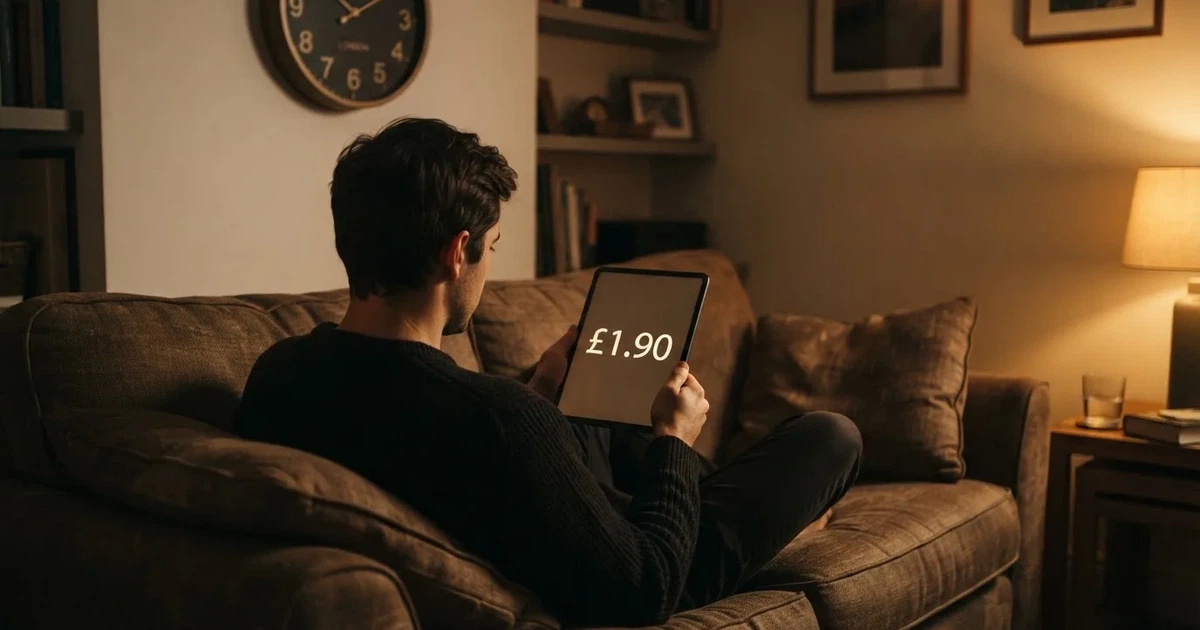
The arithmetic of a free bet whose stake is not paid back is straightforward. Take an illustrative two-way market at decimal odds of 1.90 and 1.90 — a coin-toss price, fractional 9/10, exactly the kind of line a free bet is placed at when the customer wants no risk of losing the stake on a long shot. The payout share of a 1.90/1.90 market is the reciprocal of the sum of the implied probabilities: 1 ÷ (1/1.90 + 1/1.90) = 1 ÷ (0.5263 + 0.5263) = 1 ÷ 1.0526 = 0.9500, or 95.00%. A successful free bet at 1.90 returns the stake-not-paid-back winnings of £9 for every £10 of free bet credit. Multiplied by the payout share to capture the chance of winning, the expected value of a £10 free bet at that market is £10 × (1.90 − 1) ÷ 1.90 × 0.9500 = £4.50.
That £4.50 is an average, not a promise. At a 1.90/1.90 market the bet wins roughly half the time and loses roughly half, and the £4.50 sits at the centre of a wide range. On a single bet the outcome is binary; on the average across many uses of the offer it is £4.50 per £10 nominal. The same £10 free bet at decimal odds of 5.00 — a longer price — gives £10 × (5.00 − 1) ÷ 5.00 × 0.9500 = £7.60 expected. A free bet at 1.20 — a heavy favourite — gives £10 × (1.20 − 1) ÷ 1.20 × 0.9500 = £1.58 expected. The longer the qualifying odds the more the free bet is worth on average, which is why minimum-odds floors in the operator’s terms are doing real work, not decoration.
The estimate does not predict the next race, the next match or the next set of results. It calculates what a free bet is worth at a chosen price, with the actual return depending on whether an individual bet wins. The arithmetic below shows how a free bet operates — using a £10 nominal stake, an illustrative 1.90/1.90 market, and a 95% payout share — so a bettor can see how the offer behaves with their own market and bet amount. A free bet is not a system that guarantees a win; it is a credit the operator has priced.
What minimum odds and the wagering requirement actually mean
The qualifying minimum odds say “this bet only counts towards the offer if every leg is at this price or longer”. A £20 welcome at minimum odds of 1/1 (2.0) is a bet that has to be placed on a selection whose decimal odds are 2.00 or higher. A bet at 1.80 (4/5) does not qualify. The minimum keeps the welcome trigger inside markets with real uncertainty — the operator is not paying the customer to bet on heavy favourites where the offer would have been triggered almost regardless.
The wagering requirement says “after the bonus is credited, wager this many times before withdrawing any winnings”. A £10 bonus with 10x wagering requires £100 of qualifying bets before the bonus-related winnings are withdrawable. The bets have to be on eligible markets at eligible odds, and the operator’s terms name both. Bets below the minimum price typically do not count, even when they win; the requirement is on qualifying bets, not on every bet the customer places.
The two work together. A reader who sees “100% up to £50, 10x wagering, min odds 2.0” needs to know three numbers to assess the offer: the £50 maximum bonus, the £500 turnover requirement at 10x, and the £2.00 minimum on every qualifying bet. The arithmetic on the bonus alone does not tell the reader what the bonus costs to clear, because the cost depends on the market’s margin and the qualifying odds.
Why the stake of a free bet is not paid back
A free bet is a credit on the account, not a cash balance. The operator prices the offer knowing that the customer cannot withdraw the free bet amount itself — only the winnings it produces. A £10 free bet at 2.00 returns £10 of profit, not £20; the £10 stake is the operator’s credit, and the £10 profit is the bettor’s actual winnings. The mechanic is what makes the offer affordable for the operator: a £10 free bet that pays back £20 of stake plus winnings at 2.00 would be worth £10 of expected value at any fair market; the stake-not-returned rule cuts that to roughly £5 of expected value. The lower ceiling is the cost the operator is willing to pay to put the brand in front of a new account, and the rule is built into almost every welcome offer on the GB market.
A small number of operator welcome offers do return the stake — enhanced-odds deals and “bet and get” structures where the qualifying bet is a real-money wager — and these are different offers priced differently. They are described as the operator’s terms state them.
Payments and payout speed in 2026
The minimum deposit varies by operator and by payment method. Sky Bet’s terms set a £5 floor across every payment method it accepts, with the operator able to change the minimum without prior notice. Betway’s minimum is £10. Some methods sit below the operator’s general floor: Sky Bet’s help page states that Pay by Bank has no minimum deposit amount, while other methods error out below the floor. A reader searching for a betting site with no minimum deposit is partly searching for the brand and partly searching for the method — and the page’s payment-method columns in the table below are read with that in mind.
The payment-method set is set by regulation and by the operator’s own choices. Credit cards are banned for gambling in Great Britain; that includes credit-card-funded payments through an e-wallet. The methods that remain include debit cards (Visa and Mastercard), Apple Pay, PayPal, Pay by Bank (Open Banking), Revolut Pay, bank transfer and a handful of others. LiveScore Bet’s help page lists debit cards, Apple Pay, PayPal, Pay by Bank and Revolut Pay. Sky Bet accepts debit cards, Apple Pay, Pay by Bank and Revolut Pay in GBP, with a hard limit of three debit cards linked to an account — a limit that does not apply to Apple Pay. The page does not assume any other operator runs the same list.
The number of debit cards that can be linked to one account is one of those operator-level limits a reader does not see in the marketing. Three cards is the common ceiling; some operators set two, some set five. Apple Pay, where supported, sits on top of an underlying card and is not counted towards the linked-card limit. A reader who spreads deposits across several cards to manage limits should check the operator’s linked-card policy before opening the account.
Payout speed varies by method. E-wallets and Pay by Bank tend to clear inside hours of the operator releasing the withdrawal; debit cards typically take one to three working days; bank transfer is the slowest at one to five working days. The operator’s own release step sits on top: the request is approved first, then the payment rail sends the money. The two are separate, and “instant withdrawal” marketing usually means an instant operator release rather than an instant bank arrival. Specific times for specific operators are not given on this page — they vary by method and by verification status — and the page reads the operator’s terms on this only where research names a figure.
Minimum-deposit betting sites and no-minimum-deposit betting sites are not separate market segments. The minimum is a parameter an operator sets inside its payments table, and a reader looking for the smallest entry point is reading that parameter across brands. The table below carries the operator’s own minimum and method list, and the section beneath it reads what the differences actually mean.
The minimum-deposit reading of an offer
A £5 minimum deposit and a £10 free bet welcome are two different levers. The first lowers the barrier to opening the account; the second lowers the barrier to placing the first bet. A reader who opens an account with £5 of debit-card money, places a qualifying bet at 1/1, and receives a £10 free bet has spent £5 of real money on the qualifying bet and may net £10 of free-bet value at a coin-toss market. The expected value of that £10 free bet at decimal odds of 1.90/1.90 is £4.50, as calculated above. The £5 qualifying stake has its own expected outcome — at 1.90 the expected return is £4.75, the expected loss is £0.25, and the £5 stake is returned with the winnings because it is a real-money bet. The two combine to roughly £4.25 of net expected value on the welcome. The £5 deposit is not the £10 free bet; the two are stacked.
Reading offers this way does not make them profitable. It makes the cost visible. A welcome that pays £10 of free-bet value at 1.90 in exchange for a £5 qualifying bet at 1.90 costs the customer £0.25 of expected value on the qualifying bet to receive £4.50 of expected value on the free bet, for a net of £4.25. The same welcome at 1.50 minimum odds would have a smaller expected value on the free bet because the lower minimum odds drag the free bet to a shorter price. The minimum-odds floor in the offer’s terms is doing more shaping of the value than the headline amount alone.
Ten licensed bookmakers in the GB market
The ten brands below each hold a Gambling Commission remote licence, each runs a GB-facing sportsbook, and each is read against its own terms rather than against the others. The ordering is not a ranking — no single brand is “the only” licensed operator, and a place in the comparison is not a recommendation. The reader’s job is to read each write-up for what the brand does and what its offer actually costs; the page’s job is to put the conditions on the same page so the comparison is honest.
| Brand | Gambling Commission licence holder and account | What the operator’s own terms state on free bets, deposits and welcome offers |
|---|---|---|
| LiveScore Bet | LiveScore Betting and Gaming (Gibraltar) Limited, Commission account 56859 | Debit cards, Apple Pay, PayPal, Pay by Bank and Revolut Pay accepted; minimum deposit and qualifying offer published on the operator’s site |
| Betfred | Petfre (Gibraltar) Limited, Commission account 39544 | New-customer free bets and free spins subject to the operator’s terms; safer-gambling information and GambleAware contacts in-app |
| 10bet | Blue Star Planet Limited, Commission account 43173 | 100% up to £50 betting bonus advertised for UK sign-ups, plus daily free bets and free spins |
| BetUK | LeoVegas Gaming PLC, Commission account 39198 | Four £10 free bets (two football accas of 4+ legs and two multiples of 2+) on a £10 deposit and a qualifying bet within 7 days, expiring 7 days after issue |
| Fitzwilliam Sports | SBKI Limited, Commission account 48760 | “High Stakes Welcome” subject to compliance criteria; capped-membership Dublin bookmaker |
| BetTom | Bet Tom Limited, Commission account 64959 | 50% back as a sports free bet up to £50 and a matching 50% back as casino free slot funds up to £50, presented as parallel offers |
| Star Sports | Star Racing Limited, Commission account 9177 | Pre-event and in-play markets with Bet Boosts, Daily Specials and Weekend Enhanced Boosts; in-play on football, horse racing, golf and US sports |
| Hollywoodbets | Hollywoodbets International UK Limited, Commission account 53028 | Stake returned as a free bet up to £30 on a first qualifying losing accumulator (£10+ stake, 3+ legs, odds 4/1+, settled within 7 days) |
| Fafabet | Taichi Tech Limited, Commission account 43760 | Best Odds Guaranteed on UK and Irish horse racing win and each-way bets from 9am on race days, paying the bigger of SP or original price |
| London Bet | Thistle Bet Limited, Commission account 66162 | UK-licensed and regulated; safer-gambling and age-verification controls in place; welcome offer and minimum deposit published on the operator’s site |
The columns are licence holder and the operator’s own published terms on the offers. No column shows a count of licences, a brand ranking or a comparative judgment — those are the page’s prose, not the table’s job. The format reads each row against the same three questions: who is licensed, what is offered, and what conditions sit on top. Where research does not cover a brand’s offer in detail, the table does not fill the gap with a guess; the operator write-up beneath says what is known and what is not.
LiveScore Bet — the in-play brand with a thin welcome
LiveScore Bet is the sportsbook arm of the LiveScore group, the live-scores service, and it carries a Commission licence under LiveScore Betting and Gaming (Gibraltar) Limited at account 56859. The brand’s strength is in-play: LiveScore’s scores feed gives the product a live-data backbone that other brands license in. Payment methods on the GB site cover debit cards, Apple Pay, PayPal, Pay by Bank and Revolut Pay, a list broad enough to cover most British bettors without forcing a bank transfer.
The welcome offer is published on the operator’s site and changes between promotional periods. Where research does not give a specific snapshot — and on this brand it does not give one — the offer should be checked on the operator’s own welcome page before opening the account. The page does not name a current amount, because the page does not have a current snapshot to name. What the operator’s terms make clear is that any welcome runs through the verification step before the first bet, including with a free bet.
The verdict on LiveScore Bet: a strong in-play product with a clean payment-method set and a thin welcome page compared with the bet-and-credit leaders. The bettor who values the live-data feed and a wide payment-method choice will use it; the bettor who is shopping for the largest free-bet welcome will read the table for the brands that publish one.
Betfred — the high-street name with safer-gambling depth
Betfred is the Fred Done bookmaker, a high-street name in British betting, and the GB-licensed remote operation runs under Petfre (Gibraltar) Limited at account 39544. The app lists responsible-gambling information and GambleAware support contacts visibly, which is more than a sticker on a settings page. The brand advertises new-customer free bets and free spins subject to the operator’s terms; specific amounts and minimum-odds figures should be checked on the operator’s site.
The appeal of Betfred is the multi-channel footprint. The retail shops give the brand a self-exclusion route offline, and the online product sits in the same operator group. The product is broad — horse racing, football, greyhounds, a casino tab — and the safer-gambling signage is consistent with the Commission’s LCCP. The free-bet welcome is competitive without being the headline offer on the GB market.
The verdict on Betfred: a long-standing brand with a visible safer-gambling layer and a welcome offer that runs through standard GB terms. The bettor who wants a high-street-name bookmaker with a clean app will use it; the bettor who is shopping for the largest headline amount will read the rest of the table first.
10bet — the daily-free-bet brand with a £50 cap
10bet runs under Blue Star Planet Limited, Commission account 43173. The brand’s sports welcome is a 100% bonus up to £50, plus daily free bets and free spins for returning customers. The £50 cap is on the lower end of GB welcome offers, and the daily free bets are what gives 10bet its shape beyond the headline. The wagering requirement and minimum odds are in the operator’s own terms and should be checked before opting in.
The product is broad: football, horse racing, in-play markets, a casino tab. The brand’s audience is the bettor who values a regular free-bet drip over a single big welcome. The Commission’s 10x wagering cap on bonuses applies to the welcome, which means a £50 bonus carries a maximum £500 turnover requirement before withdrawal. The combination of small welcome and frequent free bets is the brand’s pattern.
The verdict on 10bet: a lower-cap welcome with a frequent-free-bet structure that suits the regular customer more than the one-off shopper. The bettor who will bet with the brand every week gets more value here than one who signs up for a single welcome and leaves.
BetUK — the four-free-bets welcome on a £10 deposit
BetUK runs under LeoVegas Gaming PLC, Commission account 39198, and the welcome offer is published as four £10 free bets on a £10 deposit and a qualifying bet within 7 days of registering. The four free bets split into two football accumulators of 4+ selections and two multiples of 2+ selections, and they expire 7 days after issue. Opt-in is required.
The four-free-bets shape is a multiple-bet welcome: the customer is asked to place a multi-leg wager, which is a higher-variance market than a single. The football-accas-of-4+ requirement is the most restrictive part — a 4-leg acca needs four winning selections to land, and the qualifying bet’s terms describe the structure in detail. A reader who is comfortable with multiples gets more value out of the offer than one who would rather place singles.
The verdict on BetUK: a £40 welcome split across four bets on a £10 entry, well-shaped for the football-multiples bettor and poorly shaped for the singles-only customer. The expiry is tight at 7 days; the offer is read carefully before the qualifying bet is placed.
Fitzwilliam Sports — the capped-membership Dublin bookmaker
Fitzwilliam Sports describes itself as a Dublin bookmaker with capped membership, and the welcome is published as a “High Stakes Welcome” subject to compliance criteria. The brand runs under SBKI Limited, Commission account 48760, with a Commission remote general betting standard (real events) licence for GB-facing remote operations. The cap on membership is the unusual feature: this is not a bookmaker that takes every customer who applies, and the welcome is not a high-frequency offer.
The compliance criteria behind the “High Stakes Welcome” are the qualifying conditions the operator sets on each applicant, and the criteria sit on top of the standard GB verification step. A reader considering this brand should expect a more deliberate onboarding than at a mass-market bookmaker.
The verdict on Fitzwilliam Sports: a bookmaker for the customer who has been invited or who is comfortable with a deliberate onboarding process, with a welcome designed around the higher-stakes bettor rather than the casual one. The brand is not for every reader; it is for the reader it fits.
BetTom — the parallel sports-and-casino welcome
BetTom runs under Bet Tom Limited, Commission account 64959, and the welcome is a 50% back as a sports free bet up to £50 plus a matching 50% back as casino free slot funds up to £50. The two strands are presented as parallel offers rather than as a single bundle, which keeps the welcome inside the Commission’s 19 January 2026 rule on mixed-product offers.
The sports side of the welcome is the 50%-back shape: a customer whose first sports bet loses gets up to £50 back as a free bet, subject to the operator’s terms. The casino side is a free-slot-funds offer subject to its own wagering rules. Both strands have their own minimums, expiries and eligible-market lists, and the operator’s terms describe each.
The verdict on BetTom: a parallel welcome that respects the Commission’s mixed-product ban by splitting sports and casino into two offers. The bettor who wants both reads cleanly; the bettor who wants only sports skips the casino strand.
Star Sports — the price-boost and in-play brand
Star Sports runs under Star Racing Limited, Commission account 9177. The product centres on pre-event and in-play markets with Bet Boosts, Daily Specials and Weekend Enhanced Boosts on selected prices. In-play coverage spans football, horse racing, golf and US sports. The brand’s strength is the price-boost catalogue, which is the part of the product a reader with a frequent-betting habit uses most.
Readers should check the operator’s site for the current welcome offer and minimum-deposit specifics. The price-boost and enhanced-odds structure runs alongside the welcome rather than inside it, with its own rules on maximum stakes and eligible markets.
The verdict on Star Sports: a brand for the in-play and price-boost customer more than the one-off-welcome shopper. The bettor who values a strong in-play book with a daily price-boost catalogue will use it.
Hollywoodbets — the acca-insurance welcome
Hollywoodbets runs under Hollywoodbets International UK Limited, Commission account 53028. The sports welcome offer is stake returned as a free bet up to £30 on the first qualifying losing accumulator, with the qualifying bet requiring a £10+ stake, 3+ legs, odds of 4/1 or greater, and settlement within 7 days of registration. One free bet per customer.
The acca-insurance shape is the brand’s signature: the customer places a 3+ leg accumulator at minimum odds of 4/1, and if the accumulator loses the stake is returned as a free bet up to £30. The free bet is then subject to its own minimum odds and expiry on the operator’s site. The £30 cap is lower than the headline offers at bet-and-credit leaders, and the 4/1 minimum and 3-leg minimum are the qualifying bar.
The verdict on Hollywoodbets: an acca-insurance welcome that suits the multiples bettor and is less competitive for the singles customer. The £30 cap and the 7-day window keep the offer inside a tight envelope.
Fafabet — the Best Odds Guaranteed brand
Fafabet runs under Taichi Tech Limited, Commission account 43760. The product feature is Best Odds Guaranteed on UK and Irish horse racing win and each-way bets from 9am on race days: if the starting price is bigger than the original price taken, the bigger price is paid. The BOG mechanic is the brand’s centre of gravity and is one of the longest-standing customer-friendly concessions on the GB horse-racing market.
Readers should check the operator’s site for the current welcome and the qualifying terms. The horse-racing product is the brand’s strongest line; the football and in-play products sit alongside it.
The verdict on Fafabet: a horse-racing brand with BOG as the headline product feature and a welcome that should be checked before opening. The bettor who bets on UK and Irish racing gets the most value from the BOG; the bettor who does not bet on racing reads the rest of the table.
London Bet — the small GB-licensed bookmaker
London Bet runs under Thistle Bet Limited, Commission account 66162, and the app carries a 17+ App Store age rating. The brand describes itself as licensed and regulated in the UK and publishes safer-gambling and age-verification controls. Readers should check the operator’s site for the current terms.
London Bet sits at the smaller end of the GB-licensed sportsbook set, and the product is broad rather than deep: a sportsbook, a casino tab, the safer-gambling controls required by the Commission’s LCCP. The brand is a fit for the bettor who is shopping for a smaller operator with a GB licence and standard safer-gambling controls, rather than the bettor chasing the largest welcome or the deepest market catalogue.
The verdict on London Bet: a smaller GB-licensed operator with the standard Commission controls and a welcome that should be checked on the operator’s site. The bettor who wants a smaller bookmaker with the same regulatory framework as the larger ones gets what they came for.
What a no-deposit free bet actually looks like in 2026
The “no deposit” qualifier is doing something specific in the GB market in 2026. A no-deposit free bet is a credit the operator loads into the account without the customer having deposited first — a £10 free bet credited on registration, for example, with no qualifying deposit or bet required to claim. The offer exists at a handful of GB-licensed operators and rotates with promotional cycles; the Commission’s fact bank for this page does not pin a specific brand to a specific no-deposit offer in 2026.
What the framework says about such offers is closer to settled. The credit is still subject to verification — name, address, date of birth — before it can be used, and the standard verification step is the Commission’s LCCP requirement, not an operator choice. The wagering cap on bonuses applies to any welcome with a rollover condition; a no-deposit free bet that carries no rollover sits outside that cap’s arithmetic, though the Commission’s view on whether the cap applies to free bets without a wagering condition is not established. The stake of the free bet is not paid back with the winnings. The minimum odds on a qualifying bet, where the offer specifies one, must be met.
The expected value calculation on the previous section applies: a £10 no-deposit free bet at decimal odds of 1.90/1.90 is worth £4.50 on average, with the same wider range on individual bets. The fact that no deposit is required does not change the arithmetic of the credit. It does change the customer’s risk on the offer: a £10 no-deposit free bet that expires unused costs the customer £0, while a £10 deposit-gated free bet that the customer does not claim still costs the £10 deposit they have spent on a qualifying bet. The no-deposit shape is cheaper to walk away from and cheaper to leave on the table.
The reader’s checklist on any no-deposit offer is short. Verification is required before the bet can be placed, even with no deposit. The free bet stake is not returned. The minimum qualifying odds, where the offer names them, are a floor. The expiry is a deadline. The wagering condition, if any, is a turnover requirement before any winnings can be withdrawn. A bettor who reads those five lines has read the offer.
How the offer reads against the regulation
The 10x wagering cap from the 19 January 2026 promotion rules applies to bonuses at GB-licensed operators. The mixed-product ban removes bundled offers that ask the customer to bet on sport in order to qualify for casino, bingo or lottery incentives. The credit-card ban means no welcome offer can be triggered by a credit-card transaction, and a credit-card-funded e-wallet top-up is inside the ban. The £150 financial-vulnerability check, live since 28 February 2025, triggers a public-record search on accounts whose deposits-minus-withdrawals exceed £150 in a rolling 30 days; the check is not a credit-reference or income check, and the higher “financial risk assessments” of the staged Commission plan are announced but not in force. Identity verification before the first deposit or bet is the LCCP requirement since 7 May 2019, and a no-deposit free bet does not exempt the customer from that step.
The bonus cap does not abolish bonuses. Most of the welcome offers on the table above sit comfortably below 10x on any reasonable reading, and the operators that advertise a 50% back or a £10 free bet credit carry no wagering condition at all. The cap’s effect is on the worst structures — the 50x and 100x bonuses that were common at offshore brands and a few licensed holdouts — and on the bundles that tied betting to casino. The GB welcome set in 2026 is shorter on turnover and shorter on bundle.
The reader’s protection framework runs alongside the offer. GAMSTOP self-exclusion is a Commission licence condition for every GB-licensed online operator. Safer-gambling signage is required on every app. The alternative-dispute-resolution route is the formal complaint channel when an in-house complaint does not resolve. None of this turns a free bet into a safe bet, and the page does not describe any of these offers as risk-free or as guaranteed value. What the framework does is give the customer a written route when something goes wrong — a route that does not exist at an unlicensed brand.
Frequently asked questions about free sports bets with no deposit
How does someone get free bets with no deposit in Great Britain?
A no-deposit free bet is credited on registration without the customer making a deposit first. The offer exists at a handful of GB-licensed operators and rotates with promotional cycles, so the first step is to check the operator’s welcome page for the current shape. The credit is still subject to verification — name, address, date of birth — before the free bet can be used, because the Commission’s LCCP requires it. The free bet stake is not paid back with the winnings, and the operator’s terms name any minimum odds, expiry and wagering requirement.
How does someone bet on sports with no deposit?
The no-deposit free bet is the route: a credit the operator loads into the account on registration, used to place a wager without spending the customer’s own money. The credit is subject to the operator’s terms — minimum odds, eligible markets, expiry — and the stake is not returned with winnings. Verification is required before the first bet, including with a free bet or bonus, and the customer should check the operator’s welcome page for the current offer.
What is the maximum wagering requirement on a betting bonus in Great Britain?
The Commission’s promotion rules in force since 19 January 2026 cap wagering requirements on bonuses at 10x. A £10 bonus at 50x needed £500 of qualifying bets under the old rules; the cap brings that to £100. The cap applies to bonuses; a free bet with no wagering condition sits in a quieter spot, and whether the cap applies to such a free bet is not established in the Commission’s published rules. Mixed-product offers that bundle betting with casino, bingo or lottery are banned.
What do minimum odds and the wagering requirement mean in a sign-up offer?
The minimum odds are the qualifying floor: every leg of the qualifying bet must be at or above the stated price, and bets below the floor do not count towards the offer. The wagering requirement is the turnover hurdle: the bonus must be wagered the stated multiple of times before any winnings are withdrawable. Under the 10x cap, the maximum turnover on a £10 bonus is £100 of qualifying bets. Bets below the minimum odds usually do not count, even when they win.
Why is the stake of a free bet not paid back with the winnings?
The free bet is a credit on the account, not a cash balance, and the operator prices the offer knowing the customer cannot withdraw the credit itself — only the winnings it produces. The mechanic is what makes the offer affordable: a £10 free bet at decimal odds of 2.00 pays £10 of profit, not £20, and the expected value of the offer is built around the stake-not-returned rule. A small number of welcome offers do return the stake — enhanced-odds deals and bet-and-get structures with a real-money qualifying bet — and these are priced differently on the operator’s terms.
Can a bet on sport be tied to a casino bonus under the Commission’s promotion rules?
No. The Commission’s promotion rules in force since 19 January 2026 ban mixed-product offers — an offer that asks the customer to gamble on two or more product types such as betting, casino, bingo and lottery. A promotion that requires a sports bet in order to receive free casino spins, or that requires casino play to qualify for a sports free bet, is not permitted at GB-licensed operators. Single-product offers — sports only, casino only, bingo only — are unaffected, and operators structure parallel offers rather than bundled ones to keep within the rule.
Free bets & offers – UK betting
Content created by the «UK betting» team
