
Curling betting odds, 2026
 Available in US
*Current as of 27 October 2026 · verified against the Gambling Commission’s public register of remote betting licences.*
Curling is a niche event, which is the first thing to know before looking at a price. The big-tournament calendar runs the World Curling Championships, the European Curling Championships, the Grand Slam of Curling on the World Curling Tour, and the Olympic Winter Games every four years — and the rest of the year the menus thin out to domestic leagues and the World Mixed Doubles. With fewer betting houses pricing each match, the lines sit wider, and a quoted price of 1.90 on either side is not a misprint, it is the market telling you what two books can be persuaded to disagree on. What follows is a working guide to the prices you actually meet, what markets the licensed UK bookmakers carry, and the small set of mechanical facts — the margin, the licence, the verification at sign-up — that decide whether a number is worth trusting at all.

Fixtures, tournaments and what the calendar looks like
The international curling calendar is a small one, and a betting calendar mirrors it more closely than for football or tennis. Two structures carry most of the action: the men’s and women’s World Curling Championships, which decide world titles, and mixed doubles at world and Olympic level. Beneath those sit the European Curling Championships, the Continental Cup, the World Junior Curling Championships, the World Senior Curling Championships, the World Mixed Doubles Championship, and a year-round World Curling Tour whose Grand Slam events are the closest thing the sport has to a regular season. The Olympic Winter Games take place every four years, and mixed doubles was first held at the Olympics in 2018 — a separate event with a separate draw, and worth treating as its own betting subject rather than a trimmed version of the team game.
For bettors, the practical consequence of a thin fixture list is that prices change slowly and coverage is uneven. A match at the World Championships may carry head-to-head lines, totals over a stated number of ends, set-correct-score and outright markets for the tournament winner, top-four finish and group qualification. A domestic league fixture a fortnight later, on the same bookmaker’s site, is more often a single match-winner market and a few props. That is the rule of thumb to take to any site that promises extensive curling: depth is an event-by-event promise, not a sport-wide one.
Boutique sportsbooks that carry curling tend to do so for a reason. Some are hockey- or winter-sport-led and treat curling as a side product of their ice-time content. A few specialist bookmakers focus on niche winter sports and Olympic outrights and price curling because their customer base is already there. The mainstream UK brands with a long tail of in-play and outright markets tend to list curling around major events and step away in the off-season. The pattern matters: a price on a Friday-night World Curling Tour match may be the only price on a Friday-night World Curling Tour match, and the comparison you might do with a Premier League match — same operator, different market — does not apply.
In the year ahead, the natural moments when lines harden are the World Curling Championships (typically April), the European Curling Championships (typically November/December), the Continental Cup (every two years, alternating host), the World Mixed Doubles Championship and the Olympic Winter Games when one falls. Outside those windows, expect markets to be lighter and prices to be set with a wider margin. The remaining fixture list in any given week lives in the World Curling Tour calendar and the smaller national leagues (the Swiss League, the Alberta Curling Tour, the Korean leagues) where a UK bookmaker may carry only an outright or a match-winner.
Fundamenta of curling and why they shape the markets
The vocabulary below is the small working set the rest of this page leans on. Curling is built on ends, stones, the house and the hammer. A team has 4 players (2 in doubles), and each player throws two of the team’s eight stones; the eight from each side make up the 16 stones played in an end. Curling games usually last 8 or 10 ends; international competitive games are generally 10 ends, and the timing matters for any total-ends market a bookmaker offers.
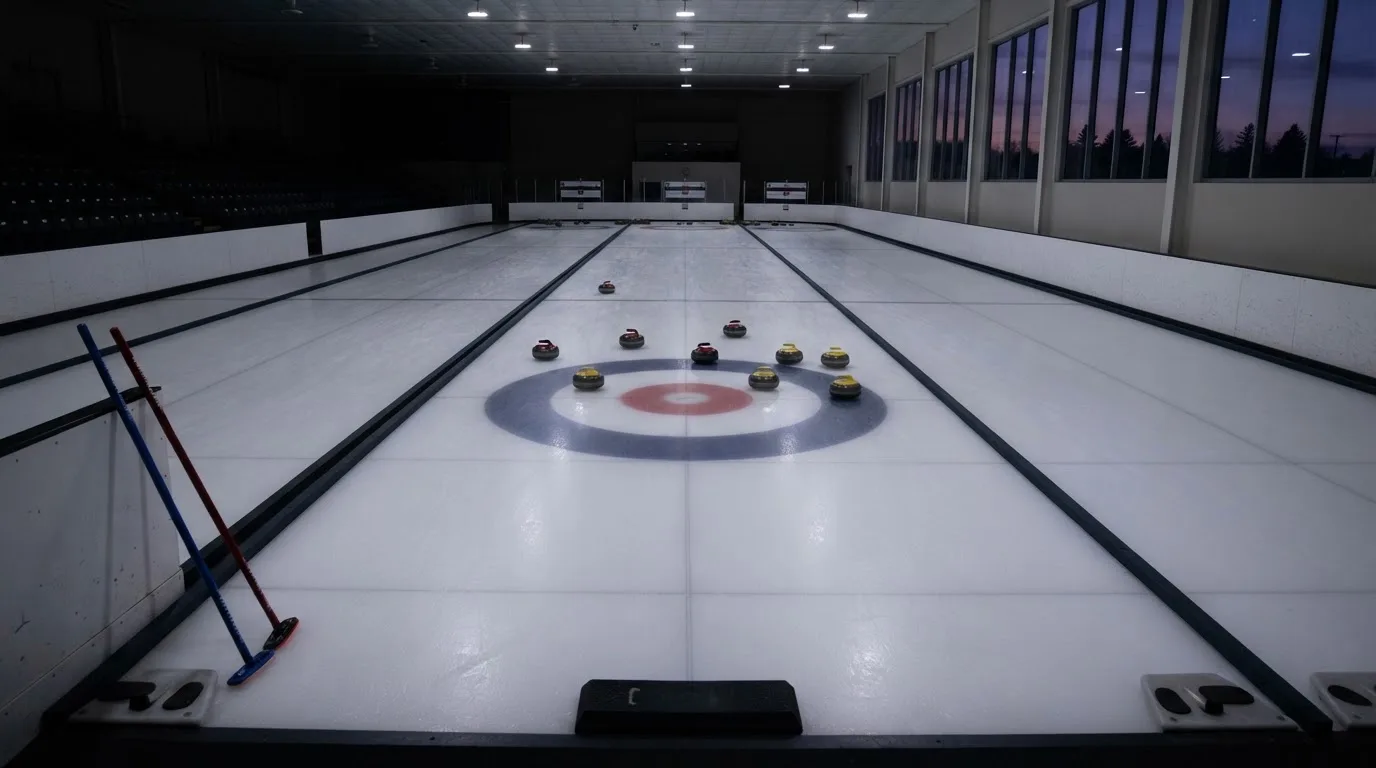
After all 16 stones of an end are thrown, the team with the stone closest to the button scores one point for each of its stones closer than the opponent’s nearest stone; only stones in the house count. Tied curling games go to extra ends, which is why any match-winner market needs the rule of “draw or extra end” in mind — a tie in regulation is not a push. The hammer (last stone of an end) goes to the team that did not score in the previous end; if an end is blanked, the hammer stays with the same team. This is the most consequential single fact on the page. In a sport where one stone decides the end, knowing who has the hammer is roughly half of in-game reading, and bookmakers who price end-by-end or hammer-related markets are pricing a flow state, not a result.
Curling stones weigh between 17.24 and 19.96 kg (38 to 44 lb) under World Curling Federation rules, which rarely matters to a bettor unless a market is built on equipment specifications. Curling became an official Olympic medal sport at the 1998 Winter Olympics, and mixed doubles was first held at the Olympics in 2018, both of which set the floor for outright and futures markets around a Games year.
For a bettor the practical reading list is short. Match-winner markets, sometimes with a draw price for a tie, and outright tournament winner are the staples. Correct-score and over/under on ends (most commonly over/under 9.5 ends in a regulation game) appear around bigger events. Handicaps are unusual in curling because the sport does not score like football or basketball; a market may offer a “first to X ends” or “lead after Y ends” instead, which behaves similarly. Props on individual ends and on hammer/no-hammer are rarer but exist, and where they do the price reads the same way as any two-way market — through the margin.
The market that does not exist in the form football bettors expect is the three-way 1X2. There is no draw in the betting sense because a regulation tie produces an extra end and a winner. The two-way line is the standard, and that has a small arithmetic consequence: a balanced two-way market at 1.91 on each side is the equivalent of a 4.5% margin, which is roughly the working level of a sharp bookmaker on a Premier League three-way at 1.95/3.40/4.33. The point is not to memorise a number but to recognise the shape. Two prices and a margin sit behind them; the rest of the article is about what that margin does to a curling price.
Where the price comes from, and what the margin does to it
A bookmaker’s margin is the share of every pound bet that the firm keeps, on average, across a market. It is built into the prices: the two sides of a market do not sum to 100% in payout share, and the gap between the sum and 100% is the margin. On a 1X2 football market priced 1.95 / 3.40 / 4.33, the payout share is about 95.0% and the margin is about 5.0%; on a balanced two-way curling market at 1.90 / 1.90, the payout share is 1 ÷ (1/1.90 + 1/1.90) = 0.9526, so the margin is 1 − 0.9526 = 0.0474, or about 4.7%. A market at 1.85 / 1.85 is wider: 1 ÷ (1/1.85 + 1/1.85) = 0.9259, a margin of 7.4%. The wider the gap between the prices and the implied 50/50, the bigger the firm’s cut on every pound bet, and the harder the bettor has to work to come out ahead.
The illustration below is not a quoted price from any bookmaker. It is a worked example at an even-money two-way line, which is roughly what curling match-winner markets tend to look like around bigger events. The numbers in this paragraph come from the formula on the page and not from a snapshot of any operator’s site, so the year of reading does not age them: a margin on a market is a property of the line, not a price.
Take an illustrative two-way market priced 1.90 / 1.90 (fractional 9/10 on each side). The payout share is 1 ÷ (1/1.90 + 1/1.90) = 0.9526, or 95.26%, and the margin is therefore 4.74%, or roughly 5p in every pound bet on the market. On a stake of £10 at 1.90, a winning bet returns £19.00 — the £10 stake plus £9.00 of profit — and a losing bet returns nothing. Over many bets at this margin, a bettor at 50% strike rate on a balanced two-way market loses 4.74% of total stake in expectation, before any bookmaker-specific terms kick in.
A balanced two-way curling market is the friendliest case. Real prices on a competitive curling match sit between 1.70 and 2.20 on either side, with the favourite shorter, the outsider longer, and the margin widening as the gap grows. A line of 1.50 / 2.75 has a payout share of 1 ÷ (1/1.50 + 1/2.75) = 0.8807, a margin of 11.9%, which is roughly twice as expensive to bet on as a balanced 1.90 / 1.90 line. A line of 1.20 / 5.00 is in a different league: 1 ÷ (1/1.20 + 1/5.00) = 0.9231, but the distribution of stakes on a 1.20/5.00 line is heavily skewed to the favourite, so the effective margin on the actual book is what the firm expects to keep on real money — typically wider than the simple average suggests. The lesson is straightforward. The further from even-money a curling market sits, the more the price contains the firm’s take, and the more the bettor is paying to play.
Free bets, price boosts and the rest of the marketing machinery change the picture at the margin but not its shape. A free bet whose stake is not returned is worth less than its face value, because the bettor is risking the operator’s money on a market with its own margin; the expected value of a £10 free bet at 1.90 on a 4.74% margin market is 10 × (1.90 − 1) ÷ 1.90 × 0.9526 = £4.51, not £9.00. A price boost that moves a 1.90 line to 2.10 is a different product, with a different arithmetic, and the value depends on the margin of the new line. Both are explained in the working-out-the-return section of this page.
How a return is worked out from the stake and the odds
Decimal odds of 1.90 mean that a winning stake of £10 returns £19.00 — the stake plus the profit, with no further subtraction. The return is stake × odds, the profit is stake × (odds − 1), and the two are the same calculation with one term added or removed. Fractional odds of 9/10 mean the same: a £10 stake returns £19.00 because £10 × (9 ÷ 10 + 1) = £19.00, and the profit is £9.00 because £10 × (9 ÷ 10) = £9.00. The conversion from fractional to decimal is a/b → a ÷ b + 1, applied to each side of the line; the two notations are not in conflict, they are the same number written two ways.
For a combination bet the odds of the legs multiply into one price. Three legs at 1.50, 1.80 and 2.00 become 1.50 × 1.80 × 2.00 = 5.40, and a £10 stake returns £54.00 if all three legs win, with a profit of £44.00. Each leg is a two-way curling match (no draws, because regulation ties go to extra ends) or another sport, and the multiplication compounds not just the upside but the margin. Three legs at a 4.74% margin each, taken as a fair illustration, give a combined payout share of 0.9526³ = 0.8650, a combined margin of 13.5%. The accumulator’s headline price looks generous; the price the bettor actually pays is the multiplied margin.
The same principle applies to a bet builder. A curling Bet Builder combines markets from one match — match-winner, total ends, lead at the fifth end — into a single price, and the price is the multiplication of each leg’s odds. The legs are correlated in reality (a team winning tends to play more ends and tends to lead at the fifth end), and a well-priced builder reflects that. A poorly priced one does not, and the bettor is left with a builder whose combined margin is wider than the legs’ individual margins would suggest if they were independent. The defensive move is to compare the builder price to a hand-multiplied price of the same legs and see what the book is taking.
Cash out is a separate calculation and is best treated as a quoted price. When a bookmaker offers a cash-out value, that value is the price the firm is willing to lock in at that moment, and it sits inside the firm’s own margin. The bettor is selling a position back to the bookmaker at a price that already includes the firm’s take, on top of any movement in the underlying odds since the bet was placed. A high cash-out value relative to the current price is a sign of either a generous bookmaker or a market that has moved against the book; a low one is the opposite. There is no general rule for which is which, only a check against the current line.
The landscape of curling betting at UK-licensed bookmakers
The set of brands that hold a Gambling Commission remote licence and offer markets on curling is a working set, not a fixed one. The Commission’s public register is the whole test of who holds one, and any brand a UK bettor can fund and place a curling bet with is either on the register or is not. The “only licensed brand” framing that some marketing pages reach for is wrong in principle: the register lists many more operators than any review can feature, and a place in a comparison is a place in a comparison. The right question is which of those licensed brands price curling at all, and at what depth.
The mainstream answer, for the bigger UK brands, is “occasionally, around major events”. Betfair Sportsbook’s proposition, including in-play, Bet Builder, free live streaming of UK and Irish horse racing and football, and a 90 Minute Payout market, is built around the volume sports; curling is a side product and tends to be priced around the World Championships and the Olympic Winter Games. bet365, the official global betting partner of the UEFA Champions League and the most downloaded sports betting app in the UK, offers Bet Builder+, Super Boosts, Winnings Boosts on Bet Builders and selected singles, and daily Bet Boosts, with curling most likely to appear in-play and outright around a tournament window. Unibet, which has operated since 1999 and is run in the UK by Platinum Gaming Limited, Gibraltar, under Gambling Commission account 45322, is a long-tail bookmaker and tends to list curling at the same windows as the rest of the volume-priced market.
The smaller UK brands vary more. Some, like Spreadex, run a hybrid fixed-odds and spread-betting model and price curling in the spread-betting book when the calendar offers it; Spreadex is regulated by the FCA for spread betting and by the Gambling Commission for fixed-odds betting, and notes that spread betting losses can exceed the deposit, which is the line every spread bettor should read before opening the book. QuinnBet, which offers Best Odds Guaranteed on UK and Irish horse racing and a maximum benefit of £150 per customer per race, is a long-tail sportsbook whose curling coverage depends on the season. Lottoland’s UK app, which combines casino, lottery betting, sports betting and scratchcards, lists curling as one of many sports, generally around the same windows. BetAhoy and BetGoodwin are smaller still, with limited outright and match-winner markets, and their curling menus are thin even in season.
Fitzdares’ app, which offers cash out, accumulators, Lucky 15s, specials and antepost markets on horse racing, football, tennis, rugby, cricket, golf and American football, with in-play live odds, names its sports openly; curling is not among them, and a bettor looking to play curling at Fitzdares during a quiet week of the World Curling Tour will not find it. The takeaway is to read the operator’s own sports list before assuming curling is in the book, especially for a boutique bookmaker whose menu is published and stable.
The other half of the landscape is the betting exchanges, which are their own category of licence. A betting exchange lets a bettor back and lay, and the margin is in the commission on net winnings rather than the overround of the prices. Exchange liquidity on curling outside the World Championships and the Olympic Winter Games is thin, and the price can be set by a small number of participants; this is a working environment that suits a bettor who can afford to wait for a price and has an account at the only exchange that happens to have a counterparty. Inside a major event, exchange prices are competitive with the bookmakers’ lines and sometimes sharper. Outside one, the bookmaker’s match-winner market is the easier trade.
A consequence that follows from the landscape: at any given moment the number of operators actively pricing a specific curling match is small. The choice between them is not the choice between ten prices but between one, two or three. Comparing those few prices — match-winner at 1.85 with one, 1.90 with another, 1.95 with a third — is the working exercise, and a difference of 0.05 in decimal odds on a £10 stake is £0.50 of profit at the same result.
Statute, jurisdiction and the licence check
The framework that governs UK-licensed online bookmakers is the Gambling Act 2005, which covers Great Britain (England, Scotland and Wales); Northern Ireland is outside the Act and has its own older law, so a GB licence does not regulate Northern Ireland. The Gambling Commission is a non-departmental public body sponsored by the Department for Culture, Media and Sport. Since the Gambling (Licensing and Advertising) Act 2014 an operator whose remote facilities are used in Great Britain needs a Commission licence wherever it is based; a Curaçao, Maltese or Gibraltar licence is not a substitute. Sections 33 and 36 of the 2005 Act, as amended, are the relevant provisions. The Commission licenses the whole commercial market: there is no state monopoly and no cap on the number of licences.
There is no statutory list of permitted bets or markets in Great Britain. An operator holds a licence for a category and offers markets under its own rules and the Licence Conditions and Codes of Practice (LCCP). Betting licence types include remote general betting standard (real events), remote general betting standard (virtual events), remote general betting limited, remote pool betting and remote betting intermediary, which is the licence for betting exchanges. Spread betting that is not a financial product is inside General Betting Duty; financial spread betting is regulated by the Financial Conduct Authority, not the Commission. In-play betting is offered by GB bookmakers, and the controls are the operator’s licence conditions and customer-protection duties; the legal position is that in-play is permitted, not that it is unrestricted. Esports are treated like any other event; virtual events are a separate licence category.
Identity is verified before the first deposit or bet. Name, address and date of birth are checked before a customer can deposit or gamble, including with a free bet or bonus, a rule in force since 7 May 2019. The minimum age is 18. Credit cards are banned for gambling in Great Britain since 14 April 2020, including credit-card-funded payments through an e-wallet; debit cards and bank-based payments are not covered by that ban. There is no state-set deposit or loss ceiling for sports betting: limits are the customer’s choice, and the operator must offer a deposit limit on a fixed time frame. A financial vulnerability check (LCCP condition 3.4.4) applies to licensed remote betting when a customer’s deposits minus withdrawals exceed £150 in a rolling 30 days; this is a public-record check (bankruptcy, county court judgments), not an income check or a credit reference check. Financial risk assessments, the so-called “affordability checks” of the press, are announced in a staged plan, with no start date. Whether a state-set default deposit ceiling is in force is not established: the rule on operators’ deposit limits has been in staged implementation, with the first changes since 31 October 2025, a second phase postponed to 30 September 2026, and the live position unclear at the date of writing. The player’s tax position is that winnings are not taxed in Great Britain, with the usual caveat about professional gamblers; General Betting Duty is the operator’s tax on gross profits, currently 15%, and from 1 April 2027 a new remote betting rate of 25% applies within it.
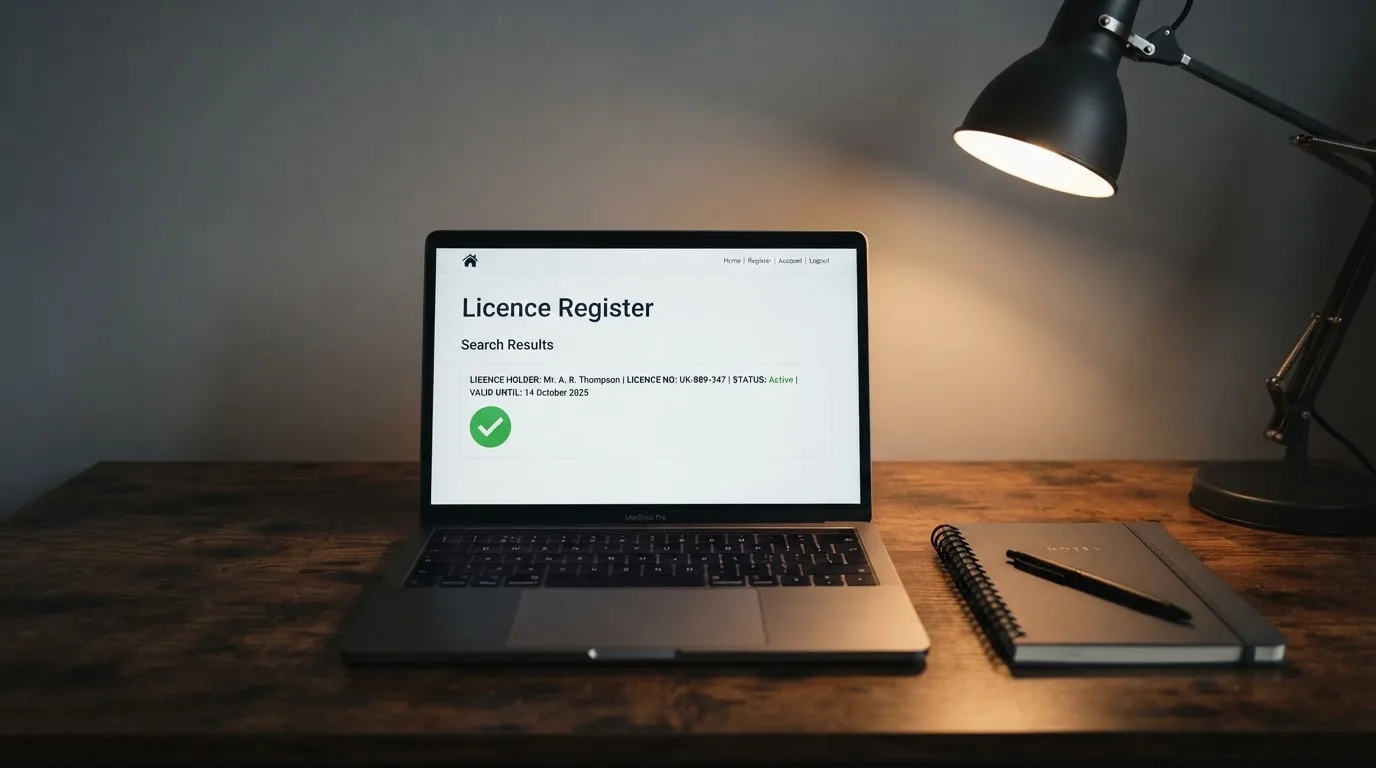
A brand’s claim of a Gambling Commission licence is checked through the Commission’s public register, which can be searched by business name, trading name, domain or account number. The register is the whole test of whether a brand holds a licence, and the page’s own licence statements below name the Commission account and the licence holder so a reader can do the check in a single visit. The account number is the unique identifier; the licence number is a longer string that records the operator’s site and category, and the two appear together on the register. Where the page states a licence it states the Commission account and the licence holder’s name; both are visible on the register and both are worth verifying before depositing.
Offshore brands are a separate question. A GB licence is compulsory at the point of consumption, and providing gambling facilities in Great Britain without the licence the Act requires is an offence under section 33 of the Gambling Act 2005, with penalties of up to 51 weeks’ imprisonment, a fine up to level 5, or both, and six months in Scotland. The offence is aimed at the operator. A customer who bets on an unlicensed site loses the consumer protections: no GAMSTOP coverage, no Commission complaints route, no approved dispute-resolution body, no British consumer redress if funds are withheld, and no obligation on the operator to follow the 10x bonus cap or the £150 vulnerability check. That is the framing: licensed brands check, verify, limit, exclude and cap; unlicensed brands do not. Neither is “the safe choice” by default, and a reader who chooses the licensed route pays for that choice in the verification step before the first bet.
Responsible gambling, GAMSTOP and where to get help
GAMSTOP is the national multi-operator online self-exclusion scheme and a mandatory licence condition for online operators since 31 March 2020. Every GB-licensed online operator takes part in it. Exclusion periods are six months, one year, five years, or five years with auto-renewal, and after the minimum period the exclusion stays in place for a further seven years unless the customer asks GAMSTOP to remove it. GAMSTOP covers online sites and apps; betting shops use a separate service.
The line that follows from that is the practical one for a curling bettor in any week of the year. A self-excluded customer at a licensed site cannot deposit, cannot place a bet and cannot claim a bonus. The exclusion applies to all GB-licensed online operators, not to the brand the customer first registered with. The bettor is in the same boat at the next brand, the one after, and the one after that, because GAMSTOP is the whole online market, not a single firm’s rule. This is what makes the exclusion work; it is also what makes the inclusion question sharper for a bettor who wants to come back before the end of a five-year exclusion.
Help is the section below the rules. GamCare runs the National Gambling Helpline, and its services are free and confidential. GambleAware funds treatment and research. The NHS runs gambling clinics in several regions. Gamblers Anonymous runs local support groups. The licensed operators link to these services — Fitzwilliam Sports, for example, links to GambleAware, GamStop and Gamblers Anonymous from its safer-gambling page — and a reader who is worried about their own betting can reach any of them directly. The 18-and-over rule, the verification step at sign-up and the 10x bonus cap are protections for the bettor who can still bet; the help lines and the exclusion scheme are for the bettor who can no longer bet safely.
The line that sits across all of this is honesty about what a bookmaker can and cannot do for a customer’s wellbeing. A licensed brand offers a deposit limit, a time-out, a self-exclusion and a signpost to help; it does not, and cannot, monitor whether a customer has a problem. The check that a customer is gambling within their means is partly the customer’s, and the help lines exist for the moment when it stops being so.
The bookmakers
The set below is the ten brands the Commission register lists against a remote general betting standard (real events) licence, with curling coverage where the operator’s own terms or app description state it. Each write-up closes on the page’s own judgement of the brand for a curling bettor, not a marketing summary. The brands are presented in a fixed order, not a ranking, and the licence check is the first fact in every card.
BetMGM — broad sportsbook, curling present at the major windows
Licence: Gambling Commission remote licence 039198-R-319450-029 (Commission account 39198); licence holder LeoVegas Gaming PLC.
BetMGM’s UK sports welcome offer for new customers who deposit £10 or more and place a sports bet within 7 days is four £10 free bets (two football accumulators of 4+ selections and two sports multiples of 2+), valid for 7 days with minimum odds and opt-in required. The bookmaker’s proposition is broad — a sportsbook with casino, in-play and a long list of price boosts — and curling is one of many sports in the menu. The free-bet construction is worth reading carefully: two of the four £10 free bets are tied to football accumulators, so a curling bettor is using the other two (the sports multiples of 2+) and the operator is paying £20 of value on a £10 qualifying deposit. That is competitive with the broader UK market for a sportsbook-led offer, and weaker than a curling-specific free bet would be — but no curling-specific free bet exists at the brand, and the multiple-of-2+ structure lets a curling bettor combine two curling lines into a £10 free bet at 1.60 or higher.
Curling coverage at BetMGM is the mainstream long-tail: outrights and match-winner markets around the World Curling Championships and the Olympic Winter Games, with in-play and bet-builder markets thinner than football’s. A bettor who wants curling prices on a Tuesday-night World Curling Tour match may find the book empty, and a bettor who wants curling prices on a Saturday World Championships final will find them.
Verdict: a competitive mainstream sportsbook for a curling bettor who plans around the major events, with a free-bet offer that pays £20 of value on a £10 deposit if the bettor is willing to use the football-accumulator free bets elsewhere. The brand’s breadth is the asset; the curling depth is the cost.
Star Sports — racing-led, with a phone-trader model and a curling book on the side
Licence: Gambling Commission remote licence 009177-R-104555-019 (Commission account 9177); licence holder Star Racing Limited.
Star Sports’ model is partly telephone-led: customers can speak to a trader directly on 08000 521 321 to open an account, place bets or ask customer queries, with email support at [email protected]. The bookmaker’s strength is horse racing, and the curling menu is a side product. A bettor who wants curling prices on a major event will find match-winner and outright markets; a bettor who wants curling prices on a smaller event will be told, often by the trader, what the book is willing to do. The phone-trader model cuts both ways: it is the route to a price on a market the firm has not pre-priced, and it is the route to a stake limit the firm has not pre-set.
Verdict: a curling bettor who already bets on horse racing and is comfortable speaking to a trader is well served; a curling bettor who wants a self-service app and a Bet Builder will be in the wrong shop. The licence and the model are both above-board; the proposition is for a particular kind of customer.
BetTom — small sportsbook with a split casino offer
Licence: Gambling Commission remote licence 064959-R-339314-003 (Commission account 64959); licence holder Bet Tom Limited.
BetTom’s sports welcome offer is 50% back as a free bet of up to £50, with a matching 50% back up to £50 as free slot funds for casino play. The two halves are not interchangeable: a curling bettor’s qualifying bet is in the sports book, and the casino half is the slot-machine side. The offer is competitive in cash terms at the upper end (£50 of sports free bets on a £100 qualifying bet, £50 of casino free funds on the same deposit) but ordinary for the kind of small sportsbook that pairs a sportsbook with a casino. A bettor who plays both is in the brand’s target market; a bettor who plays only curling is half-using the offer.
Curling coverage at BetTom is the long-tail small-sportsbook pattern. Outrights at the bigger events, match-winner markets on individual games, and a book that runs thinner outside the World Championships and the Olympic Winter Games. The in-play book on curling is light, and there is no Bet Builder for the sport.
Verdict: a fair sportsbook for a curling bettor who also plays casino. A curling-only player may find the offer less efficient, as it requires casino play to fully unlock, and the curling menu is limited outside the major events.
Betboro — curling book with a structured first-bet offer
Licence: Gambling Commission remote licence 044181-R-324363-007 (Commission account 44181); licence holder Webmedia Development N.V.
Betboro’s sports welcome offer is a 100% matched free bet of up to £25 on the first qualifying wager, requiring a debit card deposit of at least £10 and a first bet of £5 to £25 with at least three selections each at 3/5 (1.60) or higher. The “at least three selections” rule is the salient fact: the qualifying bet is a treble at minimum, and a curling bettor is combining three curling lines into one bet at 1.60 or higher. A treble of three 1.60 lines multiplies to 4.096, and a £25 qualifying bet returns £102.40 if all three legs win; a £25 qualifying bet that loses converts to a £25 free bet under the offer, and the free bet’s value depends on the market it is used on.
The treble-only structure is a deliberate choice by the operator: it raises the bar for the qualifying bet, which filters for customers who are willing to combine markets, and it lets the firm price the offer against an accumulator margin. A curling bettor who wants a single qualifying bet is in the wrong offer; a curling bettor who is happy to build a three-leg curling acca is well served.
Verdict: a curling-friendly offer at the structural level (treble legs at 1.60 minimum fits within standard match-winner and over-ends markets), and a curling book that runs as a long-tail sportsbook. It is best suited for bettors who combine selections into trebles, while single-bet players may prefer more flexibility.
Lottoland — lottery-led with a curling book as a side product
Licence: Gambling Commission remote licence 038991-R-319408-020 (Commission account 38991); licence holder EU Lotto Limited.
Lottoland’s UK app combines casino, lottery betting, sports betting and scratchcards, and it states it is licensed by the Gambling Commission for customers in Great Britain. The brand’s centre of gravity is the lottery and the lottery-betting book, and the sportsbook is a side product; the curling book sits inside that side product. A bettor looking for a curling outright on the World Curling Championships will likely find one; a bettor looking for in-play curling prices on a Wednesday-night match will not.
Verdict: a useful supplement for those who already use the brand for lottery and scratchcards, but those needing a dedicated curling sportsbook should look elsewhere.
BetGoodwin — small sportsbook with a three-part free-bet offer
Licence: Gambling Commission remote licence 002927-R-327985-008 (Commission account 2927); licence holder Goodwin Racing Limited.
BetGoodwin’s sports welcome offer is “Bet £10 & Get £15 in Free Bets”, made up of a £5 sports bet, a £5 acca and a £5 Sub-Cover bet. The three-part construction is unusual: the £5 sports bet is a single, the £5 acca is a multi-leg bet, and the £5 Sub-Cover bet is a market specific to the brand (typically a substitute-related market, and worth reading the operator’s own terms to confirm what it covers). A curling bettor’s natural use of the offer is the £5 single on a curling match, the £5 acca on a curling treble, and the £5 Sub-Cover bet — which may or may not cover curling, depending on the market.
Verdict: a curling-friendly small sportsbook with a three-part welcome offer. It suits bettors who use multiples and want to compare prices against a smaller bookmaker.
Betfair — exchange-led, with a sportsbook on the side
Licence: Gambling Commission remote licence 039439-R-319330-013 (Commission account 39439); licence holder PPB Counterparty Services Limited.
Betfair Sportsbook offers in-play betting, Bet Builder, free live streaming of events such as UK and Irish horse racing and football within the app, and a 90 Minute Payout market. The headline is the exchange, which is its own licence category, and the sportsbook is a side product that gives the exchange’s customers a fixed-odds book for markets the exchange has not priced. Curling on the exchange exists at the major events and is thin outside them; curling on the sportsbook is a longer menu around the same windows, with in-play and Bet Builder the firm being the strongest.
Verdict: a curling bettor who already uses the Betfair exchange is well served by the sportsbook; a curling bettor who wants the firm’s full attention on a curling match is in the right shop only at the World Championships and the Olympic Winter Games. The proposition is exchange-first and curling is a long-tail product of the long tail.
Fitzdares — premium boutique, no curling in the published menu
Licence: Gambling Commission remote licence 000400-R-103839-030 (Commission account 400), categories include remote general betting standard (real events); licence holder Fitzdares Limited.
Fitzdares’ app offers cash out, accumulators, Lucky 15s, specials and antepost markets on horse racing, football, tennis, rugby, cricket, golf and American football, with in-play live odds. Curling is not in the published list of sports, and the licence category is broad enough that the operator could add it; the practical position at the date of writing is that curling is not priced.
Verdict: a curling bettor is in the wrong shop, and the licence check confirms the brand is licensed for the sports it does price. A reader who wants the brand’s premium service for horse racing and golf is in the right shop; a reader who wants curling should be elsewhere.
QuinnBet — long-tail sportsbook with curling around major events
Licence: Gambling Commission remote licence 061011-R-335683-004 (Commission account 61011), categories include remote general betting standard (real events); licence holder QuinnBet (Gibraltar) Limited.
QuinnBet’s Best Odds Guaranteed applies to Irish and UK horse racing bets from 10:00am daily on singles, multiples and system bets, with a maximum benefit of £150 per customer per race. Curling is one of many long-tail sports on the book, with match-winner and outright markets at the major events and a thin in-play offering outside them. A curling bettor is in the brand’s long tail and the book is not built around the sport.
Verdict: a curling bettor who already uses QuinnBet for the horse-racing BOG offer and wants a long-tail sportsbook is well served; a curling bettor who wants a curling-specific book is in the wrong shop. The proposition is racing-led and curling is a side product.
Bet Ahoy — small sportsbook, curling present only at major events
Licence: Gambling Commission remote licence 100094-R-341742-003 (Commission account 100094), categories include remote general betting standard (real events); licence holder Bet Ahoy Ltd.
Bet Ahoy’s welcome offer is “Bet £10 & Get £10 in Free Bets”, made up of a £5 sports bet and a £5 acca. The construction is the standard small-sportsbook two-part offer, and curling is one of the long-tail sports. The published coverage of curling at the brand is not as deep as the long-tail majors, and the menu at a smaller curling event is likely to be empty.
Verdict: a curling bettor who already has a Bet Ahoy account is well served by the long-tail menu; a curling bettor who wants a brand with a curling book around the year is in the wrong shop. The licence is in order, the offer is straightforward, and the curling coverage is the limit.
Comparing the brands on licence, holder and what the operator’s own terms state
The table below sets out the licence facts in one place, for the check the reader does before depositing. The Commission account is the unique identifier; the licence holder is the legal entity behind the brand; the third column sets out what the operator’s own terms state on the page’s subject — the curling book. The point of the table is not to recommend one brand over another but to make the licence check fast and to show, in the operator’s own words, where curling sits in the menu.
| Brand | Gambling Commission account and licence holder | What the operator’s own terms state on curling |
|---|---|---|
| BetMGM | Account 39198; LeoVegas Gaming PLC | Sportsbook lists curling at major events; in-play and bet-builder menus thin outside the World Championships and the Olympic Winter Games. |
| Star Sports | Account 9177; Star Racing Limited | Racing-led book; curling prices set on request via the phone-trader model, with match-winner and outright markets at major events. |
| BetTom | Account 64959; Bet Tom Limited | Long-tail small sportsbook; curling at major events, in-play book thin, no curling Bet Builder. |
| Betboro | Account 44181; Webmedia Development N.V. | Curling book with a treble-only qualifying bet; match-winner and outright markets at major events. |
| Lottoland | Account 38991; EU Lotto Limited | Lottery-led with a sportsbook as a side product; curling outrights at the World Championships. |
| BetGoodwin | Account 2927; Goodwin Racing Limited | Three-part free-bet offer; curling long-tail menu with match-winner and outright markets at major events. |
| Betfair | Account 39439; PPB Counterparty Services Limited | Exchange-led; curling in-play and Bet Builder on the sportsbook, exchange liquidity thin outside the World Championships and the Olympic Winter Games. |
| Fitzdares | Account 400; Fitzdares Limited | Curling not in the published menu; licence category covers real-event sports. |
| QuinnBet | Account 61011; QuinnBet (Gibraltar) Limited | Long-tail sportsbook; curling match-winner and outright at major events, in-play thin. |
| Bet Ahoy | Account 100094; Bet Ahoy Ltd | Small sportsbook; curling at major events, menu empty at smaller events. |
The licence check is one search of the Commission’s public register; the account number is the unique identifier and the licence holder is the legal entity behind the brand. The third column is a snapshot of what the operator’s own terms state on the page’s subject at the date of writing, and a reader who is about to deposit on a curling bet is well advised to re-check the menu on the operator’s site, because long-tail sports coverage changes with the calendar.
A worked example of the margin in a curling market
The worked example below shows the margin in an illustrative two-way curling market, with the inputs and the result. The figures follow the formula on the page and are not taken from a specific operator’s site, so they remain valid regardless of the date. The focus is on how the margin is calculated, rather than a single quoted price.
The market is an illustrative two-way curling match-winner at decimal odds 1.90 on each side, fractional 9/10. The two outcomes are equally likely in the example, which is the friendliest case for a margin calculation. The payout share is 1 ÷ (1/1.90 + 1/1.90) = 1 ÷ 1.0526 = 0.9526, or 95.26%, and the margin is 1 − 0.9526 = 0.0474, or about 4.74%. A bettor who places a £10 stake on either side and wins receives £19.00, of which £9.00 is profit. A bettor who places a £10 stake on either side and loses receives nothing. Over many bets at this margin and a 50% strike rate, the bettor loses 4.74% of total stake in expectation, before any operator-specific terms are applied.
A worked example of a wider market shows what the same calculation does at a less friendly line. Take an illustrative two-way market at 1.70 on the favourite and 2.30 on the outsider. The payout share is 1 ÷ (1/1.70 + 1/2.30) = 1 ÷ (0.5882 + 0.4348) = 1 ÷ 1.0230 = 0.9775, a margin of 2.25%, which is tighter than the balanced 1.90 / 1.90 line because the favourite is shorter and the favourite will attract more of the actual book. The same market at 1.50 / 2.75 has a payout share of 1 ÷ (1/1.50 + 1/2.75) = 1 ÷ (0.6667 + 0.3636) = 1 ÷ 1.0303 = 0.9706, a margin of 2.94%, again tighter on the average than the balanced line because of where the money tends to land. A line of 1.30 / 4.00 is a different shape again: 1 ÷ (1/1.30 + 1/4.00) = 1 ÷ (0.7692 + 0.2500) = 1 ÷ 1.0192 = 0.9812, a margin of 1.88%, the tightest of the four, but the distribution of money on a 1.30/4.00 line is heavily skewed to the favourite, and the effective margin on real money is what the firm actually keeps, which is typically wider than the simple average.
The conclusion to draw is the one that fits the page’s subject. A curling bettor who wants to see what the price contains should run the calculation: sum the reciprocal of each side’s odds, take 1 ÷ that sum, and the result is the payout share. The complement is the margin. The calculation works for two-way markets and three-way markets alike, and it is the one arithmetic every price on this page is built on. A 1.90 / 1.90 curling line is a 4.74% margin. A 1.85 / 1.85 line is a 7.41% margin. A 1.95 / 1.95 line is a 2.56% margin. The shape is consistent and the value of doing the arithmetic is exactly the difference between a price a bettor accepts on trust and a price a bettor has read.
Frequently asked questions about curling betting odds
How is a bet placed on curling?
Curling is bet on like any other sport at a UK-licensed bookmaker. Open an account, complete the verification step (name, address and date of birth) before the first deposit or bet, deposit by debit card or another accepted method, and place a bet from the curling menu. The major events to look for are the World Curling Championships, the European Curling Championships, the Olympic Winter Games, the World Mixed Doubles Championship and the Grand Slam of Curling on the World Curling Tour.
Can curling be bet on at all?
Yes, at UK-licensed bookmakers that list the sport. The market is thinner than for football or tennis, and coverage is concentrated around the major events. A reader who wants curling prices on a Tuesday-night World Curling Tour match will find fewer bookmakers pricing the match than a reader who wants curling prices on a Saturday World Championships final. The Gambling Commission does not restrict curling; the menu is the operator’s call.
How is a bookmaker’s Gambling Commission licence checked?
The Commission’s public register can be searched by business name, trading name, domain or account number. Each operator card on this page lists the Commission account and the licence holder; both are visible on the register, and a single search of the register confirms whether the brand holds a remote general betting standard (real events) licence. The register is the whole test of whether a brand is licensed, and a brand claiming a licence that does not appear on the register is not licensed.
How is the return on a bet worked out from the stake and the odds?
Return is stake × odds, profit is stake × (odds − 1). At decimal odds of 1.90, a £10 stake returns £19.00 (£10 × 1.90), of which £9.00 is profit. At fractional odds of 9/10, the same stake returns £19.00 because £10 × (9 ÷ 10 + 1) = £19.00. For a combination bet, the odds of the legs multiply into one price, and a £10 stake at 5.40 returns £54.00 if all legs win.
What is the bookmaker’s margin and how is it seen in the odds?
The margin is the share of every pound bet that the firm keeps on average, and it is built into the prices. The payout share is 1 ÷ (1/odds₁ + 1/odds₂ + …), the margin is 1 minus the payout share. On a balanced two-way curling market at 1.90 / 1.90, the payout share is 95.26% and the margin is 4.74%. A wider gap between the prices and the implied 50/50 means a wider margin, and a curling bettor reading the prices can do the calculation in two steps.
How do fractional odds such as 5/1 convert to decimal odds such as 6.00?
The conversion is a/b → a ÷ b + 1. Fractional odds of 5/1 become 6.00 in decimal (5 ÷ 1 + 1 = 6.00), fractional odds of 9/10 become 1.90 in decimal (9 ÷ 10 + 1 = 1.90), and fractional odds of 11/4 become 3.75 in decimal (11 ÷ 4 + 1 = 3.75). The two notations are the same number written two ways, and a curling bettor who reads one form can convert to the other in a single step.
Tennis, darts & cue sports – UK betting
Content created by the «UK betting» team
